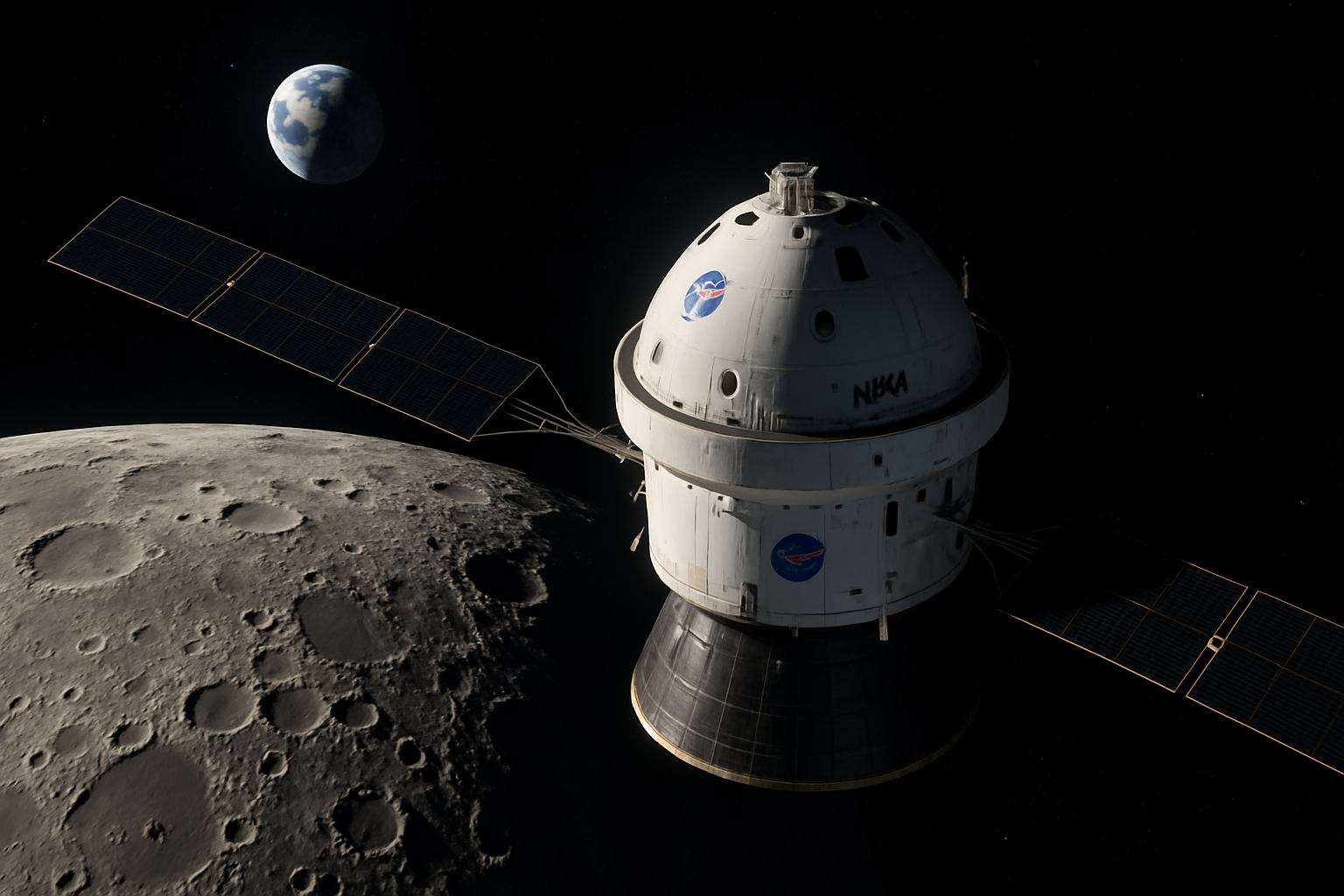
Fresh from celebrating the triumphant return of the Artemis II crew—the first humans to travel beyond Earth orbit in over 54 years—NASA faces an unexpected challenge as the Trump administration proposes sweeping budget cuts that could dramatically reshape America's space exploration ambitions.
The proposed fiscal year 2027 budget calls for a 23 percent reduction in NASA's overall funding and nearly a 50 percent cut to the agency's science programs, creating uncertainty for future missions just as the agency celebrates its most significant spaceflight achievement since the Apollo era.
Historic Artemis II Success Sets New Records
The Artemis II mission, which concluded with a Pacific Ocean splashdown on April 11, 2026, shattered multiple records and ended humanity's longest gap in deep space exploration. The four-astronaut crew—Canadian Jeremy Hansen, NASA Commander Reid Wiseman, Christina Koch, and Victor Glover—reached a record-breaking distance of 406,777.8 kilometers from Earth, surpassing Apollo 13's 1970 record by over 6,600 kilometers.
Hansen's participation marked a historic first for Canadian space exploration, making him the first Canadian to travel beyond Earth orbit. The mission validated the Artemis Accords framework for peaceful international lunar exploration while demonstrating crucial technological capabilities for sustained deep space operations.
"The human mind isn't made to go through what we just went through," Commander Reid Wiseman reflected during the crew's first press conference from space in over five decades.
— Reid Wiseman, Artemis II Mission Commander
The 10-day mission covered 685,000 miles and included unprecedented scientific achievements, including the first Earth photographs from a crewed spacecraft beyond Earth orbit since Apollo 17 in December 1972. The crew captured historic "Earthset" images showing Earth below the lunar horizon and documented the Moon's permanently hidden far side—regions never before observed by human eyes.
Technical Challenges Overcome with Innovation
Despite multiple technical challenges, including a now-viral toilet system malfunction that Christina Koch helped repair, communication failures, and thermal sensor issues, the crew demonstrated exceptional adaptability and problem-solving skills. These incidents, rather than detracting from the mission's success, highlighted the advancement in space technology and crew training since the Apollo era.
The SLS rocket—standing 322 feet tall, weighing 5.75 million pounds when fully fueled, and containing over 700,000 gallons of liquid hydrogen and oxygen—successfully demonstrated its capabilities as the most powerful rocket NASA has ever built. The mission vindicated years of engineering work that resolved persistent helium system failures and hydrogen leak problems that had caused multiple delays throughout 2026.
Budget Cuts Threaten Future Missions
The proposed budget reductions come at a critical juncture for NASA's ambitious lunar program. The agency has committed $20 billion toward establishing a permanent lunar surface base by 2030—the largest space infrastructure investment in NASA history. The Artemis III mission, scheduled for 2028, aims to return astronauts to the lunar surface for the first time since 1972.
Lithuanian sources indicate that the proposed cuts would particularly impact NASA's science programs, potentially affecting planetary exploration missions, climate research initiatives, and fundamental space science research that has driven decades of technological advancement.
The timing of these budget proposals contrasts sharply with the current "space economy golden age," as industry experts describe the period. The global space economy is projected to exceed $1 trillion by 2030, with SpaceX preparing for a potential trillion-dollar IPO in June 2026.
International Competition Intensifies
The budget uncertainty emerges as international space competition reaches new heights. China has announced plans for crewed lunar missions by 2030 and has achieved significant technological breakthroughs, including AI-powered analysis of Moon far-side samples from the Chang'e-6 mission, providing the first detailed mapping of permanently hidden lunar regions.
Christina Koch's role in the mission has inspired particular attention, especially in Pacific communities. Sources from Micronesia highlight how Koch's journey has become a symbol of achievement for underrepresented groups in space exploration, demonstrating the program's broader cultural impact beyond its scientific objectives.
Medical and Scientific Breakthroughs
The Artemis II mission built upon crucial space medicine research, including French astronaut Sophie Adenot's record eight-month ISS mission focusing on lung tissue cultivation and Space-Associated Neuro-Ocular Syndrome (SANS) research. These studies are essential for extended missions beyond Earth's protective environment, where medical evacuation is impossible.
European research has revealed reproduction challenges in microgravity environments, highlighting the need for artificial gravity solutions in permanent space settlements. Such research directly informs protocols for lunar base design and Mars expedition planning, where astronauts may spend years without Earth-based medical support.
Strategic Implications for Space Leadership
The success of Artemis II represents more than technological achievement—it marks humanity's transition from brief space visits to sustained cosmic expansion capabilities. The mission validated critical systems for permanent lunar settlements and Mars exploration, establishing the foundation for a truly spacefaring civilization.
President Trump personally congratulated the crew, calling them "truly extraordinary" and emphasizing Artemis as an administration priority. However, the proposed budget cuts suggest potential shifts in space exploration priorities that could impact America's leadership position in the emerging space economy.
The mission's international cooperation success, featuring Argentina's Atenea radiation device and Czech ADVACAM safety monitoring chips, demonstrates the collaborative framework necessary for sustainable space exploration. These partnerships may become increasingly important as budget constraints force greater reliance on international cooperation.
Looking to the Future
Despite budget uncertainties, NASA continues advancing ambitious programs, including the Space Reactor 1 Freedom nuclear propulsion system for Mars missions. Nuclear propulsion offers faster transit times, continuous power generation, and reduced radiation exposure—capabilities essential for interplanetary exploration where solar power proves insufficient.
The Artemis program has been restructured to include an additional test mission between Artemis II and the lunar landing, moving the actual Moon landing from Artemis III to Artemis IV while maintaining the 2028 timeline. This approach prioritizes safety and mission success over arbitrary schedules, reflecting institutional learning from past spaceflight tragedies.
As the crew continues their post-mission medical evaluations and mission debriefings, their experiences provide crucial data for future deep space missions. The toilet repair incident, which became a viral cultural moment, demonstrated human adaptability in space environments while highlighting practical challenges that must be addressed for extended space operations.
The Artemis II mission has proven that humanity possesses the technological capability and international cooperation framework necessary for sustained lunar presence and eventual Mars exploration. However, realizing these ambitious goals will require continued political support and adequate funding to maintain America's leadership in space exploration during an era of unprecedented global competition.
The coming months will reveal whether the United States will maintain its commitment to becoming a spacefaring civilization or allow budget constraints to cede leadership in humanity's expansion beyond Earth to international competitors who view space exploration as critical infrastructure rather than discretionary spending.