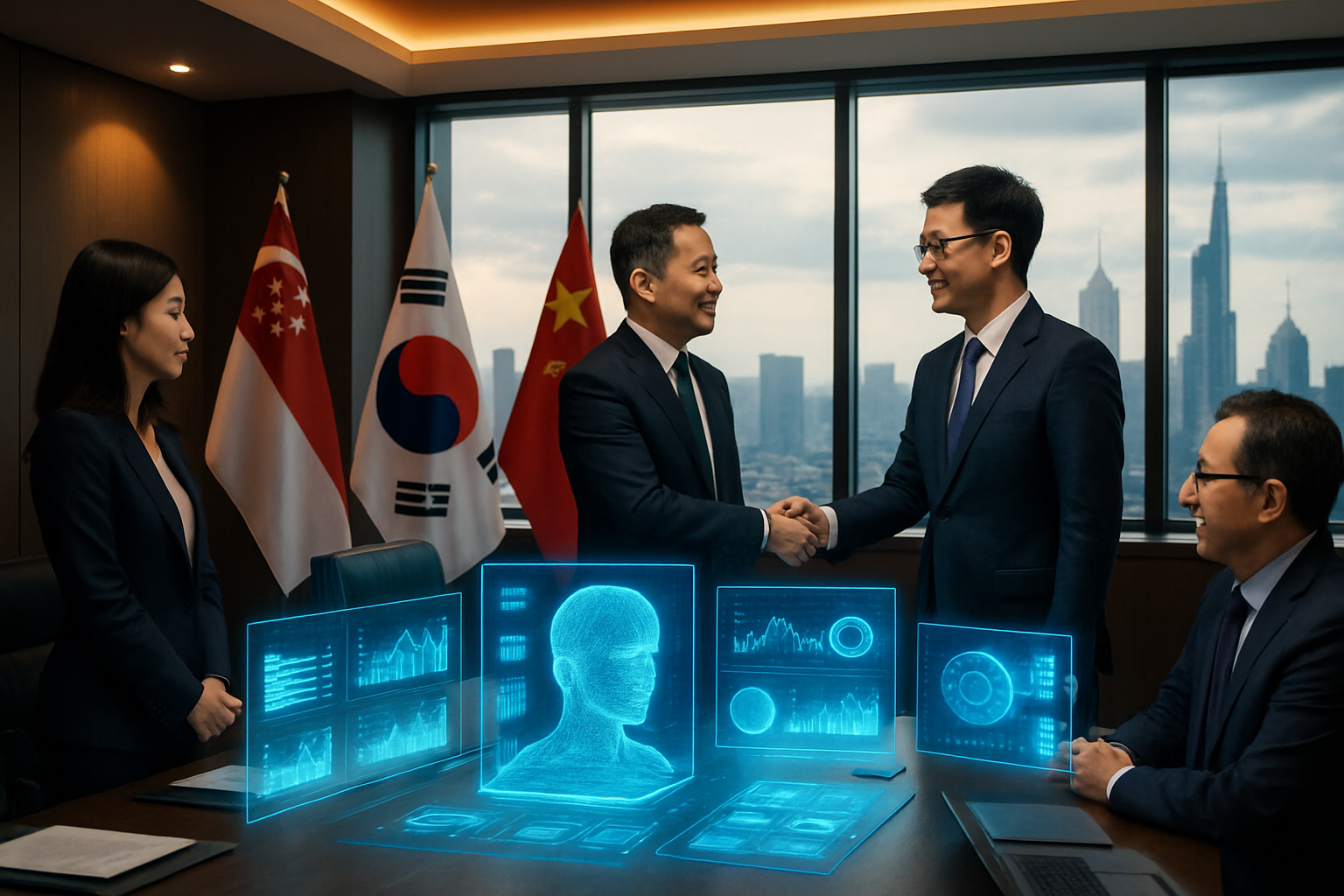
A series of groundbreaking announcements across Asia has positioned the region as the new epicenter of global artificial intelligence development, with South Korea committing $300 million to a joint AI fund with Singapore while China advances major infrastructure and automotive AI initiatives.
President Lee Jae Myung concluded a successful three-day summit in Singapore on March 2, 2026, announcing comprehensive cooperation frameworks focusing on AI technology and nuclear energy partnerships. The centerpiece agreement establishes a $300 million Global AI Fund designed to accelerate artificial intelligence research and development across both nations, marking a significant shift in global AI investment patterns away from traditional Silicon Valley dominance.
Strategic Singapore-Korea Partnership
The Singapore summit, conducted alongside Prime Minister Lawrence Wong, emphasized technological cooperation between two of Asia's most advanced economies. Singapore brings proven AI integration success through innovations including the WonderBot 2.0 heritage education system and systematic AI deployment across manufacturing, connectivity, finance, and healthcare sectors.
South Korea's contribution leverages its advanced manufacturing capabilities and nuclear expertise, creating a complementary partnership that addresses both nations' strategic technology goals. The cooperation occurs amid a global semiconductor crisis affecting Samsung and SK Hynix, positioning both countries as alternative suppliers and innovation centers for AI infrastructure.
China's Dual Technology Push
Simultaneously, China announced major developments across two critical AI sectors. Xpeng founder and CEO He Xiaopeng called for accelerated autonomous driving development, suggesting China skip intermediate technological steps to advance directly to more sophisticated self-driving capabilities. Speaking on March 2, He advocated for regulatory adjustments to enable faster deployment of autonomous vehicle technology.
In parallel, Hong Kong's Northern Metropolis secured a groundbreaking supercomputing project. Range Intelligent Computing Technology, whose parent company is Shenzhen-listed Runze Technology Group, won the sole tender to build the facility with a premium payment of HK$581 million ($74.25 million). The project will boost Hong Kong's computing power by 36-fold, significantly enhancing the region's AI processing capabilities.
Global Context and Infrastructure Challenges
These developments occur during what experts term the "2026 AI Infrastructure Inflection Point" - a critical transition from experimental AI technology to essential business and governmental infrastructure. The timing is particularly significant given ongoing global supply chain constraints, with memory semiconductor prices experiencing a sixfold surge affecting major manufacturers until new fabrication facilities come online in 2027.
Despite these challenges, massive corporate commitments continue. Alphabet has allocated $185 billion for AI infrastructure in 2026, while Amazon's development plans exceed $1 trillion. The World Bank projects AI systems will require 4.2-6.6 billion cubic meters of water annually by 2027 for data center cooling - equivalent to 4-6 times Denmark's total annual consumption.
Regulatory and Governance Framework
The Asian AI surge comes amid intensifying global regulation. The United Nations has established an Independent International Scientific Panel with 40 experts led by Secretary-General António Guterres, representing the first fully independent global AI assessment body. Spain implemented the world's first criminal executive liability framework for tech platforms, while France conducted cybercrime raids on AI companies.
This regulatory environment has created opportunities for Asian nations to position themselves as responsible AI leaders. The recent India AI Impact Summit in New Delhi, featuring 250,000+ delegates from 100+ countries, resulted in the Delhi Declaration signed by 88 countries - the largest AI diplomatic agreement in history.
Success Models and Best Practices
Asia has demonstrated several successful AI integration models that balance technological advancement with cultural sensitivity. Malaysia operates the world's first AI-integrated Islamic school, combining artificial intelligence with traditional learning. Canada has implemented university AI teaching assistants while maintaining critical thinking standards, and Singapore's WonderBot 2.0 has achieved notable success in heritage education applications.
These examples contrast sharply with concerns about AI replacing human capabilities, instead demonstrating how artificial intelligence can enhance rather than replace fundamental human skills and cultural knowledge.
Economic and Strategic Implications
The Asian AI momentum represents a fundamental shift in global technology geography. Traditional North American and European dominance in AI development is being challenged by distributed innovation ecosystems across Asia-Pacific. Countries are diversifying infrastructure investments to serve growing Asian markets while hedging geopolitical risks.
The Singapore-Korea partnership exemplifies sophisticated middle power diplomacy, balancing economic development, technological advancement, and security management. Success demonstrates Asian technological integration potential while maintaining crisis response capabilities during unprecedented global tensions.
Looking Forward
The developments announced in early March 2026 signal Asia's emergence as a major force in global AI governance and development. The region's approach emphasizes practical applications, international partnerships, and cultural sensitivity, potentially providing a global template for responsible AI advancement.
Success will depend on resolving infrastructure constraints, maintaining international cooperation frameworks, and implementing sustainable business models that prioritize human welfare alongside technological advancement. The decisions made across Asia in 2026 will likely influence global AI development trajectories for decades to come.
As artificial intelligence transitions from experimental technology to essential infrastructure, Asia's coordinated approach - combining strategic partnerships, massive investments, and responsible governance - positions the region to lead the next phase of the global AI revolution.