
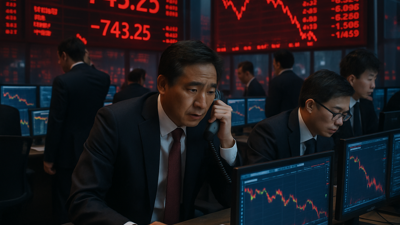
Asian stock markets experienced their worst trading session in months as Japan's Nikkei plummeted 3.55% and regional exchanges across South Korea, Hong Kong, and other major financial centers posted steep declines following escalating tensions between the United States and Iran amid President Trump's ultimatum.
The dramatic sell-off reflects mounting concerns over Iran's threats to attack energy infrastructure across the Middle East region, creating unprecedented volatility in global financial markets and raising fears of a broader regional conflict that could disrupt critical energy supplies.
Japanese Markets Lead Regional Decline
Japan's Nikkei 225 index suffered its largest single-day decline in recent months, falling 3.55% as analysts noted that "the continuing escalation in the Middle East remains the dominant factor behind the decline in stock prices." The sharp drop wiped billions from market capitalization as investors fled to safer assets amid the geopolitical uncertainty.
The decline marks the third-largest point drop in Nikkei history, reflecting the severity of investor concerns about potential disruptions to global energy markets and supply chains that could significantly impact Japan's import-dependent economy.
Regional Contagion Spreads
The market turbulence quickly spread across Asia, with South Korea's financial markets experiencing severe pressure as investors withdrew from technology and semiconductor positions that had previously driven growth. Currency markets also felt the impact, with several regional currencies weakening against the US dollar as capital fled emerging market assets.
Hong Kong's Hang Seng index joined the broader regional decline, with analysts pointing to concerns about shipping routes through the Persian Gulf and potential disruptions to trade flows that are vital to the region's interconnected economies.
Energy Security Concerns Drive Selling
The market collapse coincides with Iran's declaration that the Strait of Hormuz is "unsafe for shipping," effectively threatening to close the critical waterway that handles 40% of global seaborne oil transit. This development has sent oil prices soaring above $80 per barrel, with natural gas prices surging 24% in Europe and 78% in the United States.
Major shipping companies including Maersk and MSC have suspended operations in the Persian Gulf, leaving over 150 oil and LNG tankers stranded with billions of dollars worth of cargo. Qatar has halted LNG production at key facilities, representing approximately 20% of global exports and further tightening energy supplies.
"The situation is going longer than people initially thought, and financial markets are becoming the ultimate constraint on prolonged conflict."
— Damien Boey, Portfolio Strategist
Aviation Industry Paralyzed
Adding to market concerns, over 18,000 flights have been cancelled worldwide in what represents the most extensive aviation disruption since the COVID-19 pandemic. Eight Middle Eastern countries have simultaneously closed their airspace, including Iran, Iraq, Israel, UAE, Qatar, Syria, Kuwait, and Bahrain.
Dubai International Airport, the world's busiest with over 86 million passengers annually, remains completely shut down due to missile damage, eliminating a critical hub for Europe-Asia travel routes. Major carriers including Emirates, Air France-KLM, Wizz Air, and Bulgaria Air have suspended operations indefinitely, stranding hundreds of thousands of passengers globally.
Diplomatic Breakdown Context
The market chaos follows the complete collapse of US-Iran nuclear negotiations despite previous diplomatic progress. Earlier talks in Geneva had achieved what officials described as "broad agreement on guiding principles" - representing the most significant progress since the 2018 JCPOA collapse.
However, fundamental disagreements over scope proved insurmountable, with Iran excluding ballistic missiles and regional proxies as "red lines" while demanding nuclear-only talks. The US, led by Secretary of State Marco Rubio, insisted on comprehensive agreements addressing missiles, armed groups, and human rights issues.
Nuclear Stakes Escalate
Iran continues enriching uranium to 60% purity, approaching the 90% threshold needed for weapons-grade material, with sufficient stockpiles for multiple weapons if weaponized. The crisis occurs against the backdrop of the New START treaty's expiration on February 5, 2026 - marking the first time in over 50 years without US-Russia nuclear constraints.
Regional Coalition Under Strain
The escalating conflict has severely tested an unprecedented diplomatic coalition of Saudi Arabia, UAE, Qatar, and Egypt that had been supporting the diplomatic process. Iranian retaliation strikes have directly targeted member territories, with casualties reported across the region:
- UAE: 1 civilian killed in Abu Dhabi from missile debris
- Kuwait: 32 foreign nationals injured in airport drone strikes
- Qatar: 8 wounded despite successfully intercepting 65 missiles and 12 drones
- Cyprus: RAF Akrotiri struck - first European territory attack since WWII
Egyptian President Abdel Fattah el-Sisi condemned attacks on "sisterly Arab countries," warning of "comprehensive chaos" if the conflict continues to expand.
Global Economic Implications
The crisis extends far beyond financial markets, with global supply chains facing severe disruption due to the Persian Gulf's role as a critical trade hub. Manufacturing sectors dependent on Gulf logistics networks, including automotive, electronics, and textiles, are experiencing significant challenges.
Consumer prices are already rising globally, with Sweden predicting electricity increases of 10-20 öre and gasoline up 1-2 kronor per liter. Ireland faces "brazen rip-off" heating oil prices approaching €2 per liter, while Pakistan has implemented wartime austerity measures including four-day work weeks.
Central Bank Response
Central banks across the region are coordinating emergency responses, with the European Central Bank and Bank of Japan leading efforts to provide liquidity and prevent broader financial contagion. However, traditional monetary policy tools are showing limited effectiveness against structural geopolitical disruptions that affect physical infrastructure and international relationships.
"This represents the most severe energy security crisis in decades, exposing single-chokepoint vulnerabilities in our interconnected global system."
— Samuel Ciszuk, Energy Security Analyst
Historical Context and Precedent
Market analysts describe the current crisis as the most dangerous international situation since the end of the Cold War, with implications extending far beyond immediate financial impacts. The rapid transition from diplomatic breakthrough to military escalation demonstrates the fragility of crisis management in the current multipolar era.
Unlike weather-related disruptions with predictable timelines, recovery depends entirely on military operations resolution and diplomatic normalization. Aviation industries cannot make long-term scheduling decisions with multiple airspaces closed, while energy markets remain volatile with critical transit routes blocked.
Looking Ahead
The coming days are viewed as template-setting for 21st-century international crisis management. Success in containing the escalation could provide a framework for future nuclear crisis resolution and strengthen diplomatic precedents. However, failure may accelerate military solutions, reshape Middle Eastern geopolitics for decades, and encourage nuclear proliferation globally while undermining diplomatic credibility worldwide.
As UN Secretary-General António Guterres noted, this represents "the greatest test of multilateral cooperation and crisis management in the modern era," with decisions in the coming weeks likely to reverberate through international relations for decades to come.
The stakes encompass not only regional war prevention and global energy security, but also nuclear governance credibility and the enforcement of international law principles that have underpinned the post-WWII order. Market participants and policymakers worldwide are closely watching developments, as the current crisis may fundamentally reshape approaches to conflict resolution and international stability mechanisms in an increasingly interconnected yet volatile world.