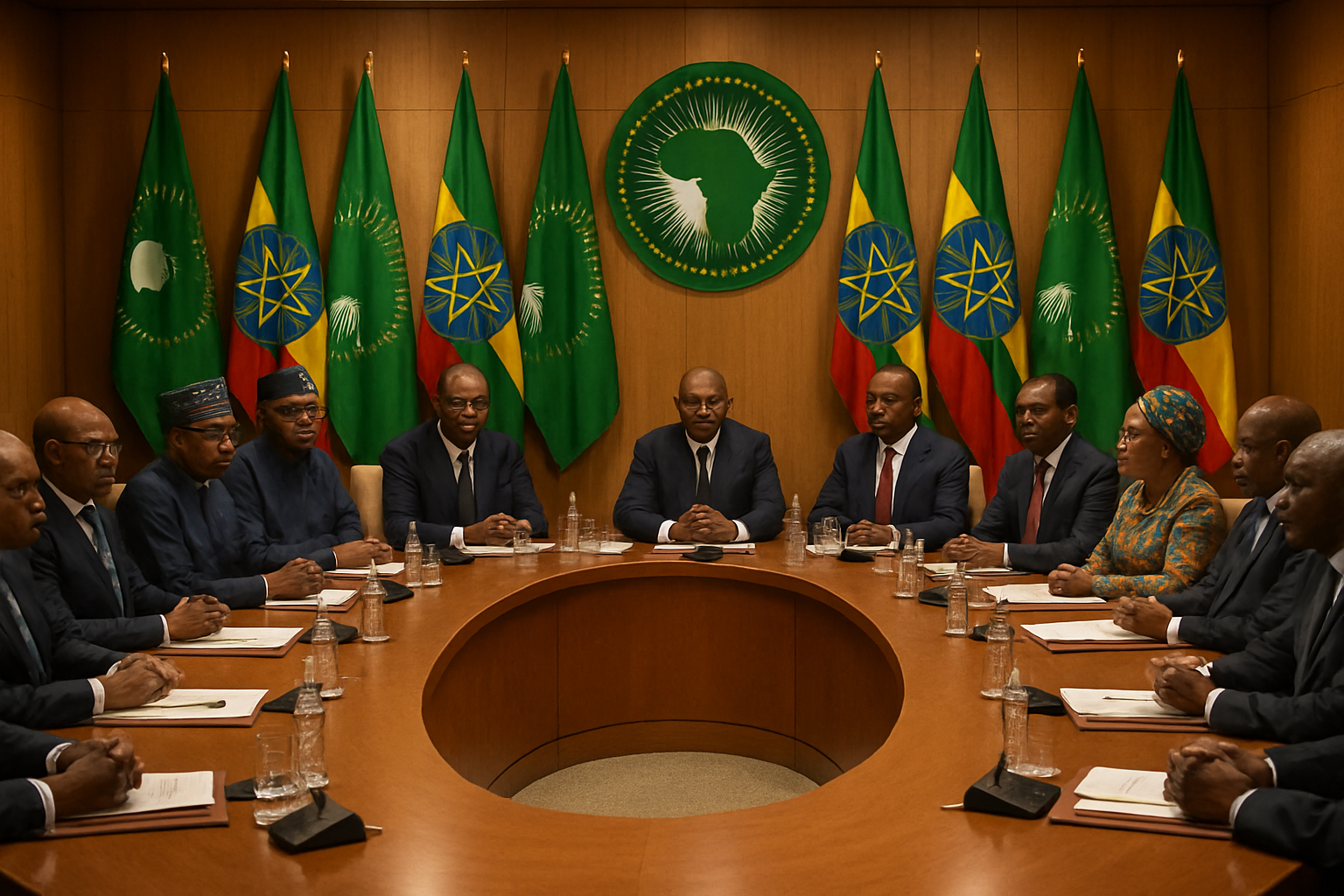
African leaders convened in Addis Ababa this weekend for the 39th Ordinary Session of the African Union Assembly, confronting a continent grappling with water insecurity, mounting regional conflicts, and renewed calls for historical justice as Angola prepares to hand the rotating AU chair to Burundi.
The summit, held under the theme "Ensuring Sustainable Water and Sanitation Access for All by 2030," highlights the urgent need for climate adaptation across a continent that has experienced devastating floods while struggling with water scarcity. The theme reflects the damage done by recent flooding across multiple African nations and the pressing need to tackle climate change effects.
High-Level Participation and Continental Representation
The summit has drawn significant participation from across the continent, with heads of state and government officials representing all 55 AU member states. Algeria's Prime Minister Naib Ghrib is participating on behalf of President Abdelmadjid Tebboune, while Sierra Leone's President Julius Maada Bio confirmed his arrival in the Ethiopian capital for the deliberations.
Senegal's Prime Minister Ousmane Sonko is representing President Bassirou Diomaye Faye, marking another significant West African presence at the continental gathering. The participation reflects the AU's evolution from a symbolic organization to an active policy development body addressing 21st-century challenges through enhanced cooperation.
Palestinian Solidarity and Regional Conflicts
In a powerful opening statement, AU Commission Chairperson Moussa Faki Mahamat called for an immediate end to what he termed the "genocide" of the Palestinian people. Speaking at the summit's opening, Mahamat declared: "In the Middle East, Palestine and the suffering of its people challenge our consciences. The genocide of this people must be stopped."
The statement reflects the African Union's consistent support for Palestinian rights and adds another dimension to the continental body's engagement with global conflicts beyond Africa's borders. This solidarity comes at a time when the AU is simultaneously grappling with multiple internal conflicts affecting member states.
Water Security and Climate Adaptation
The summit's central theme of water and sanitation access underscores one of Africa's most pressing developmental challenges. With climate change intensifying both droughts and flooding across the continent, the 2030 target for universal water and sanitation access faces significant obstacles.
Recent devastating floods in Mozambique affected over 724,000 people across five provinces, while other regions continue to struggle with water scarcity. The summit's focus on water infrastructure represents a critical component of the AU's Agenda 2063 development framework.
Reparations and Historical Justice
Ghana's President John Dramani Mahama, serving as the AU Champion on Reparations, delivered a forceful address demanding an end to "ceremonial language" regarding Africa's historical injustices. Speaking at a high-level panel on Friday, President Mahama called for a transition from moral aspirations to "binding frameworks" with clear timelines.
"The healing of deep historical wounds, inflicted by centuries of slavery and colonial exploitation, cannot be achieved without critical structural reforms and enhanced cooperation from all AU member states."
— President John Dramani Mahama, AU Champion on Reparations
The panel, themed "Reparations, Memory and Sovereignty: Common African Position on the Restitution of Heritage Resources," focused specifically on the systematic return of African artifacts currently held in foreign museums. President Mahama emphasized that these cultural objects represent more than historical curiosities—they are integral to African identity and heritage.
Regional Security Challenges
The summit takes place against a backdrop of significant security challenges across the continent. The AU's Peace and Security Council, recently reconstituted with ten new members including Somalia, Democratic Republic of Congo, and Morocco, faces immediate challenges including instability in West Africa, ongoing conflicts in the Sahel, and tensions in the Horn of Africa.
The Alliance of Sahel States, comprising Niger, Mali, and Burkina Faso, represents a new dynamic in regional security arrangements, while the Democratic Republic of Congo continues to struggle with violence in its eastern provinces. These conflicts strain the AU's capacity for effective peacekeeping and conflict resolution.
Leadership Transition and Continental Governance
A significant outcome of the summit will be the formal handover of the AU's rotating chairmanship from Angola to Burundi. This transition occurs at a critical juncture for continental governance, with the AU facing both internal challenges and external pressures.
The leadership change comes amid strained relations with some international partners, including tensions with the United States, and reflects the AU's ongoing efforts to assert greater African agency in continental affairs.
Economic Integration and Development
Beyond the immediate political challenges, the summit addresses ongoing economic integration efforts through the African Continental Free Trade Area (AfCFTA) implementation. Infrastructure developments, including Algeria's Gara Djebilet railway project and Angola's Lobito Corridor, demonstrate the continent's commitment to enhancing connectivity and trade facilitation.
Digital transformation also features prominently in discussions, with continental cybersecurity frameworks and technology transfer mechanisms representing key areas for cooperation. These initiatives reflect the AU's broader vision of technological sovereignty and economic diversification.
Climate Adaptation and Resilience
The summit's water theme occurs within the context of January 2026 being recorded as the hottest month globally, marking the 18th consecutive month exceeding 1.5°C above pre-industrial levels. This climate reality underscores the urgency of adaptation measures across African nations.
Recent climate-related disasters, including the Mozambique floods that prompted Southern African Development Community (SADC) emergency responses, demonstrate the immediate need for enhanced continental cooperation on climate resilience. Rwanda's provision of cross-regional humanitarian aid exemplifies the type of solidarity required to address these challenges.
Looking Forward: Continental Unity and Challenges
As the 39th AU Summit progresses, the continental body faces the challenge of translating ambitious declarations into concrete action. The summit's diverse agenda—from water security and climate adaptation to reparations and conflict resolution—reflects both the complexity of African challenges and the AU's growing ambition as a continental governance institution.
The participation of 55 member states in Addis Ababa demonstrates continued commitment to multilateral African solutions to continental challenges. However, the effectiveness of these solutions will depend on member states' willingness to move beyond symbolic gestures toward binding commitments and coordinated implementation.
The summit represents a critical moment for African leadership to demonstrate unity in addressing shared challenges while respecting the sovereignty and diverse interests of member states. As climate change intensifies, conflicts persist, and global economic pressures mount, the AU's capacity to provide effective continental governance faces its most significant test since the organization's establishment.