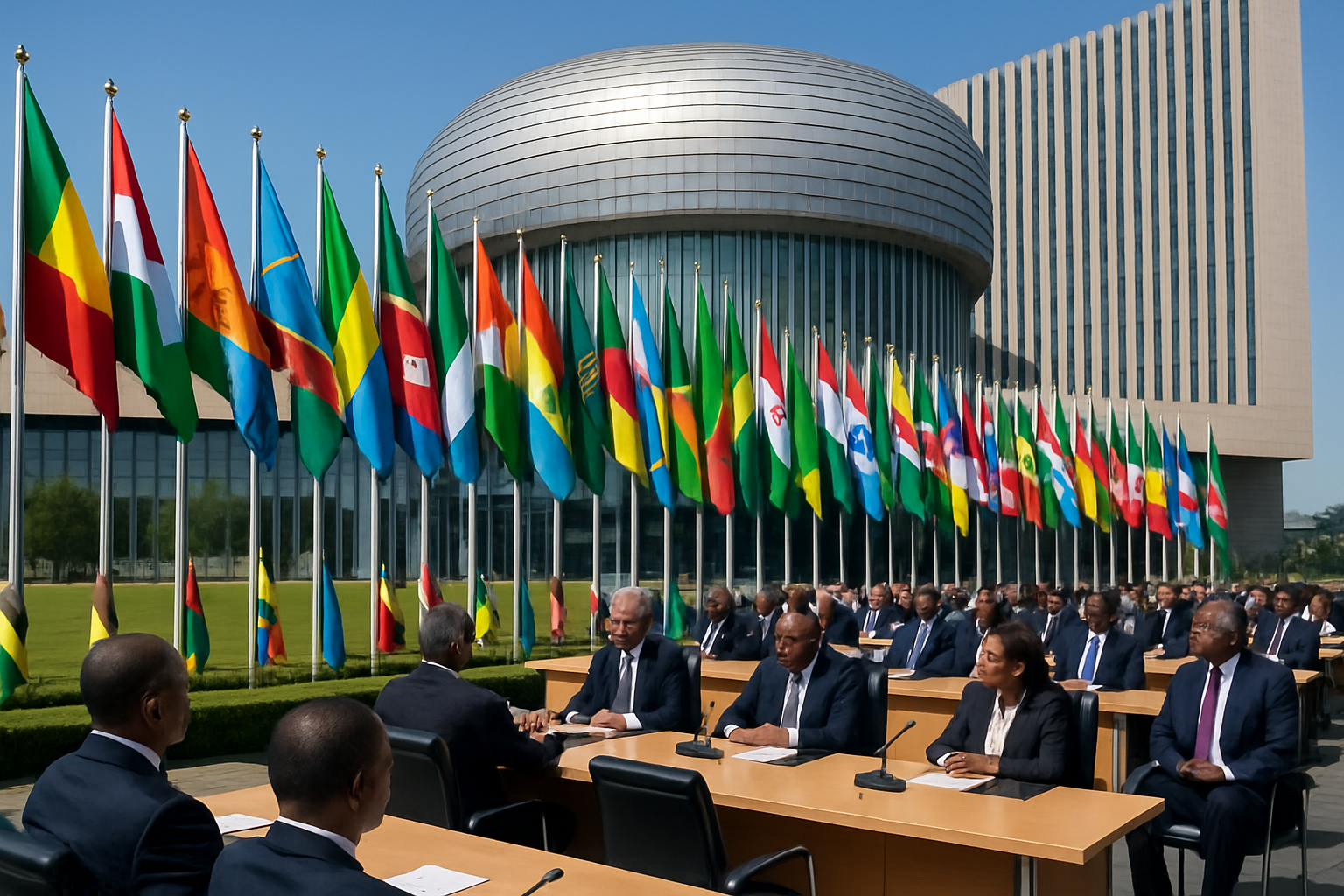
The 39th African Union Summit concluded in Addis Ababa with urgent calls for action on Sudan's devastating humanitarian crisis while unveiling ambitious development initiatives, including Egypt's groundbreaking $500 billion "Team Africa" program and renewed commitments to continental trade integration.
Sudan's three-year civil war emerged as the most pressing issue at the summit, with UN Secretary-General António Guterres and AU Commission Chairperson Moussa Faki Mahamat urging immediate intervention in what the United Nations has described as the world's worst humanitarian crisis. The conflict has killed tens of thousands and displaced over 11 million people, with diplomatic sources warning that regional rivalries continue to fuel the devastating war.
Sudan Crisis Takes Center Stage
African Union Commissioner for Peace and Security, Bankole Adeoye, outlined a comprehensive roadmap for resolving the Sudanese crisis, emphasizing the need for an unconditional ceasefire and inclusive political dialogue among all stakeholders. The AU's intervention comes as the conflict between the Sudanese Armed Forces and the Rapid Support Forces enters its third year with no clear resolution in sight.
Despite diplomatic efforts, Egypt's Foreign Minister Badr Abdelatty confirmed that no consensus has been reached regarding the restoration of Sudan's suspended AU membership, maintaining the country's diplomatic isolation. The crisis has created a massive refugee burden on neighboring countries, particularly Chad and South Sudan, while disrupting critical trade routes across the Horn of Africa.
Sudan Tribune reported that the AU is preparing new consultations for Sudanese-Sudanese dialogue, though previous efforts have been repeatedly postponed due to ongoing hostilities. The continental body faces mounting pressure to demonstrate its effectiveness in resolving conflicts, with critics questioning the organization's capacity for decisive action.
Egypt Launches $500 Billion Continental Initiative
In a major development announcement, Egypt's Foreign Minister Badr Abdelatty unveiled the ambitious "Team Africa" initiative aimed at mobilizing $500 billion for approximately 300 developmental projects across the continent. Speaking on behalf of President Abdel Fattah Al-Sisi at the African Union Development Agency (NEPAD) steering committee meeting, Abdelatty outlined a comprehensive roadmap for the agency's second ten-year plan under Agenda 2063.
The initiative seeks to bridge Africa's massive funding gap while addressing rising poverty, unemployment, and food security challenges across the continent. Egypt, which has chaired the NEPAD steering committee since February 2023, is transferring its leadership to Angolan President João Lourenço as part of the summit's leadership transitions.
"Despite our challenges, Africa stands on the threshold of true integration. Our success hinges on our collective will to align national reforms with continental goals."
— Ghana Minister Emmanuel Armah-Kofi Buah
During its tenure, Egypt focused on reorganizing NEPAD's internal structure and intensifying resource mobilization for high-priority continental projects. The "Team Africa" initiative represents a significant escalation of continental cooperation efforts, with Egypt offering technical expertise and training programs to strengthen institutional capacities across African nations.
Continental Trade Integration Advances
The African Continental Free Trade Area (AfCFTA) received renewed momentum during the summit, with Egypt's Foreign Minister pledging continued technical support and capacity-building for the continental trade agreement. In a meeting with AfCFTA Secretary-General Wamkele Mene, Abdelatty described the agreement as a primary pillar for sustainable development, highlighting its potential to increase intra-African trade and enhance global competitiveness of African products.
Egypt's commitment includes offering training programs for African professionals to strengthen institutional capacities and meet the objectives of Agenda 2063. The AfCFTA offers vital opportunities to facilitate the movement of goods and services across the continent, creating a single market that could stimulate unprecedented economic growth.
The summit also welcomed China's announcement of zero-tariff access for 53 African countries beginning May 1, 2026, representing the most comprehensive expansion of China-Africa trade relations in history. This development complements AfCFTA objectives by providing external market opportunities alongside internal African trade expansion.
High-Level Diplomatic Engagements
Foreign Minister Abdelatty conducted extensive bilateral meetings with African leaders, including President Faustin-Archange Touadéra of the Central African Republic, Prime Minister Joseph Dion Ngute of Cameroon, and Kenyan President William Ruto. These engagements focused on regional security, infrastructure development, and economic integration, with leaders praising President Al-Sisi's leadership role in advancing joint African action.
The UAE's participation through Minister of State Sheikh Shakhbout bin Nahyan Al Nahyan demonstrated continued Gulf engagement with African development priorities. The minister participated in discussions on peace and security, economic integration, and sustainable development across the continent.
Portugal President Marcelo Rebelo de Sousa's message of solidarity with Guinea-Bissau, delivered through Ambassador António Montalvão Machado, highlighted continuing European interest in African stability and development partnerships.
Leadership Transitions and Institutional Development
The summit marked significant leadership transitions within AU institutions. Burundi President Évariste Ndayishimiye assumed the rotating AU chairmanship from Angola's João Lourenço, while Angola prepared to lead the NEPAD steering committee. These transitions occurred against the backdrop of recent Peace and Security Council elections that brought new members including Somalia, the Democratic Republic of Congo, and Morocco to address continental security challenges.
Angolan President João Lourenço delivered pointed criticism of coup legitimization during the summit, reflecting ongoing tensions over democratic governance across the continent. His remarks addressed what he termed the "whitewashing" of military takeovers, demonstrating the AU's continued struggle to balance stability concerns with democratic principles.
Infrastructure and Economic Development
The summit highlighted Africa's ongoing infrastructure renaissance, with multiple projects advancing continental connectivity and economic integration. Algeria's Gara Djebilet railway project, providing access to the world's third-largest iron ore reserves, exemplifies the continent's resource development ambitions. Similarly, Angola's Lobito Corridor revival and Tanzania's completed feasibility studies for the Mtwara-Mbamba Bay Standard Gauge Railway demonstrate coordinated infrastructure development.
Guinea's preparation for the 32nd African Mining Indaba showcased the country's Simandou iron ore strategy, while seven African countries participate in the US-EU-Japan Critical Minerals Partnership to challenge China's dominance in strategic materials production and processing.
Challenges and Criticisms
Despite ambitious initiatives, the summit faced significant criticism regarding AU institutional effectiveness. Observers questioned the organization's capacity to address "genocide, myriad insurgencies and coups" across the continent while delivering concrete solutions to persistent challenges.
The summit occurred during January 2026, which marked the 18th consecutive month of global temperatures exceeding 1.5°C above pre-industrial levels, adding urgency to climate adaptation discussions. Recent flooding in Mozambique affecting over 724,000 people demonstrated the continent's vulnerability to climate change impacts.
Regional security challenges persist across multiple theaters, including ongoing conflicts in the Democratic Republic of Congo's eastern provinces, instability in the Sahel region, and the formation of the Alliance of Sahel States comprising Niger, Mali, and Burkina Faso.
Looking Forward
The 39th African Union Summit represents a critical test of the organization's evolution from symbolic gatherings to active policy implementation. Success will be measured by concrete progress on water access, peace and security, and economic integration serving 1.4 billion Africans, rather than symbolic commitments alone.
The dual challenge of addressing immediate crises like Sudan while advancing long-term development initiatives reflects the complexity of contemporary African governance. The summit's outcomes will influence whether the AU can demonstrate effective continental leadership amid climate intensification, persistent regional conflicts, and global economic pressures.
As the continent faces unprecedented challenges and opportunities, the summit's ambitious agenda sets the stage for determining whether African unity can translate into measurable improvements in peace, prosperity, and regional integration throughout 2026 and beyond.