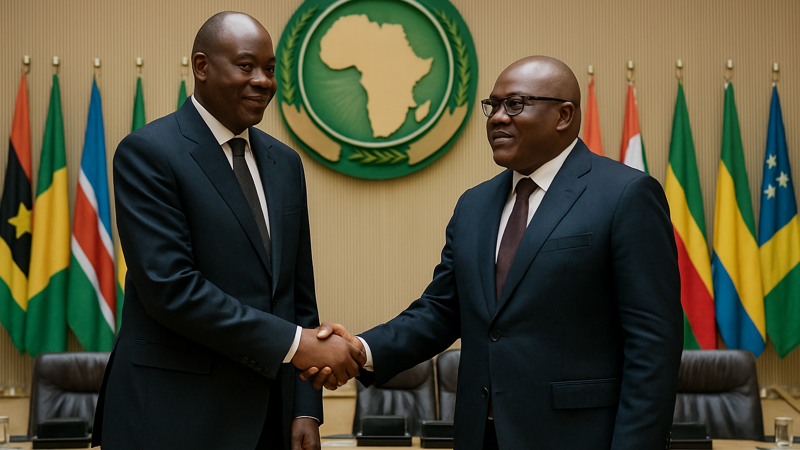
The 39th African Union Summit concluded in Addis Ababa on February 15, 2026, marking a pivotal moment for continental governance as approximately fifty heads of state and government convened to address pressing challenges from water security to political stability across Africa's 55 member states.
The summit was highlighted by the formal transition of the AU rotating chairmanship from Angola's João Lourenço to Burundi's President Évariste Ndayishimiye, symbolizing the continuity of continental leadership amid turbulent regional dynamics. This year's theme, "Ensuring Sustainable Water and Sanitation Access for All by 2030," underscored the urgent need for climate adaptation as Africa faces unprecedented environmental pressures.
Leadership Transition and Continental Vision
President Ndayishimiye's assumption of the AU chairmanship comes at a critical juncture for the organization, which has faced mounting criticism over its institutional effectiveness. AU Commission Chairperson Moussa Faki Mahamat opened the summit with a forceful declaration of solidarity with Palestinians, calling for an end to what he termed the "genocide of Palestinian people," reflecting the continental body's consistent stance on international justice issues.
The outgoing chairman, Angola's João Lourenço, used his final address to criticize the "whitewashing" of military coups across the continent, highlighting persistent tensions between democratic governance principles and the reality of unconstitutional power changes that have affected several African nations in recent years.
"There will be no tolerance for anticonstitutional changes of power,"
— Mahmoud Ali Youssouf, AU Commission Chairperson
Water Security at the Forefront
The summit's thematic focus on water security reflects the existential challenge facing over 400 million Africans who lack access to safe water and sanitation. This crisis has been exacerbated by climate change, with January 2026 marking the 18th consecutive month of global temperatures exceeding 1.5°C above pre-industrial levels.
Recent devastating floods in Mozambique, which affected over 724,000 people across five provinces, served as a stark reminder of the continent's vulnerability to extreme weather events. The summit discussions emphasized the need for integrated water resource management and climate-resilient infrastructure development.
Gabon's Strategic Positioning
A significant development emerged from Gabon's participation, with President Brice Clotaire Oligui Nguema conducting strategic diplomatic meetings on the summit's margins. The Gabonese leader met with the country's ambassador to Ethiopia and diplomatic personnel, reinforcing Gabon's international engagement following its recent election to the AU Peace and Security Council.
This diplomatic activity reflects Gabon's commitment to playing an active role in continental security affairs, particularly as the newly reconstituted Peace and Security Council faces immediate challenges across multiple African regions.
Regional Security Challenges
The summit addressed multiple security crises plaguing the continent, from the ongoing civil war in Sudan to instability in West Africa's Sahel region. The Alliance of Sahel States, comprising Niger, Mali, and Burkina Faso, continues to maintain distance from traditional regional cooperation mechanisms, creating new dynamics in West African security architecture.
The recently reconstituted Peace and Security Council, which includes Somalia, Democratic Republic of Congo, Morocco, and other new members, faces the daunting task of addressing these multifaceted challenges. The Council's effectiveness will be crucial in determining whether the AU can evolve from symbolic gestures to concrete policy implementation.
Economic Integration and Development
Despite security challenges, the summit highlighted significant progress in continental economic integration through the African Continental Free Trade Area (AfCFTA) implementation. Major infrastructure developments were showcased, including Algeria's Gara Djebilet mining railway project accessing the world's third-largest iron ore reserves, and Angola's Lobito Corridor railway revival connecting the Atlantic coast to the DRC's mineral-rich regions.
The economic dimension received a significant boost with China's announcement of zero-tariff access for 53 African countries starting May 1, 2026, representing the most comprehensive China-Africa trade expansion in history. This development, revealed by President Xi Jinping during the summit period, could dramatically reshape African export opportunities.
Climate Urgency and Adaptation
The summit occurred against the backdrop of accelerating climate change, with participants acknowledging the urgent need for adaptation strategies. Infrastructure projects discussed include Ethiopia's shift toward climate-resilient water systems, Rwanda's identification of 417,000 hectares of irrigation potential, and various renewable energy initiatives across the continent.
These developments demonstrate Africa's evolution from a climate aid recipient to a solutions provider, leveraging the continent's abundant renewable resources and innovative governance approaches to address environmental challenges.
Testing Continental Unity
The summit represents a critical test of the AU's capacity for effective continental governance amid multiple simultaneous crises. Success will be measured not by symbolic commitments but by concrete progress on water access, peace and security, and economic integration serving Africa's 1.4 billion people.
Critics have questioned the AU's institutional effectiveness amid what some describe as "genocide, myriad insurgencies and coups" across the continent. The organization's ability to move beyond ceremonial language to binding frameworks will determine its relevance in addressing 21st-century challenges.
As the 39th Summit concluded, African leaders faced the reality that continental integration success depends on member states' willingness to move beyond symbolic gestures toward coordinated implementation of policies that can genuinely transform the lives of their citizens. The months ahead will test whether the summit's outcomes translate into tangible improvements in water security, regional stability, and economic development across the continent.