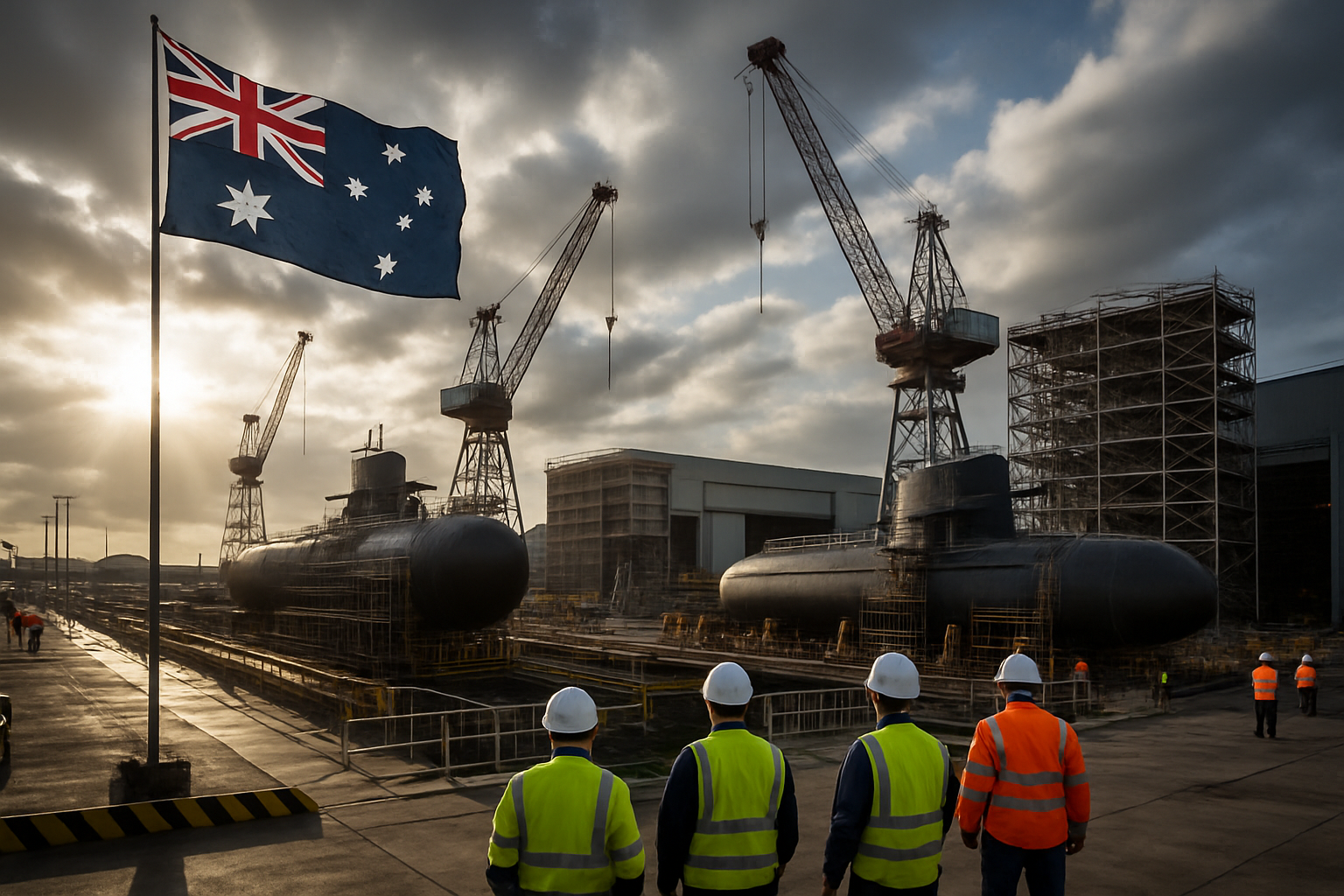
Australia has taken a decisive step toward naval independence with Prime Minister Anthony Albanese announcing a $3.9 billion federal investment in the Osborne shipyard in Adelaide, marking the beginning of a historic $30 billion commitment to build nuclear-powered submarines under the AUKUS defense partnership.
The substantial funding injection represents what Albanese described as a "downpayment" for transforming the South Australian facility into a world-class nuclear submarine construction center. The investment will support the training and employment of 10,000 skilled workers required to build the advanced vessels that will form the backbone of Australia's future naval defense capabilities.
Speaking at the announcement, Albanese confirmed the total project cost aligns with forecasts from the Australian Naval Infrastructure, cementing the $30 billion figure that represents the nation's most expensive defense project to date. The investment will create thousands of jobs in South Australia while establishing Australia as a key player in nuclear submarine technology within the Indo-Pacific region.
AUKUS Partnership Drives Strategic Investment
The announcement comes as part of Australia's broader commitment to the AUKUS alliance, a trilateral security partnership formed in 2021 between Australia, the United Kingdom, and the United States. This strategic alliance was specifically designed to counter China's growing military presence in the Indo-Pacific region, with nuclear submarines serving as a critical deterrent capability.
The AUKUS agreement represents a fundamental shift in Australia's defense strategy, moving the nation away from conventional diesel-electric submarines toward nuclear-powered vessels that offer significantly greater range, endurance, and operational flexibility. This technological leap positions Australia to project naval power across the vast distances of the Indo-Pacific theater.
According to Bulgarian news sources covering the announcement, the initial $3.9 billion Australian dollar investment (approximately $3 billion USD) will "advance" the shipyard construction as part of the AUKUS program, with submarines expected to enter service from the next decade onward to counter Chinese maritime expansion.
Osborne Shipyard Transformation
The Osborne shipyard in Adelaide has been selected as the primary construction facility for Australia's nuclear submarine fleet, requiring extensive upgrades and expansion to accommodate the sophisticated manufacturing processes involved in nuclear vessel construction. The facility will need specialized infrastructure for handling nuclear propulsion systems, advanced materials, and the complex integration systems that define modern submarine warfare capabilities.
The 10,000 skilled workers who will be employed at the facility will require extensive training in nuclear technology, advanced manufacturing techniques, and submarine construction methodologies. This represents one of the largest skills development programs in Australian defense history, with workers needing certification in handling nuclear materials and operating sophisticated construction equipment.
The transformation of Osborne will establish Australia as only the seventh nation capable of constructing nuclear submarines, joining an exclusive group that includes the United States, United Kingdom, Russia, China, France, and India. This capability represents not just military advancement but also significant technological and industrial achievement.
Economic and Strategic Implications
The $30 billion investment represents far more than a defense expenditure – it constitutes a fundamental restructuring of Australia's naval industrial base. The project will create a entire ecosystem of suppliers, contractors, and specialized manufacturers supporting submarine construction, maintenance, and operation throughout the vessels' service lives.
South Australia stands to benefit enormously from this investment, with the state positioned to become Australia's nuclear submarine manufacturing hub. The economic multiplier effects will extend beyond direct employment at Osborne, creating opportunities in supporting industries, research and development, and specialized services required for nuclear vessel operations.
The project also strengthens Australia's strategic partnerships with the United States and United Kingdom, creating deeper defense industrial cooperation and technology sharing arrangements. This integration will provide Australia access to cutting-edge nuclear propulsion technology while contributing Australian expertise in areas such as advanced materials and systems integration.
Timeline and Implementation Challenges
The nuclear submarine program faces significant implementation challenges, including the complexity of nuclear technology transfer, workforce development, regulatory frameworks, and construction timelines. Building nuclear submarines requires mastery of some of the most sophisticated engineering and manufacturing processes in modern industry.
Australia will need to establish comprehensive nuclear regulatory capabilities to oversee submarine construction, operation, and maintenance. This includes developing expertise in nuclear safety, waste management, and the specialized protocols required for nuclear vessel operations in naval environments.
The timeline for delivering operational submarines extends into the next decade, reflecting the complexity of establishing nuclear construction capabilities from the ground up. Australia will likely receive submarines from United Kingdom and United States production lines before domestic construction reaches full capacity.
Regional Security Context
The AUKUS submarine program occurs against the backdrop of increasing strategic competition in the Indo-Pacific region. China's military modernization, including expansion of its submarine fleet and assertive territorial claims in the South China Sea, has prompted allied nations to strengthen their naval capabilities and deepen security cooperation.
Australia's nuclear submarines will provide the range and endurance necessary to operate effectively across the vast distances of the Indo-Pacific, from the Indian Ocean to the Western Pacific. This capability ensures Australia can contribute meaningfully to allied operations and maintain credible deterrent effects in critical sea lanes.
The program also represents a significant shift in Australia's strategic posture, moving from a primarily defensive regional navy toward expeditionary capabilities that can support broader allied operations and power projection throughout the Indo-Pacific theater.
Looking Forward
The Osborne shipyard investment marks the beginning of Australia's transformation into a nuclear submarine power, with implications extending far beyond naval capabilities to include industrial capacity, technological advancement, and strategic partnerships. The $30 billion commitment represents the largest defense investment in Australian history and will define the nation's naval capabilities for decades to come.
Success in building nuclear submarines will establish Australia as a major defense industrial power in the Indo-Pacific region, while failure could compromise critical alliance relationships and national security capabilities. The stakes are correspondingly high for the government, defense establishment, and industrial partners involved in this historic undertaking.
As construction begins at Osborne and the workforce development programs commence, Australia embarks on a journey that will fundamentally reshape its naval capabilities and strategic position in an increasingly contested regional security environment.