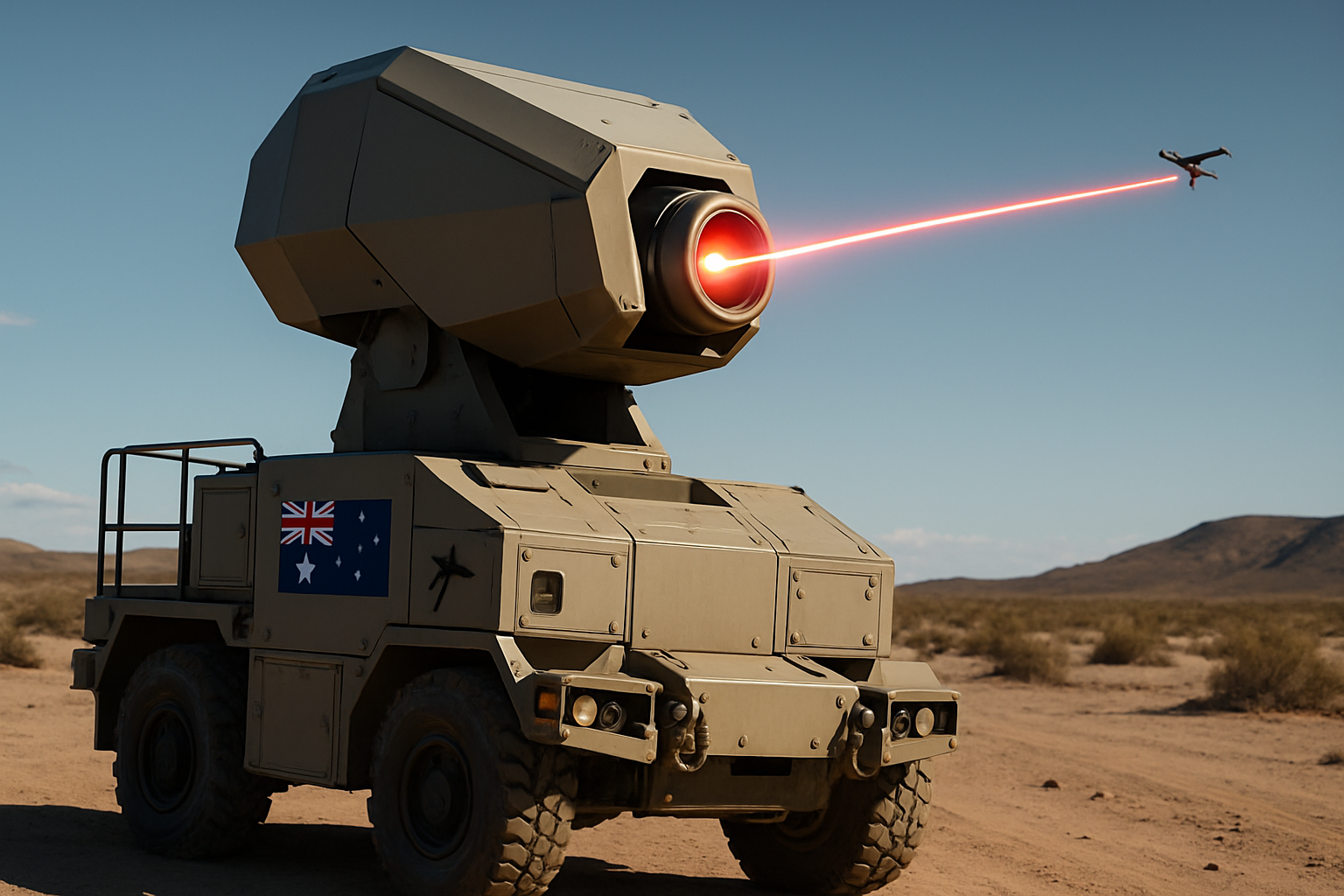
Australia has unveiled a revolutionary anti-drone laser defense system capable of hitting targets as small as a 10-cent piece, earning comparisons to "Star Wars" technology as the nation fast-tracks deployment amid escalating global drone threats and a $7 billion defense spending commitment.
The Australian-made laser system represents a significant leap forward in precision defense technology, offering capabilities that military analysts describe as unprecedented in the field of counter-drone warfare. The system's extraordinary accuracy has captured international attention as nations worldwide grapple with the growing threat of unmanned aerial vehicles in both military and civilian contexts.
Revolutionary Precision Technology
The laser defense system demonstrates remarkable targeting capabilities, with the ability to neutralize drone threats with surgical precision. According to defense officials, the system can engage targets as small as a 10-cent coin, representing a level of accuracy that surpasses many existing anti-drone technologies currently deployed by allied nations.
The system's advanced targeting algorithms and high-energy laser components work in concert to deliver precise strikes against unmanned threats, offering significant advantages over traditional kinetic defense systems. Unlike missile-based interceptors, the laser system provides virtually unlimited ammunition capacity, requiring only electrical power to operate continuously.
Defense experts note that this precision capability addresses a critical gap in modern military defense systems, where traditional anti-aircraft weapons often prove ineffective against small, agile drone targets that can evade conventional radar detection and missile interception systems.
$7 Billion Defense Investment Context
The laser system's accelerated development forms part of Australia's substantial $7 billion investment in drone-killing technology, reflecting the nation's recognition of unmanned aerial vehicles as a primary security concern for the 21st century. This investment represents one of the most significant peacetime defense technology commitments in Australian history.
The comprehensive funding package encompasses not only laser-based systems but also electronic warfare capabilities, kinetic interceptors, and advanced detection networks designed to create layered defense against drone threats. Military strategists emphasize that the multi-billion dollar commitment demonstrates Australia's long-term vision for countering asymmetric warfare challenges.
Australian defense procurement officials have prioritized domestic manufacturing capabilities, ensuring that critical components of the laser system are produced within the country's borders. This approach aims to reduce dependency on foreign suppliers while building indigenous expertise in cutting-edge defense technologies.
Global Anti-Drone Technology Landscape
The Australian system enters a rapidly evolving global market for counter-drone technologies, where nations are investing heavily in solutions to address the proliferation of unmanned threats. From the memory of recent military conflicts, the devastating effectiveness of drone warfare has become clear, prompting urgent development of defensive capabilities.
Recent conflicts have demonstrated how relatively inexpensive commercial drones can be weaponized to devastating effect against conventional military forces. Iranian drone attacks on European territory in Cyprus marked the first such strikes on European soil since World War II, highlighting the global nature of the drone threat and the need for effective countermeasures.
European nations have responded with their own anti-drone initiatives, including coordinated naval deployments featuring advanced missile defense systems. The Australian laser technology offers a complementary approach, providing continuous engagement capability without the logistical challenges associated with missile-based systems.
Technical Specifications and Capabilities
While specific technical details remain classified for security reasons, defense sources indicate that the Australian laser system operates using high-energy directed energy technology capable of engaging multiple targets in rapid succession. The system's modular design allows for deployment across various platforms, from stationary installations to mobile units.
The laser's targeting system integrates advanced optical tracking, artificial intelligence-assisted threat identification, and automated engagement protocols. These components work together to detect, classify, and engage drone threats with minimal human intervention, reducing response times to milliseconds.
Energy efficiency represents a crucial advantage of the laser system, with each engagement consuming only a fraction of the cost associated with missile interceptors. This economic efficiency enables sustained defensive operations without the ammunition resupply concerns that plague conventional weapons systems.
Strategic Defense Implications
Military analysts view the Australian laser development as part of a broader shift toward directed energy weapons in modern warfare. The technology offers significant advantages in defending critical infrastructure, military installations, and civilian areas against the growing threat of weaponized unmanned systems.
The system's rapid deployment capability makes it particularly valuable for protecting mobile forces and temporary installations, addressing scenarios where traditional fixed defense systems prove inadequate. This flexibility has attracted interest from allied nations seeking similar capabilities for their own defense requirements.
Australian defense officials emphasize that the laser system complements rather than replaces existing air defense capabilities, creating layered protection that addresses threats across multiple domains. The integration of laser technology with conventional systems creates a comprehensive defense network capable of addressing diverse aerial threats.
International Collaboration and Export Potential
The Australian government has indicated willingness to share the technology with close allies, recognizing that drone threats transcend national boundaries and require coordinated international responses. Defense cooperation agreements with the United States, United Kingdom, and other allied nations may facilitate technology transfer and joint development initiatives.
Export potential for the Australian laser system appears substantial, with nations worldwide seeking effective counter-drone capabilities. The system's domestic manufacturing base positions Australia to become a significant player in the global defense technology market while supporting domestic employment and technological expertise.
Military technology experts suggest that the Australian approach of combining precision targeting with cost-effective operation could influence international standards for next-generation anti-drone systems. The technology's proven capabilities may establish benchmarks for similar systems under development by other nations.
Operational Deployment Timeline
Australian defense forces are implementing an accelerated deployment schedule, with initial operational capabilities expected within the current fiscal year. The fast-track approach reflects the urgency with which military planners view the drone threat and the need for immediate defensive capabilities.
Training programs for military personnel operating the laser systems are already underway, with specialized courses designed to maximize the technology's effectiveness in various operational scenarios. The comprehensive training approach ensures that Australian forces can leverage the system's full capabilities upon deployment.
Future development phases include enhanced mobility platforms, increased power output, and integration with emerging artificial intelligence systems. These improvements aim to maintain Australia's technological edge as drone threats continue to evolve and become more sophisticated.
Broader Defense Technology Revolution
The Australian laser system represents part of a broader revolution in defense technology, where directed energy weapons are increasingly viewed as essential components of modern military capabilities. The technology's success may accelerate development of similar systems for naval, ground, and aerospace applications.
Defense industry analysts predict that successful demonstration of the Australian system will prompt increased investment in directed energy research worldwide. The technology's potential applications extend beyond counter-drone operations to include missile defense, satellite protection, and other critical military missions.
As global security challenges continue to evolve, the Australian "Star Wars" laser system demonstrates how advanced technology can provide decisive advantages in protecting national interests. The system's precision targeting capability and operational flexibility position it as a model for future defensive systems designed to address 21st-century threats.
The successful development and deployment of this revolutionary anti-drone technology marks a significant milestone in Australia's defense capabilities, offering a glimpse into the future of precision warfare where advanced laser systems provide both deterrent effects and practical defensive solutions against emerging aerial threats.