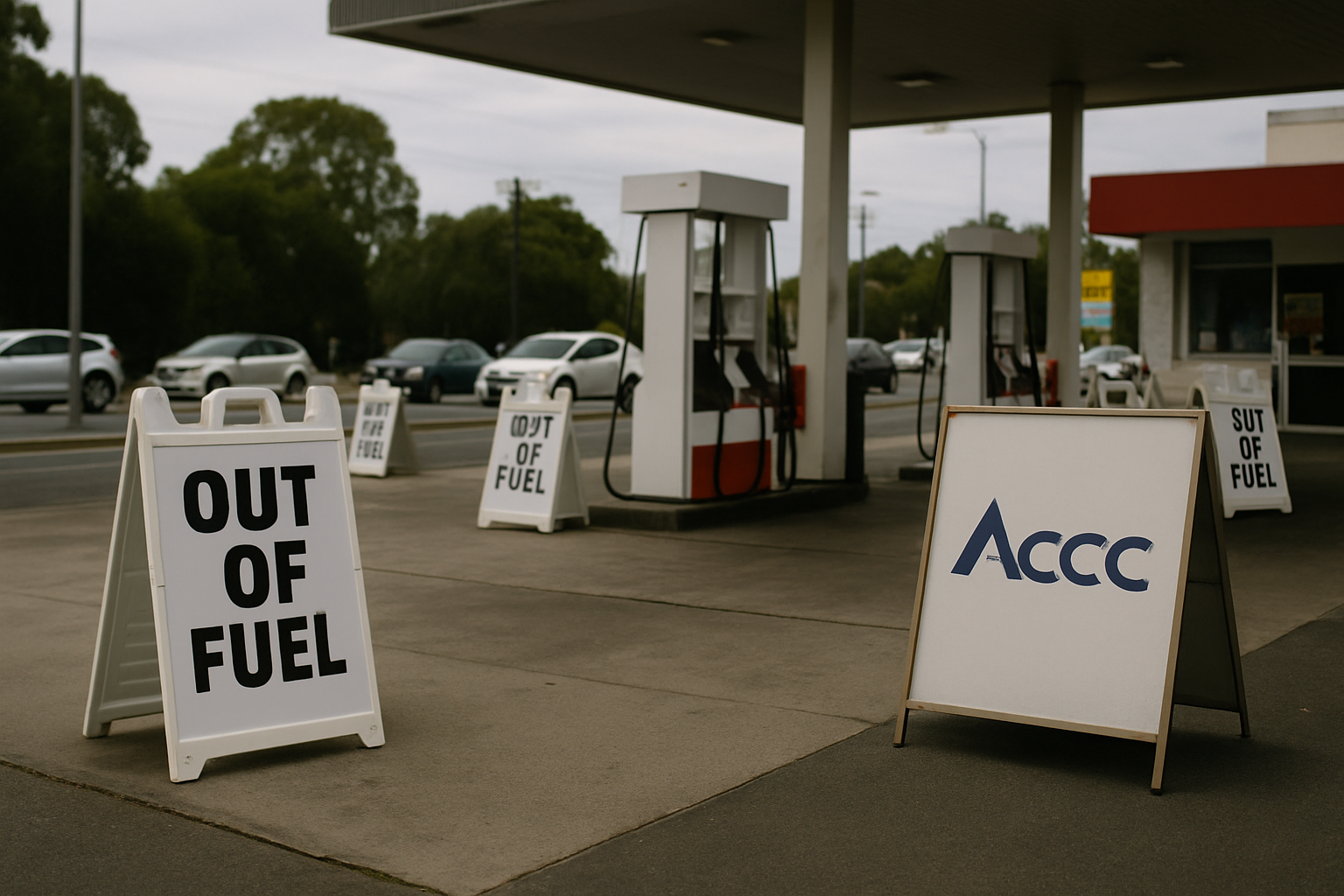
More than 90 service stations across New South Wales have been issued compliance notices for alleged fuel price gouging during the Easter travel period, as Australian authorities crack down on exploitative pricing practices amid an ongoing nationwide fuel crisis.
The enforcement action comes as Australia continues to grapple with severe fuel shortages and soaring prices that have seen petrol approach $3 per liter in some regions. The crisis, which began in March 2026 following the Iran Revolutionary Guard's closure of the Strait of Hormuz affecting 40% of global oil transit, has created unprecedented challenges for Australian consumers and businesses.
Unprecedented Enforcement Action
The Australian Competition and Consumer Commission (ACCC) has been monitoring fuel companies intensively as prices surged past $2.50 per liter nationally, with some regions approaching the critical $3 threshold. The 90+ service stations targeted represent the largest coordinated price gouging enforcement action in Australia's recent history.
NSW Energy Minister Penny Sharpe has been chairing crisis talks in Sydney, bringing together representatives from transport, agriculture, mining, and consumer groups to address the mounting fuel supply emergency. These discussions have focused on both immediate relief measures and longer-term energy security strategies.
"We're seeing systematic exploitation of Australian consumers during their time of greatest need,"
— ACCC spokesperson on the Easter price gouging investigation
The enforcement action specifically targets pricing behavior during the Easter travel period, when demand traditionally peaks as families embark on holiday journeys. Authorities allege that certain operators took advantage of limited competition and increased demand to impose excessive price increases beyond what could be justified by underlying cost pressures.
Context of the Broader Fuel Crisis
Australia's fuel crisis reached critical levels in early 2026, with regional Queensland communities including Texas township and Robinvale becoming completely depleted of fuel supplies. Goondiwindi Mayor Lawrence Springborg has repeatedly reported that major suppliers have been favoring bulk distributors over independent stations, creating acute regional shortages that have left rural communities without transport alternatives.
Prime Minister Anthony Albanese's government has implemented unprecedented emergency powers, including the ability to underwrite private fuel imports and a 26.3-cent excise tax cut costing A$2.55 billion. These measures represent the most significant government intervention in fuel markets since World War II.
Deputy Prime Minister Richard Marles has acknowledged that fuel rationing remains a possibility if the Iran conflict continues, while Energy Minister Chris Bowen has advocated for work-from-home arrangements as a "sensible" demand management strategy to reduce overall fuel consumption.
Global Energy Crisis Impact
The Australian fuel crisis is part of the most severe worldwide energy emergency since the 1970s oil shocks. The Iran Revolutionary Guard's declaration of the Strait of Hormuz as "unsafe for shipping" effectively blocked the critical 21-mile chokepoint through which 40% of global seaborne oil transit passes.

Oil prices breached $100 per barrel for the first time since 2022, reaching peaks of $119.50 for Brent crude and $108.15 for WTI with a record 18.98% single-day jump. The International Energy Agency (IEA) deployed its largest strategic petroleum reserve release in 50-year history – 400 million barrels from 32 countries, more than double the 2022 Ukraine crisis response.
The supply chain collapse has been comprehensive, with major shipping companies Maersk and MSC suspending operations in the Persian Gulf, stranding over 150 oil and LNG tankers representing billions in cargo value. Qatar's LNG production halt at Ras Laffan and Mesaid facilities affects approximately 20% of global exports.
Consumer Impact and Regional Vulnerabilities
The fuel crisis has exposed dangerous over-dependencies in Australia's energy security architecture. With limited domestic refining capacity and heavy reliance on fuel imports, Australia has proven particularly vulnerable to global supply chain disruptions.
Regional communities have borne the brunt of the crisis. Independent service stations, lacking the bulk purchasing power of major retailers, have been systematically abandoned by suppliers who prioritize their own distribution networks. This has created a two-tiered fuel market where metropolitan areas maintain better supply while rural regions face complete depletion.
The economic implications extend beyond transportation. Small businesses in regional areas face mounting operational challenges as transport costs escalate, while the tourism sector confronts reduced domestic travel prospects as families reconsider holiday plans due to mobility constraints.
"This crisis demonstrates the urgent need for enhanced energy security infrastructure and planning to protect Australian communities from future supply disruptions,"
— Energy security analyst on the broader implications
Government Response and Coordination
Australia's response has required unprecedented coordination across multiple government levels. The federal government's $100 million enforcement fund to combat fuel "cartel behavior" represents enhanced regulatory powers while avoiding direct price controls, reflecting a preference for market-based solutions over government intervention.
The crisis has prompted Australia's first-ever deployment of strategic fuel reserves, highlighting the severity of supply disruptions. Emergency protocols similar to natural disaster responses have been activated, with government departments coordinating relief efforts across affected regions.
International coordination has also been critical. Japan's release of 80 million barrels – its first since the 2011 Fukushima disaster – demonstrates the global nature of the emergency. Despite Japan's 95% Middle East oil dependence and 70% reliance on Hormuz transit, the country has contributed significantly to international stabilization efforts.
Long-term Energy Security Implications
The 2026 fuel crisis represents a watershed moment for Australian energy security planning. Expert consensus identifies this as the most severe energy security crisis in decades, exposing single-chokepoint vulnerabilities that require fundamental restructuring.
Samuel Ciszuk, a leading energy analyst, describes the situation as demonstrating "the most severe energy security crisis in decades with single-chokepoint vulnerabilities exposed." The 21-mile Strait of Hormuz represents a single-point failure in modern logistics with no realistic alternatives, highlighting the need for fundamental energy architecture transformation.
Recovery timeline remains uncertain, depending on military and diplomatic resolution of the Middle East conflict rather than predictable economic factors. Unlike weather-related disruptions, geopolitical crises present unpredictable durations that can extend indefinitely.
Template-Setting Crisis Management
The 2026 crisis is establishing new paradigms for 21st-century crisis management. UN Secretary-General António Guterres has described it as "the greatest test of multilateral cooperation in the modern era," highlighting the global coordination required for effective response.
Success in containing the crisis provides a framework for future nuclear crisis resolution and strengthens diplomatic precedents. However, failure could accelerate military solutions, reshape Middle Eastern geopolitics for decades, encourage nuclear proliferation globally, and undermine diplomatic credibility worldwide.
The template-setting significance extends beyond immediate fuel markets. This crisis affects regional war prevention, global energy security, nuclear governance credibility, and international law enforcement simultaneously – representing the most dangerous international crisis since the Cold War's end.
Future Preparedness and Resilience
The fuel price gouging enforcement action, while addressing immediate consumer protection concerns, highlights broader questions about Australia's energy resilience. Strategic petroleum reserves provide only temporary buffers for sustained disruptions, requiring fundamental policy shifts toward supply diversification and renewable transitions.
Energy security planning now requires reduced dependence on strategic chokepoints in volatile geopolitical regions. While supply diversification and renewable transitions require years or decades for implementation, the current crisis has dramatically accelerated the urgency of such transformations.
The lessons learned from the 2026 crisis will influence energy security policy for generations. As Australia navigates immediate supply challenges while planning for long-term resilience, the coordination between emergency response, regulatory enforcement, and strategic planning will determine the nation's preparedness for future disruptions.
"March 2026 represents a watershed moment in establishing new energy security paradigms requiring fundamental transformation to reduce dependence on strategic chokepoints,"
— International energy security expert
The enforcement action against 90+ service stations for Easter price gouging represents both immediate consumer protection and a signal that exploitative behavior will not be tolerated during national emergencies. As Australia continues managing its most severe fuel crisis in modern history, the balance between market mechanisms and regulatory intervention will shape energy policy responses for decades to come.