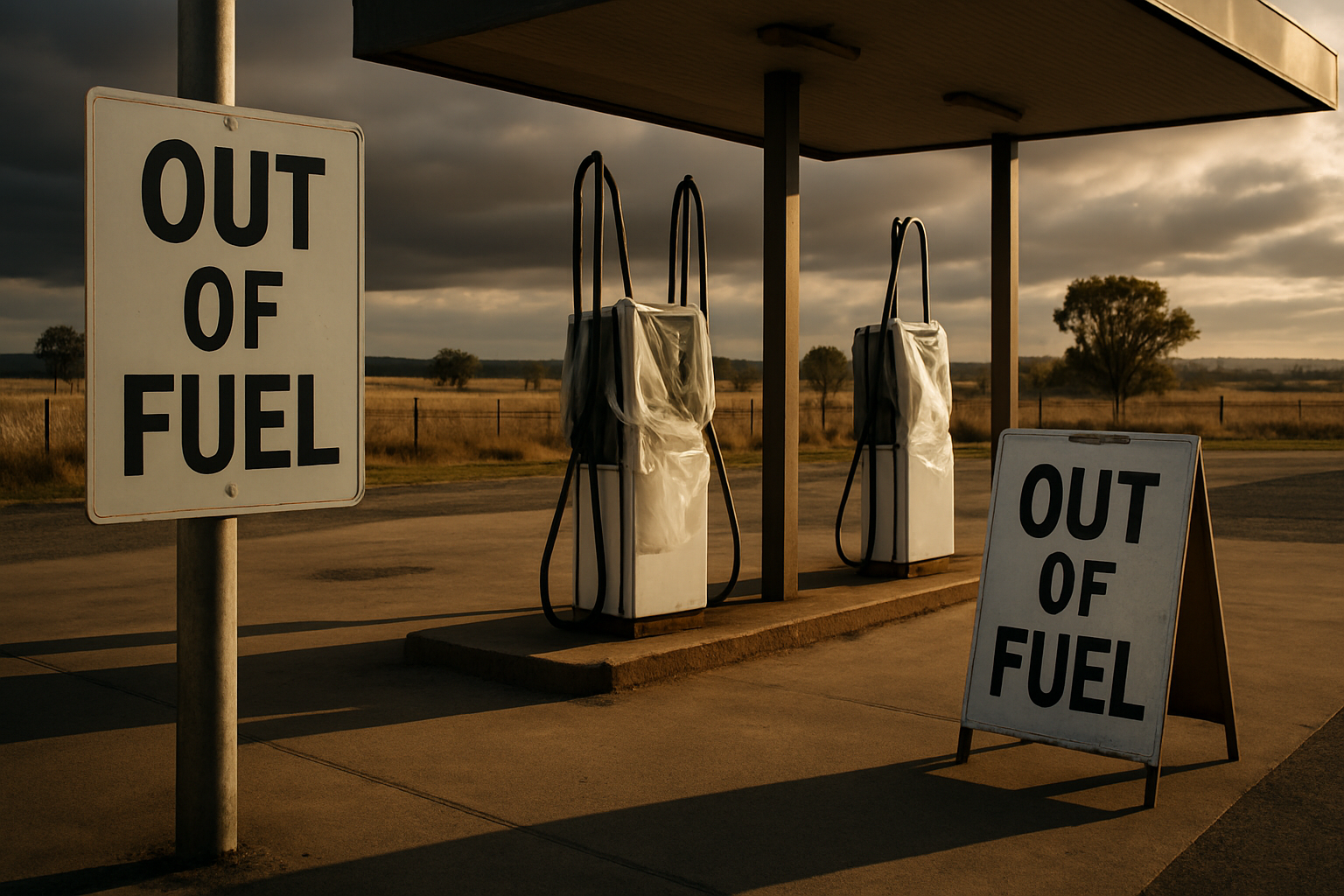
Australia is drawing down hundreds of millions of litres of petrol and diesel from its strategic fuel stockpile for the first time in the nation's history, as regional communities across the country face complete fuel depletion amid an unprecedented global energy crisis.
The emergency deployment comes as towns like Batlow in New South Wales—located more than 400 kilometers from Sydney—have completely run out of fuel, with no clear timeline for when supplies will be restored. The rural township's only service station has been empty for days, leaving residents stranded without access to essential fuel supplies.
Historic Strategic Reserve Deployment
The Australian government's decision to tap its strategic fuel reserves marks a watershed moment in the nation's energy security planning. According to sources from the Sydney Morning Herald, the deployment involves "hundreds of millions of litres" of both petrol and diesel from carefully maintained strategic stockpiles designed for exactly this type of crisis.
"This is an unprecedented situation requiring unprecedented action," said a government source familiar with the reserve deployment. "The strategic stockpile exists precisely for moments when our fuel supply chains face critical disruption."
The reserves, established as part of Australia's energy security infrastructure, have never been accessed since their creation. Their deployment signals the severity of the current crisis and the government's recognition that traditional supply chains have failed to meet the needs of regional communities.
Regional Communities in Crisis
The situation in Batlow exemplifies the broader crisis facing rural Australia. The town's independent petrol station—the only fuel source for hundreds of kilometers—ran completely dry earlier this week. Unlike major urban centers with multiple supply options, regional communities depend heavily on single service stations that lack the bulk purchasing power of major retail chains.
A worker at the Batlow service station told reporters that even the operator supplying petrol to the local servo "doesn't know" when new fuel deliveries will arrive. This uncertainty has created a cascade of problems for residents who rely on personal vehicles for everything from medical appointments to grocery shopping in an area with limited public transport alternatives.
The crisis isn't limited to Batlow. Reports indicate multiple independent stations across regional Queensland and NSW have exhausted their supplies, with fuel companies prioritizing their own bulk distributors and major retail partners over smaller independent operators.
Global Energy Crisis Impact
Australia's fuel shortage crisis stems directly from the global energy emergency that has seen oil prices surge above $100 per barrel for the first time since 2022. The crisis began when Iran's Revolutionary Guard declared the Strait of Hormuz—through which 40% of the world's seaborne oil transits—"unsafe for shipping," effectively closing this critical chokepoint.
The ramifications have been swift and severe. Major shipping companies including Maersk and MSC have suspended operations in the Persian Gulf, stranding over 150 oil and LNG tankers worth billions in cargo value. Natural gas prices have exploded by 24% in Europe and 78% in the United States, while Qatar has halted LNG production at key facilities that account for approximately 20% of global exports.
For Australia, which imports roughly 75% of its refined fuel products, the global supply chain disruption has created immediate shortages, particularly in regional areas furthest from major distribution hubs.
Supply Chain Vulnerabilities Exposed
The current crisis has starkly exposed Australia's energy security vulnerabilities. Unlike major fuel retailers who maintain extensive distribution networks and bulk purchasing agreements, independent rural stations operate on thin margins with limited storage capacity and just-in-time delivery systems.
Regional Queensland has been particularly hard hit, with multiple towns near the Queensland-NSW border reporting complete fuel depletion over the weekend. Agricultural operations face immediate risks as farm machinery, produce transport, and seasonal activities all depend on reliable fuel access.
Goondiwindi Mayor Lawrence Springborg previously reported that major fuel suppliers were "favoring their own bulk distributors," leaving independent stations without reliable supply guarantees. This hierarchical supply system has created acute regional shortages even as fuel remains available in major urban centers.
Economic and Social Implications
The fuel shortage has immediate economic implications for regional communities. Small businesses face operational challenges, while residents experience significant difficulties accessing basic services. Agricultural operations—the backbone of many regional economies—are particularly vulnerable during critical seasonal periods requiring intensive machinery use.
Transport costs for essential goods and services have increased substantially in affected areas, creating an effective economic isolation for communities already struggling with geographic remoteness. The situation mirrors patterns seen during the COVID-19 pandemic, where regional areas faced disproportionate impacts from supply chain disruptions.
Government Response and Emergency Measures
Beyond the historic strategic reserve deployment, the Australian government has activated emergency protocols similar to those implemented during natural disasters. Consumer watchdog ACCC is monitoring fuel companies closely as prices surge past $2.50 per liter in some regions, watching for potential price gouging amid the crisis.
The government's response represents a template for 21st-century energy security planning, demonstrating how rapid regional conflicts can become worldwide economic disruptions in an interconnected global economy. The strategic reserve deployment serves as both immediate necessity and a stark reminder of the urgent need for energy system transformation.
International Context and Energy Security
Australia's crisis occurs within a broader global energy emergency affecting multiple continents. European nations face similar challenges, with countries like Bangladesh implementing fuel rationing for 170 million people, while Bosnia-Herzegovina has been reduced to just two days of gas reserves.
The International Energy Agency has announced its largest strategic petroleum reserve release in 50-year history—400 million barrels from 32 member countries—more than double the amount released during the 2022 Russia-Ukraine crisis. Japan is releasing 80 million barrels starting this week, marking its first deployment since the 2011 Fukushima disaster.
Long-Term Energy Security Implications
The current crisis highlights fundamental vulnerabilities in Australia's energy infrastructure that extend far beyond immediate fuel shortages. The nation's dependence on imported refined fuel products, combined with limited domestic refining capacity, creates strategic risks that require comprehensive policy responses.
Energy security experts warn that over-dependence on strategic chokepoints like the Strait of Hormuz requires fundamental energy architecture restructuring. While strategic petroleum reserves provide temporary relief during acute disruptions, longer-term solutions require supply diversification and renewable energy transitions that take years or decades to implement.
The crisis serves as a stark reminder of the importance of energy security and supply chain resilience in an increasingly interconnected but unstable world. Regional communities like Batlow represent the frontline of these vulnerabilities, where global geopolitical events translate into immediate local impacts affecting residents' daily needs.
Recovery Timeline and Future Planning
Unlike weather-related disruptions with predictable patterns, the current crisis depends on military operations and diplomatic resolution of international conflicts. Recovery timelines remain highly uncertain, making traditional crisis management approaches insufficient for addressing structural geopolitical disruptions.
The lessons learned from Australia's first strategic reserve deployment will likely influence energy security planning for decades. The crisis demonstrates both the necessity of strategic reserves and the limitations of current energy infrastructure in addressing sustained supply disruptions.
As communities like Batlow await fuel deliveries with no clear timeline, the broader implications of this historic crisis continue to unfold. The emergency measures implemented today may well become the template for energy security responses in an increasingly volatile global environment where local fuel shortages reflect worldwide geopolitical instabilities.