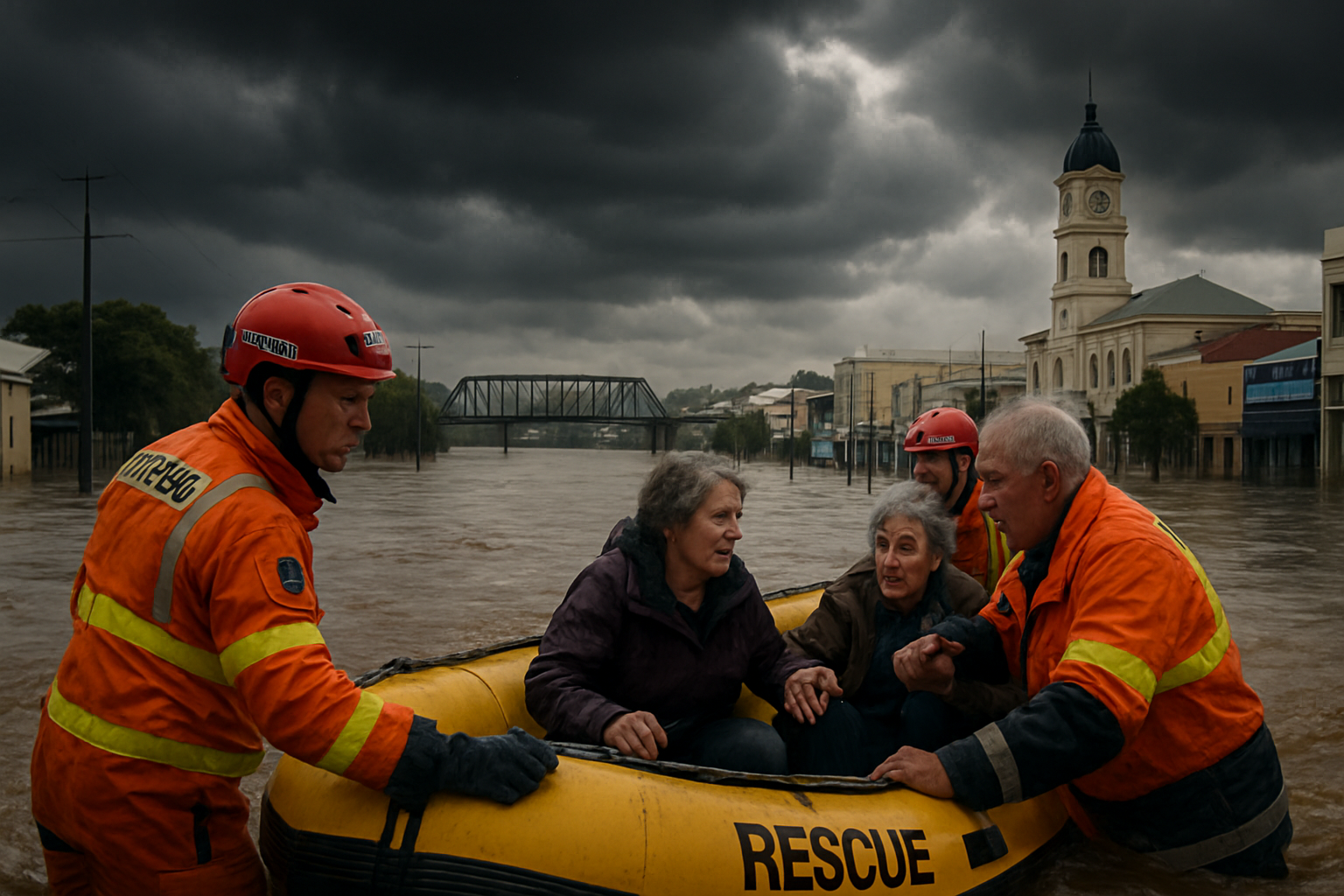
Australia faces a complex convergence of natural emergencies across multiple states as Queensland flooding moves westward following peak levels in Bundaberg, Sydney beaches close due to shark sightings within safety nets, and emergency services coordinate a search for a missing swimmer on the Sunshine Coast.
Queensland Flooding Crisis Expands
As flood levels peak in Bundaberg, emergency attention has shifted to Queensland's Western Downs, where some residents are being told to leave immediately. The Burnett River system continues to pose significant threats to communities across the region, with authorities warning that flood conditions could persist for several days.
The current flooding represents a continuation of Queensland's severe weather patterns throughout early 2026. According to emergency management records, the state has experienced some of the wettest conditions since 2010, with the region having recorded its wettest February day in over a decade at 93mm rainfall in Birdsville.
"The scale of this weather system is testing our traditional flood defenses and response capabilities,"
— Queensland Emergency Services Spokesperson
These conditions echo the devastating 2010 Bundaberg floods, raising concerns about infrastructure designed for historical weather patterns rather than current climate realities. Emergency services are managing what experts describe as a shift from sequential to concurrent disasters, where multiple regions face simultaneous emergencies rather than isolated incidents.
Sydney Beach Safety Crisis
In a separate but equally concerning development, Balmoral Beach on Sydney's Lower North Shore was closed after two sharks were reportedly sighted inside the netted safety area. The unusual breach of beach protection systems prompted immediate closure of the popular swimming location as a precautionary measure.
Two sharks were reportedly spotted swimming within the netted area of Balmoral Beach in Mosman early in the afternoon, leading to the immediate shutdown of the beach and baths. This incident highlights ongoing challenges with marine safety as environmental conditions continue to change.
The beach closure comes amid a broader pattern of marine incidents along Australia's coast, with authorities noting increased shark activity in traditionally safe swimming areas. Environmental scientists have linked these changes to shifting ocean temperatures and altered marine ecosystem patterns consistent with ongoing climate change.
Sunshine Coast Search Operation
Meanwhile, a multi-agency search operation continues for a swimmer who went missing at Happy Valley beach in Caloundra on Queensland's Sunshine Coast. Police and emergency services were alerted to the missing swimmer around 2pm, prompting immediate deployment of search and rescue teams.
The missing person is described as a man in his 60s with a bald head. The search involves coordination between police, fire and emergency services, and marine rescue units, demonstrating the comprehensive response capabilities that have become increasingly important as water-related emergencies rise across Australia.
Climate Context and Infrastructure Challenges
The simultaneous weather-related emergencies across Australia occur within the broader context of the 20th consecutive month of global temperatures exceeding 1.5°C above pre-industrial levels. This unprecedented warming streak has created what climate scientists call a "climate volatility paradox," where global heat records coincide with extreme regional weather events.
Australia's experience with extreme weather has intensified throughout 2026, beginning with "apocalyptic rain" in February that created dangerous flash flooding conditions across Sydney and New South Wales. The Northern Territory also faced significant challenges, with Katherine Hospital requiring evacuation due to the worst flooding in the region in decades.
Emergency Response Evolution
Emergency management experts note that Australia's current crisis represents a fundamental shift in disaster response requirements. Traditional mutual aid mechanisms, where resources from unaffected regions support disaster zones, are being challenged as multiple areas face simultaneous emergencies.
The Australian Fire and Emergency Services Council (AFAC) has identified increasing challenges with what they term "compound disasters" – situations where multiple types of emergencies occur simultaneously or in rapid succession, stretching response capabilities across various specialties from flood rescue to marine safety.
Historical and Regional Context
The current Australian weather crisis builds upon a devastating pattern of extreme weather events that have affected the continent throughout 2026. Previous incidents include dramatic police rescues in Bargara near Bundaberg, where officers waded through fast-moving, thigh-deep floodwater to rescue a schoolboy trapped in a submerged vehicle.
These heroic individual rescues have been documented by community Facebook groups, highlighting the vital role of social media coordination in emergency communications when traditional systems are overwhelmed. The "Bargara Facebookers" group exemplified how local communities have adapted to provide real-time emergency information and coordination.
Regional infrastructure vulnerabilities have become increasingly apparent as weather systems exceed the parameters for which transportation networks, power grids, and communication systems were designed. The shift from drought to flood conditions in many areas has created particularly dangerous circumstances, as hardened soil from extended dry periods cannot absorb sudden heavy rainfall, leading to rapid runoff and flash flooding.
Economic and Social Implications
The economic implications extend well beyond immediate emergency response costs. Queensland's agricultural operations face mounting pressures during critical growing seasons, with the sugar industry and tourism sectors experiencing substantial disruption. Transportation networks essential for regional commerce continue to face closures and delays.
Mental health services report increased demand as communities face repeated extreme weather events, with families potentially losing generational properties for the second time in a decade. The psychological impact of climate-related disasters has become an increasingly important component of emergency response planning.
Marine Ecosystem Changes
The shark incidents at Balmoral Beach reflect broader changes occurring in Australian marine ecosystems. Marine biologists have documented shifts in species distribution patterns as ocean temperatures rise and currents change, affecting traditional feeding and migration routes.
These changes pose new challenges for beach safety management, as protection systems designed for historical patterns may not account for altered marine life behavior. The breach of safety nets represents a concerning development for popular swimming locations across the country.
Adaptation and Future Preparedness
Australia's response to current emergencies provides insights into climate adaptation strategies that may become essential for future preparedness. The integration of traditional emergency services with community-based information systems, such as local Facebook groups providing real-time coordination, represents an evolution in disaster management approaches.
Infrastructure adaptation has become a critical focus, with emphasis on "building back better" rather than simply restoring damaged systems to their original specifications. This approach recognizes that historical weather patterns may no longer provide adequate design parameters for future infrastructure.
"We're seeing weather conditions that exceed what our infrastructure was designed to handle. The question is whether we adapt our systems or continue to respond reactively to each crisis."
— Australian Climate Adaptation Expert
Early warning systems have proven essential, with the Bureau of Meteorology providing increasingly sophisticated forecasting that enables preemptive evacuations and resource positioning. However, the simultaneous nature of current emergencies tests the limits of traditional emergency management frameworks.
International Coordination and Learning
Australia's experience with simultaneous natural disasters provides valuable lessons for international climate adaptation efforts. The coordination challenges faced by emergency services managing multiple concurrent incidents offer insights relevant to other nations preparing for similar climate-related challenges.
Climate scientists emphasize that current Australian conditions may represent a preview of routine circumstances expected in the 2030s without significant adaptation investment. The country's experience with managing everything from severe flooding to marine safety incidents simultaneously provides a template for comprehensive emergency preparedness.
Looking Ahead
As immediate emergency responses continue across Queensland's Western Downs and Sydney's beaches, longer-term recovery planning is already addressing infrastructure hardening and enhanced community preparedness programs. The current crisis underscores the importance of integrated emergency management capabilities that can address multiple types of disasters simultaneously.
Recovery timelines for current flooding may extend for months, with some infrastructure damage requiring years to fully address. This extended recovery period has led to renewed emphasis on building climate resilience rather than simply restoring damaged systems.
The experience of managing floods, shark incidents, and missing person searches concurrently demonstrates the complex nature of modern emergency management in an era of increasing climate volatility. Australia's response to these challenges may serve as a model for other nations facing similar convergent environmental pressures.
As authorities continue to monitor developing weather systems across the continent, the current crisis represents both an immediate challenge and an opportunity to strengthen the nation's capacity for managing the complex, interconnected emergencies that may become increasingly common in coming decades.