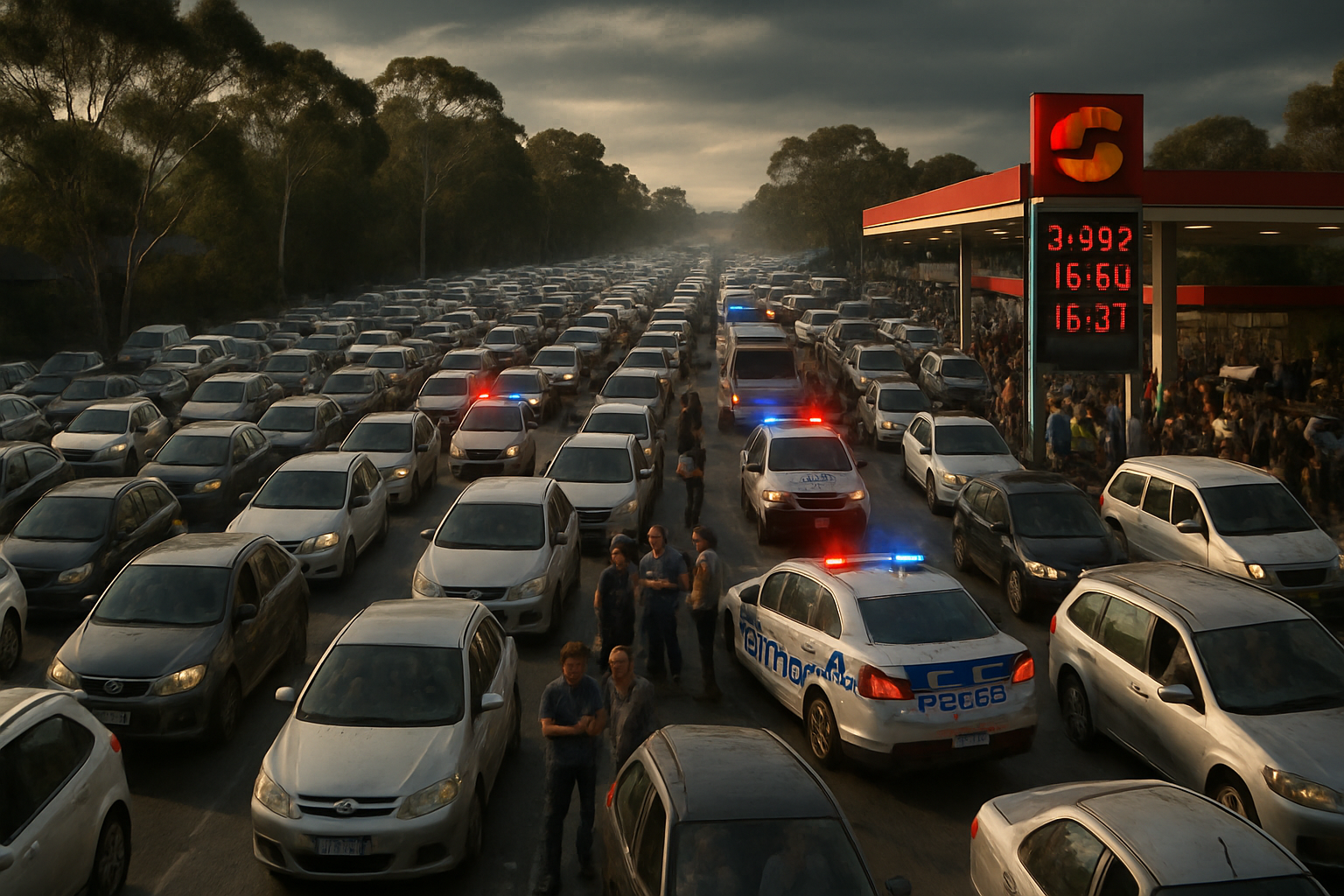
Police were forced to shut down a $100,000 fuel giveaway at a Melbourne petrol station after thousands of desperate motorists created unprecedented traffic chaos, highlighting the severity of Australia's deepening fuel crisis as global energy markets face their worst disruption since the 1970s oil shocks.
The extraordinary scenes at a Liberty fuel station in Truganina, in Melbourne's west, began early Friday morning when rewards club founder Billy Beasley announced a Good Friday promotion offering free petrol on a first-come, first-served basis. Within hours, cars were backed up bumper-to-bumper on Leakes Road, creating gridlock that stretched for kilometres and forced emergency services intervention.
Approximately $70,000 worth of fuel was dispensed before police deemed the situation too dangerous to continue, with traffic management systems overwhelmed by the sheer volume of vehicles. The incident reflects the mounting desperation among Australian motorists as fuel prices surge past $2.50 per litre nationally, approaching the critical $3 threshold in some regions.
Crisis Context: Global Energy Emergency Hits Australia
The Melbourne fuel chaos occurs against the backdrop of the most severe global energy crisis since the 1970s oil shocks. Iran's Revolutionary Guard declaration that the Strait of Hormuz is "unsafe for shipping" has effectively closed the critical waterway that handles 40% of global seaborne oil transit, creating unprecedented supply disruptions worldwide.
Oil prices have surged past $100 per barrel for the first time since 2022, with Brent crude reaching a peak of $119.50 and WTI jumping a record 18.98% to $108.15 in single-day trading. The International Energy Agency has responded with its largest strategic petroleum reserve release in 50 years—400 million barrels from 32 countries, double the amount released during the 2022 Ukraine crisis.
Australia's vulnerability to this global crisis stems from its heavy dependence on fuel imports and limited domestic refining capacity. The nation faces particular exposure to Middle East supply disruptions, with regional Queensland stations now completely depleted and the small town of Texas running entirely out of fuel over the weekend.
Regional Australia Bears the Brunt
The fuel crisis has hit regional communities hardest, with independent petrol stations struggling against major suppliers that favour bulk distributors. Goondiwindi Mayor Lawrence Springborg reports systematic abandonment of independent stations, leaving rural communities without adequate transport alternatives.
The Australian Competition and Consumer Commission (ACCC) is now monitoring fuel companies for price gouging as desperation grows among consumers. NSW Energy Minister Penny Sharpe has been chairing crisis talks in Sydney with transport, agriculture, mining, and consumer groups as the government grapples with supply chain vulnerabilities.
Deputy Prime Minister Richard Marles has acknowledged that fuel rationing remains a possibility if the Iran conflict continues, marking the first time Australian officials have openly discussed such drastic measures since the 1970s energy crisis.
International Context and Response
Australia's crisis forms part of a worldwide energy emergency that has triggered unprecedented government interventions across multiple continents. The Philippines has declared a year-long "national energy emergency," while New Zealand is considering "Muldoon-era" emergency measures including car-free days and petrol sale limits not implemented since the 1970s.
European nations have implemented dramatic responses: Ireland cut diesel excise by 20 cents and petrol by 15 cents in a €235 million package, Hungary imposed immediate price caps on gasoline and diesel to counter "war-driven explosions," and France deployed 500 fuel station inspectors to prevent price manipulation.
"The situation is going on longer than people initially thought, and financial markets are the ultimate constraint for a prolonged conflict."
— Damien Boey, Portfolio Strategist
The crisis has also paralysed global aviation, with over 18,000 flights cancelled worldwide—the most extensive disruption since COVID-19. Dubai International Airport, the world's busiest with 86 million passengers annually, remains shut due to missile damage.
Economic and Social Impact
The fuel crisis has created a cascade of economic and social pressures across Australia. The Reserve Bank has warned of fuel cost inflation potentially necessitating interest rate increases, creating what economists describe as a "triple whammy" for Australian households facing pressure at the bowser, checkout, and mortgage counter.
Air New Zealand has already cut over 1,000 flights affecting 44,000 passengers as jet fuel costs have surged 122% from $85-90 to $150-200 per barrel. The rideshare industry faces mounting pressure with drivers described as "depressed and angry" amid fuel price surges affecting gig economy profitability.
Financial markets have reflected the severity of the crisis, with Pakistan's KSE-100 crashing 8.97% in its largest single-day decline in history, while South Korea's KOSPI fell 12% triggering circuit breakers. The Korean won has hit a 17-year low, and PayPal postponed its $1.1 billion IPO indefinitely due to market volatility.
Energy Security Architecture Under Scrutiny
The crisis has exposed dangerous over-dependence on strategic chokepoints in volatile geopolitical regions. The 21-mile Strait of Hormuz represents a single-point failure for modern logistics, with no realistic alternatives for the massive volumes of oil and gas that transit the waterway daily.
Qatar's Energy Minister Saad Al Kaabi has warned that Gulf states may be forced to declare force majeure "within weeks" if oil approaches $150 per barrel, threatening to "bring down economies of the world." This warning has intensified discussions about fundamental restructuring of global energy architecture.
"This is the most severe energy security crisis in decades, exposing single-chokepoint vulnerabilities that require fundamental transformation."
— Samuel Ciszuk, Energy Analyst
The supply chain collapse extends beyond energy, affecting consumer goods and industrial materials worldwide. Major shipping companies Maersk and MSC have suspended operations entirely, with over 150 oil and LNG tankers stranded in the Persian Gulf representing billions in cargo value.
Government Response and Future Planning
Prime Minister Anthony Albanese announced emergency powers allowing the government to underwrite private fuel imports, alongside fuel excise tax cuts providing 26.3 cents per litre relief costing the budget A$2.55 billion. Energy Minister Chris Bowen has advocated for work-from-home arrangements as a "sensible" demand management strategy to avoid more drastic measures like rationing.
The crisis has prompted urgent reassessment of Australia's energy security infrastructure and long-term preparedness requirements. Strategic petroleum reserves, designed as temporary buffers for exactly such geopolitical disruptions, face potential depletion if the crisis extends beyond current projections.
The Australia Institute has proposed a 25% gas export tax that could generate $350 million weekly to fund emergency responses and infrastructure development. However, such measures would require time to implement while immediate supply needs remain critical.
Template-Setting Crisis for the 21st Century
UN Secretary-General António Guterres has described the current situation as "the greatest test of multilateral cooperation and crisis management in the modern era." The rapid transition from diplomatic negotiations to military confrontation demonstrates the fragility of crisis management mechanisms in an increasingly multipolar world.
The nuclear diplomacy breakdown that triggered this crisis—the complete collapse of US-Iran talks despite a Geneva "broad agreement on guiding principles" breakthrough—represents the most progress since the 2018 JCPOA collapse. The failure occurred over Iran's "red lines" regarding ballistic missiles and proxy forces versus US comprehensive demands.
With the New START treaty having expired on February 5—the first time in 50+ years without US-Russia nuclear constraints—and Iran's continued uranium enrichment to 60% with over 400kg of weapons-grade material, nuclear risks have reached their highest levels in decades.
Long-term Implications and Recovery Timeline
Unlike weather-related disruptions, recovery from this geopolitical crisis depends entirely on military and diplomatic resolution rather than predictable patterns. Aviation industries cannot maintain long-term scheduling with multiple airspaces closed, while energy markets remain volatile with critical transit routes blocked.
Traditional monetary policy tools have proven limited in effectiveness against structural geopolitical disruptions, forcing central banks to coordinate emergency liquidity provision while governments implement direct market interventions abandoned since the 1970s.
Success in containing this crisis could provide a framework for nuclear crisis resolution, strengthening diplomatic precedents for future conflicts. However, failure may accelerate military solutions that reshape Middle Eastern geopolitics for decades, encourage nuclear proliferation globally, and undermine diplomatic credibility worldwide.
The Road Ahead
The Melbourne fuel station chaos represents more than a local traffic incident—it symbolises the vulnerability of modern energy-dependent societies to geopolitical disruption. As thousands of desperate motorists lined up for free petrol, they illustrated the human cost of strategic chokepoint dependencies in an interconnected but unstable world.
The crisis demands fundamental transformation of energy security planning to reduce dependence on volatile regions and strategic chokepoints. Supply diversification and renewable energy transitions, while requiring years or decades to implement, have gained new urgency from current events.
April 2026 represents a watershed moment in Australian crisis management, establishing precedents for government intervention, international cooperation, and energy security policy that will influence national resilience for generations. The question remains whether lessons learned from this crisis will drive the fundamental changes needed to prevent similar vulnerabilities in an increasingly uncertain world.