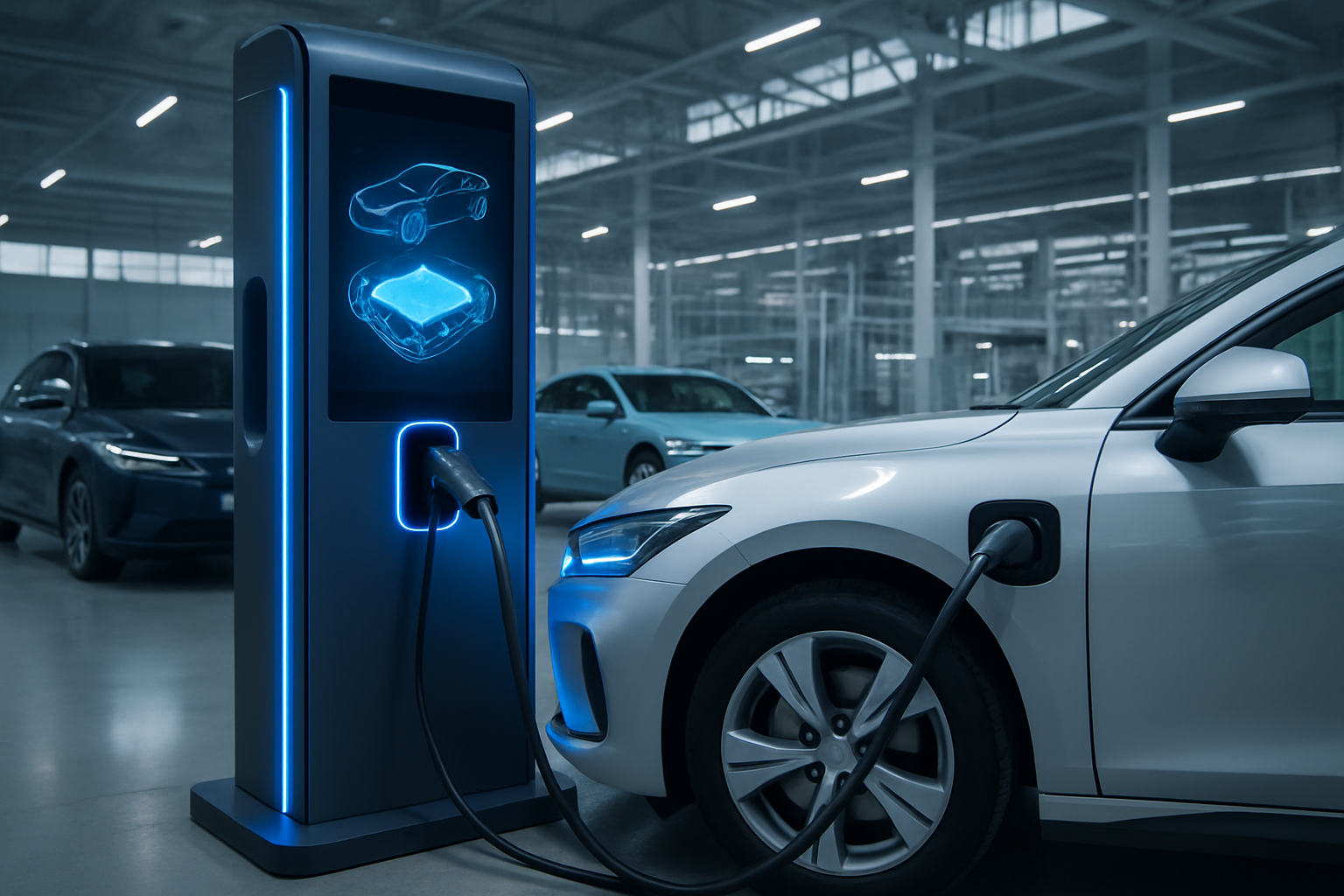
The global automotive industry is experiencing its most dramatic transformation in over a century, driven by revolutionary battery technologies, shifting consumer preferences, and fundamental changes in manufacturing strategies across multiple continents.
Recent developments spanning from Austria to New Zealand reveal an industry at a critical inflection point, where traditional automotive paradigms are giving way to electric mobility solutions, advanced manufacturing processes, and entirely new approaches to vehicle design and functionality.
Battery Technology Breakthrough Addresses Core EV Barriers
Austrian automotive analysts have challenged overly optimistic expectations about revolutionary battery technologies, noting that claims about solid-state, sodium, or "donut" batteries providing the "final breakthrough" for electric vehicles remain unrealistic from a research perspective. This sobering assessment comes as the industry grapples with the practical realities of scaling new battery technologies from laboratory conditions to mass production.
However, significant progress continues in existing battery technologies. Recent longevity studies reveal that Tesla Model S vehicles from 2012-2014 with over 200,000 miles retain 85-92% of their battery capacity, while Nissan Leaf models from 2011-2013 demonstrate 75-85% capacity retention after a decade of operation. These findings suggest practical EV battery lifespans may extend 15-20 years, far exceeding initial manufacturer warranties and early industry predictions.
The implications for total cost of ownership calculations are substantial, making EVs increasingly attractive propositions for consumers concerned about long-term vehicle economics. Insurance companies are already adjusting policies based on this improved reliability data, while the findings support the development of robust used EV markets.
Chinese Manufacturers Reshape Global Market Dynamics
The automotive landscape is being fundamentally altered by Chinese manufacturers' aggressive expansion into global markets. In Switzerland, the MG S6 EV represents the latest example of Chinese electric SUVs competing in European markets with competitive pricing strategies that prioritize efficiency over emotional appeal.
Chinese manufacturers benefit from significant strategic advantages, including control over 60% of global critical materials production and 90% of refining capacity for lithium, cobalt, and rare earth elements. This supply chain dominance enables technological leadership through companies like BYD, which has achieved breakthrough charging capabilities with its Megawatt Flash Charging system delivering 400km range in just 5 minutes.
The Chinese approach extends beyond pricing to encompass comprehensive regulatory frameworks. Recent announcements include a ban on hidden door handles in vehicles effective January 2027, requiring all new vehicles to have both interior and exterior mechanical releases. This safety-focused regulation affects major EV manufacturers including Tesla, BYD, NIO, and XPeng, demonstrating China's growing influence as a global automotive standards-setter.
Traditional Manufacturers Navigate Transition Challenges
Established automotive manufacturers face unprecedented challenges adapting to the electric vehicle transition. New Zealand's automotive market reflects broader global trends, with Suzuki's popular Ignis nameplate nearing discontinuation as manufacturers reassess their model lineups in response to changing consumer preferences and regulatory pressures.
The transition is complicated by persistent supply chain vulnerabilities, including memory chip shortages that have driven semiconductor prices up sixfold, affecting vehicle control systems across the industry. These challenges are expected to continue until new fabrication facilities come online in 2027.
European manufacturers are responding through various strategies, including intensifying calls for Brussels to provide financial support for domestic EV manufacturing to compete with Chinese alternatives. The success of these approaches will largely determine whether traditional automotive powerhouses can maintain competitiveness during the industry's transformation.
Infrastructure Development Accelerates Globally
Supporting the automotive transition requires massive infrastructure investments worldwide. Austria has doubled its EV charging capacity by adding 1,000 additional stations, while Estonia maintains European leadership with 88% renewable electricity and continental Europe's largest battery storage facility serving 90,000 households.
New Zealand recently announced a $50 million investment to double its public EV charging network through zero-interest loans to ChargeNet and Meridian Energy, deploying 2,574 new charging points nationwide. This represents the most significant EV infrastructure expansion in the country's history and demonstrates the coordinated policy responses required to address urban-rural adoption disparities.
The infrastructure challenges are particularly acute in addressing the needs of apartment dwellers versus homeowners. Urban residents face significant barriers to EV adoption due to limited access to home charging, while rural residents and homeowners enjoy clear advantages through private charging access.
Economic and Environmental Pressures Drive Change
The automotive transformation is occurring against a backdrop of unprecedented environmental urgency. January 2026 marked the 18th consecutive month of global temperatures exceeding 1.5°C above pre-industrial levels, demonstrating that human-induced climate change is now overriding natural climate variability.
Economic pressures are equally significant, with global fuel costs approaching crisis levels due to geopolitical tensions. The Strait of Hormuz closure has affected 40% of global oil transit, pushing Brent crude prices above $119 and making electric vehicles an economic necessity beyond environmental considerations.
These pressures are creating market conditions where electric vehicles are becoming cost-competitive with traditional gasoline vehicles, particularly when total ownership costs are considered. Caribbean markets demonstrate this trend, with EV owners saving $75 per $100 compared to gasoline despite electricity rate increases.
Regional Variations in Adoption Patterns
The automotive transition is proceeding at different rates across global markets, reflecting varying infrastructure capabilities, economic conditions, and policy frameworks. Denmark has achieved record-breaking EV sales that defy traditional seasonal patterns, while Croatia still faces significant barriers to electric vehicle adoption despite rising fuel prices.
Asian markets continue to lead global EV adoption, with one unspecified Asia-Pacific country achieving 11 million electric vehicle sales in a single year—nearly double the rest of the world combined. This performance aligns with technological breakthroughs including advanced charging systems and cold-weather battery performance improvements.
Technology Integration and Future Outlook
Vehicle-to-grid technology is emerging as a crucial component of the automotive transformation, enabling EVs to function as mobile energy storage systems. This capability allows vehicles to charge during off-peak renewable energy generation periods and discharge electricity during high-demand times, supporting grid stability while providing additional economic benefits to vehicle owners.
The convergence of automotive and energy sectors represents one of the most significant industrial transformations in modern history. Success requires coordination across energy systems, infrastructure development, materials supply chains, and regulatory frameworks during what climate scientists term the "decisive climate action decade."
Commercial vehicle electrification is accelerating alongside consumer adoption, with Tesla announcing large-scale Semi truck production and BMW planning electric 3 Series production beginning August 2026 at its Munich facility. These developments signal that the transformation extends beyond personal transportation to encompass the entire mobility ecosystem.
Supply Chain Security and International Cooperation
The industry transformation highlights critical supply chain vulnerabilities and the need for international cooperation. The US-EU-Japan Critical Minerals Partnership, encompassing 55 countries and 7 African suppliers, represents coordinated efforts to diversify supply chains and reduce dependence on single sources of critical materials.
Regional manufacturing strategies are emerging as companies establish production facilities closer to primary markets, reducing transportation costs and supply chain vulnerabilities while improving responsiveness to local market requirements. This trend could fundamentally reshape global automotive production geography over the coming decade.
The March 2026 developments represent a watershed moment where crisis-driven demand converges with technological readiness, creating conditions for accelerated mass adoption of electric vehicles. The window for effective climate action is narrowing, but the combination of technological innovation, economic incentives, and policy coordination offers genuine opportunities for maintaining planetary habitability while transforming global transportation systems.
The automotive industry's transformation extends far beyond simple vehicle electrification to encompass fundamental changes in how societies approach mobility, energy systems, and industrial policy. The success of this transition will largely determine humanity's ability to address climate change while maintaining economic prosperity and social mobility in the 21st century.