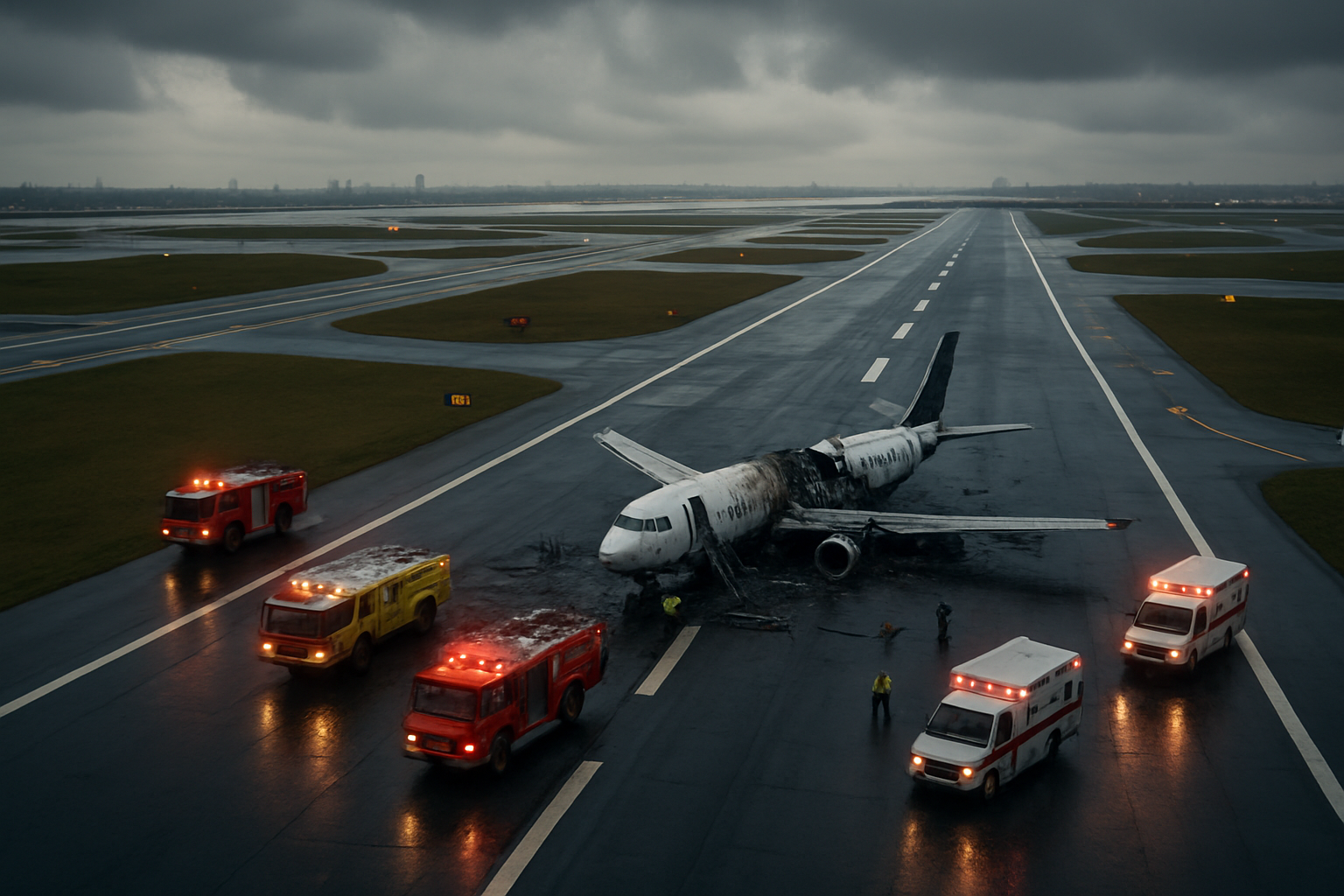
A fatal collision between an Air Canada Express aircraft and a Port Authority fire truck at LaGuardia Airport has killed two pilots and exposed critical vulnerabilities in aviation safety systems, as the transportation industry grapples with an unprecedented series of emergencies spanning from operational failures to political interventions.
The Bombardier CRJ-900 regional jet, operated by Jazz Aviation under the Air Canada Express banner, struck the emergency vehicle during landing operations Sunday night at 11:40 PM EST. The aircraft, arriving from Montreal with 72 passengers and four crew members, sustained complete destruction of its nose and cockpit sections, leaving the two pilots with no chance of survival.
Immediate Casualties and Emergency Response
Among the victims was Quebec pilot Antoine Forest from Coteau-du-Lac, whose death represents a significant loss to the aviation community. Thirteen others were hospitalized, including eleven passengers and two first responders from the fire truck, though most passenger injuries were classified as non-life-threatening.
In a remarkable survival story, flight attendant Solange Tremblay was ejected from the aircraft while still strapped into her crew seat, surviving with leg fractures that required surgery. Her daughter Sarah Lepine called the survival "a total miracle," attributing it to the four-point crew restraint system that likely saved her mother's life.
The collision forced a complete closure of LaGuardia Airport through Monday afternoon, with the FAA issuing a ground stop that affected thousands of passengers nationwide. The airport, serving as a critical domestic hub, created ripple effects throughout the national aviation network.
Investigation Reveals Systemic Coordination Failures
Federal investigators from the NTSB and FAA have launched a comprehensive examination focusing on the fatal breakdown in coordination between aircraft operations and emergency vehicle responses. The fire truck was reportedly responding to a separate, unrelated emergency incident when it was struck by the landing aircraft during routine operations.
Aviation experts emphasize that this incident occurred during standard airspace operations, ruling out terrorism or hostile activity. The investigation centers on mechanical systems, weather conditions, communication protocols, and the critical question of how emergency vehicles coordinate with active flight operations at busy airports.
"The investigation will focus on simultaneous aircraft operations and ground emergency response coordination vulnerabilities that this tragedy has exposed."
— Federal Aviation Official
Trump Administration's Immigration Enforcement Creates New Aviation Disruption
The LaGuardia incident occurs as President Trump deploys armed immigration agents to major airports to address security line delays caused by personnel shortages. This unprecedented move adds another layer of complexity to aviation operations already strained by various crises throughout 2026.
The deployment of ICE agents represents a significant shift in airport security protocols, as facilities struggle with staffing challenges that have created lengthy passenger delays. The intersection of immigration enforcement with aviation operations raises questions about operational priorities and resource allocation during critical safety periods.
Pattern of 2026 Aviation Safety Challenges
The LaGuardia tragedy represents the latest in a series of concerning aviation incidents that have marked 2026 as one of the most challenging years for the industry since the COVID-19 pandemic. Previous disruptions include the Middle East crisis that cancelled over 18,000 flights globally, multiple European strikes, and various safety incidents across continents.
The year has seen unprecedented aviation challenges including Dubai International Airport shutdowns, extensive weather-related disruptions, and multiple military aviation accidents in Latin America. The Colombian Air Force alone has experienced three major accidents, including a C-130 Hercules crash in Puerto Leguízamo that killed two pilots and injured dozens of military personnel.
Bolivia experienced its worst military aviation disaster in recent history when a C-130 Hercules carrying newly printed banknotes crashed at El Alto International Airport, killing 22 people and creating chaotic scenes as thousands of people rushed to collect scattered currency despite police warnings.
International Safety Concerns Mounting
Aviation safety experts are documenting a concerning pattern of incidents that extends beyond U.S. borders. Qatar recently lost seven military personnel, including Turkish nationals, in a helicopter crash during routine operations, while Norway experienced an ambulance aircraft emergency landing after landing gear problems.
The industry maintains an exceptional statistical safety record, with the International Air Transport Association's 2025 report showing 51 accidents among 38.7 million flights globally. However, each incident provides crucial lessons for improving protocols and emergency response procedures.
Systemic Infrastructure Vulnerabilities Exposed
The LaGuardia collision highlights fundamental questions about communication adequacy between air traffic control and emergency vehicles operating on active runways. Runway incursions and ground vehicle conflicts remain among the most serious operational concerns at major airports worldwide.
Aviation authorities are examining whether current protocols for coordinating emergency responses with active flight operations are sufficient for the complex operational environment of modern airports. The investigation findings are expected to influence global airport safety procedures for years to come.
Industry experts emphasize that while commercial aviation maintains exceptional safety standards, the coordination between different operational elements—aircraft movements, emergency response, and ground operations—requires constant vigilance and improvement.
Economic and Operational Impact
The complete closure of LaGuardia during the investigation created significant economic consequences extending far beyond the immediate tragedy. Airlines implemented emergency protocols, alternative routing strategies, and comprehensive passenger accommodation procedures, while facing dramatically increased operational costs.
The aviation industry is still recovering from previous 2026 crises, including weather disruptions and international conflicts that have strained operational resilience. Each new incident tests the industry's capacity to maintain safety standards while managing complex logistical challenges.
Technology and Safety Protocol Evolution
The investigation may accelerate implementation of enhanced communication systems between air traffic control and emergency vehicles, improved coordination protocols for simultaneous operations, and possibly redesigned airport layouts that better separate emergency vehicle routes from active aircraft operations areas.
Aviation safety depends heavily on the experience and expertise of flight crews, making the loss of seasoned pilots like Antoine Forest particularly significant for the broader aviation community's safety culture and operational excellence.
Looking Forward: Lessons and Reforms
As federal investigators work to determine the exact circumstances of the collision, the aviation industry faces pressure to demonstrate that lessons learned will translate into meaningful safety improvements. The findings are expected to influence international aviation safety standards and emergency response protocols globally.
The tragedy underscores the need for continuous evolution in safety protocols as aviation operations become increasingly complex. Success in preventing future incidents will depend on the industry's commitment to implementing comprehensive reforms based on investigation findings.
For families affected by this tragedy, including those of the deceased pilots and injured crew members, the industry's response will serve as a measure of its commitment to safety above all other considerations. The aviation community's ability to learn from this incident and implement meaningful changes will determine whether such tragedies can be prevented in the future.