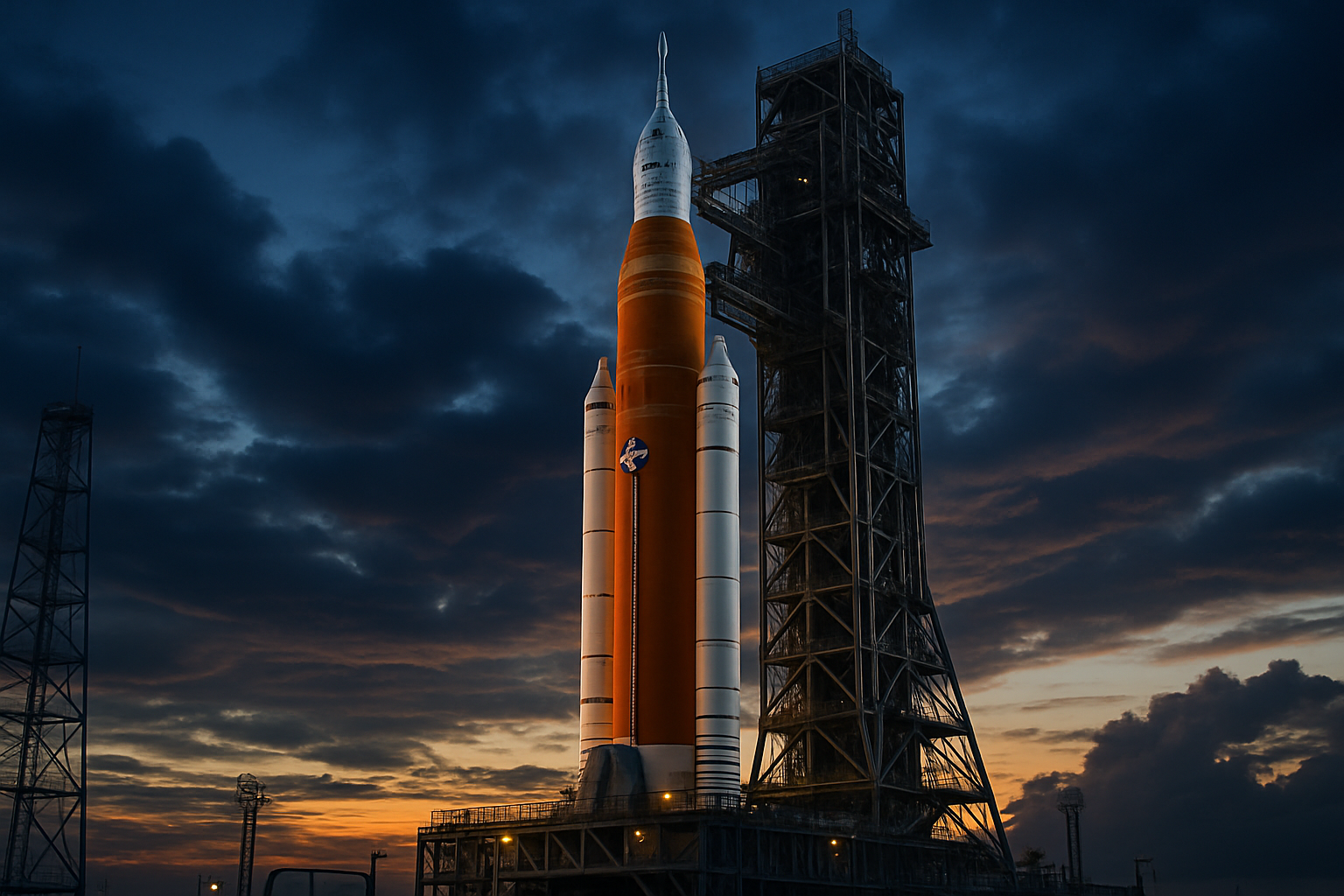
NASA Administrator Jared Isaacman announced a dramatic strategic shift toward permanent lunar surface habitation, redirecting $20 billion from the cancelled Lunar Gateway project to establish a lunar base by 2030, while the Artemis II mission continues facing technical delays that underscore both the promise and challenges of humanity's return to deep space exploration.
The comprehensive restructuring represents the most significant pivot in NASA's lunar strategy since the Artemis program's inception, occurring as the space industry navigates a complex landscape of technical hurdles, international competition, and aviation safety concerns that highlight the interconnected nature of aerospace advancement in 2026.
Artemis Program Faces Technical Realities
The Artemis II mission, originally scheduled for February 2026, has encountered persistent technical challenges that have pushed the launch date to April 1, 2026. The four-astronaut crew—Canadian Jeremy Hansen (the first Canadian to travel beyond Earth orbit), NASA Commander Reid Wiseman, Christina Koch, and Victor Glover—awaits what will be humanity's first crewed mission beyond Earth orbit since Apollo 17 in December 1972, ending a 54-year gap in deep space human exploration.
Critical helium system failures affecting the Space Launch System (SLS) rocket's upper stage, combined with persistent hydrogen leak issues during wet dress rehearsal testing, have demonstrated the complex engineering challenges inherent in deep space transportation. The SLS rocket, standing 322 feet tall and weighing 5.75 million pounds when fully fueled with over 700,000 gallons of liquid hydrogen and oxygen, represents the most powerful rocket NASA has ever built.
"We will only launch when we believe we are ready. Safety remains our paramount concern, and we have learned from historical tragedies to prioritize crew protection over schedule adherence."
— Jared Isaacman, NASA Administrator
The technical problems have consistently emerged at T-minus 5 minutes during countdown simulations, with helium systems essential for engine purging and fuel tank pressurization failing at critical moments. This methodical problem-solving approach, while causing delays, reflects NASA's institutional learning from the Challenger and Columbia tragedies, particularly as Boeing's Starliner was recently classified as a Type A mishap—the same severity level as those historical disasters.
Revolutionary Lunar Base Strategy
The cancellation of the Lunar Gateway orbiting space station project marks a fundamental shift from NASA's original Artemis architecture. The Gateway, designed as a staging post for lunar surface operations, will see its components from Northrop Grumman and Vantor repurposed for direct surface infrastructure rather than orbital operations.
This strategic pivot addresses international competitive pressures, particularly China's plans to deploy lunar crews by 2030, while leveraging lessons learned from the International Space Station's operational history. The permanent base will require advanced radiation shielding, in-situ resource utilization capabilities, and sophisticated life support systems built on research conducted during extended ISS missions.
Sophie Adenot's record-breaking eight-month ISS mission has provided crucial data through lung tissue cultivation studies and Space-Associated Neuro-Ocular Syndrome (SANS) research, both essential for understanding human adaptation to extended space environments. These medical insights directly inform the life support systems and health protocols required for permanent lunar habitation.
Nuclear-Powered Mars Initiative
Concurrent with the lunar base development, NASA announced the Space Reactor 1 Freedom nuclear spacecraft program for Mars exploration. This nuclear-powered system addresses the energy density requirements for interplanetary missions where solar power becomes insufficient, representing a technological leap toward sustainable deep space operations.
The nuclear propulsion system enables faster transit times and continuous power generation during Mars missions, reducing crew exposure to cosmic radiation and providing reliable energy for advanced life support systems during the journey and surface operations.
Aviation Safety Challenges
While space exploration captures headlines, aviation safety continues facing significant challenges that underscore the interconnected nature of aerospace advancement. The investigation into the Air Canada Express collision with a Port Authority fire truck at LaGuardia Airport has been complicated by delays caused by the partial U.S. government shutdown, affecting security clearances and personnel access to the crash site.
National Transportation Safety Board Chair Jennifer Homendy reported that specialized investigators faced airport delays that prevented timely examination of the wreckage, highlighting how broader infrastructure challenges affect critical safety investigations. The accident, which killed two pilots, demonstrates the ongoing need for enhanced ground operations safety protocols at major airports.
These aviation safety concerns occur as the aerospace industry experiences unprecedented growth, with commercial space ventures expanding rapidly alongside traditional aviation operations. The convergence of technologies and operational procedures between aviation and space exploration creates both opportunities for advancement and complex safety challenges requiring comprehensive regulatory frameworks.
International Space Competition
The broader context of these developments includes intensifying international competition in space capabilities. China's Shenlong reusable spacecraft program continues advancing, while Pakistan's selection of astronaut candidates for China's Tiangong station missions scheduled for October-November 2026 demonstrates the democratization of space access beyond traditional space powers.
European space independence efforts include Germany's significant investments in satellite systems and Sweden's expansion of rocket testing facilities, with Isar Aerospace conducting monthly tests of 30 rocket engines. These developments represent a fundamental shift from the U.S.-Soviet duopoly that characterized the early space age to a multipolar space environment with diverse capabilities and objectives.
Space Economy Golden Age
The transformation occurs during what industry analysts term the "space economy golden age," with SpaceX preparing for a potential trillion-dollar IPO in June 2026. This valuation reflects the maturation of commercial space capabilities from experimental ventures to essential infrastructure supporting communications, navigation, Earth observation, and human transportation.
The convergence of government programs like Artemis with commercial capabilities creates unprecedented opportunities for rapid advancement, though it also generates complex coordination challenges. NASA's partnership with SpaceX for crew transportation to the ISS has proven successful, while the agency's relationship with traditional contractors like Boeing faces scrutiny following technical setbacks.
Canadian Space Program Implications
The Gateway cancellation creates significant uncertainty for Canada's space industry, particularly the Canadarm3 robotic arm system developed by MDA Systems in Brampton, Ontario. While Jeremy Hansen's role in Artemis II continues, the broader Canadian space industry must adapt to NASA's surface-focused strategy rather than the orbital operations originally envisioned.
This shift reflects broader questions about international cooperation in space exploration as national priorities evolve and competitive dynamics intensify. The Artemis Accords framework provides a foundation for peaceful lunar exploration, but permanent settlement will require detailed international agreements addressing resource utilization, environmental protection, and emergency protocols.
Technical Challenges and Solutions
The persistent technical challenges facing Artemis II highlight the sophisticated engineering required for human deep space transportation. Beyond the immediate helium and hydrogen leak issues, the mission must validate radiation protection systems, life support capabilities, and navigation systems operating beyond Earth's protective magnetic field.
Advances in artificial intelligence have begun addressing some operational challenges, with NASA achieving fully AI-planned Mars rover missions in December 2025. These autonomous navigation capabilities reduce dependence on Earth-based control systems, enabling real-time decision-making across cosmic distances—essential for both robotic missions and human exploration of distant destinations.
Economic and Strategic Implications
The $20 billion investment in lunar base infrastructure represents the largest space infrastructure commitment in NASA history, positioning the United States for leadership in the emerging trillion-dollar space economy. Permanent lunar presence enables resource extraction, technology demonstration, scientific research, and Mars crew training while providing strategic advantages in space-based operations.
The economic implications extend beyond government investment to encompass commercial opportunities in space-based manufacturing, research facilities, and resource utilization. Private companies are already developing space-based data centers to address terrestrial memory shortages and semiconductor supply constraints, demonstrating how space capabilities can address Earth-based challenges.
Looking Forward
The successful resolution of Artemis II technical challenges and implementation of the permanent lunar base strategy will determine humanity's trajectory as a spacefaring civilization. The mission serves as a critical stepping stone, testing systems essential for sustained human presence beyond Earth while validating international cooperation models for future Mars exploration.
The convergence of technical advancement, international cooperation, commercial innovation, and strategic competition creates both unprecedented opportunities and complex challenges. Success requires balancing ambitious objectives with rigorous safety standards, coordinating diverse international capabilities, and maintaining public support for long-term exploration goals.
As NASA works to resolve the final technical issues preventing Artemis II's launch, the broader aerospace community continues advancing technologies and operational procedures that will define humanity's cosmic future. The transition from temporary visits to permanent settlement represents a fundamental evolution in human capabilities, with implications extending far beyond space exploration to encompass technology development, international relations, and our species' long-term survival.
The coming months will prove crucial in determining whether the methodical, safety-focused approach to space exploration can overcome technical hurdles while maintaining the momentum necessary for sustained cosmic expansion. The stakes extend beyond individual missions to encompass humanity's emergence as a truly spacefaring civilization capable of thriving beyond Earth's boundaries.