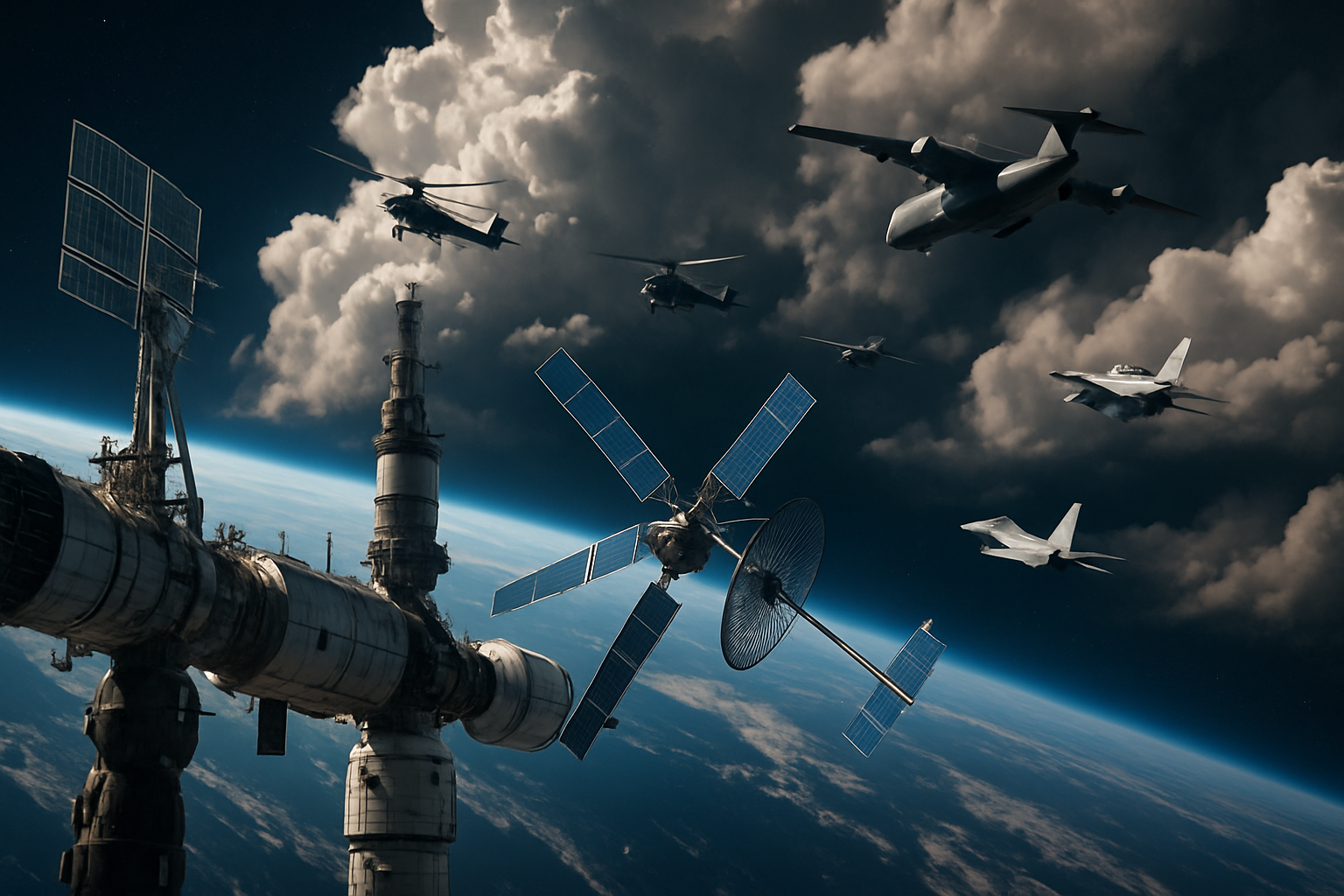
A critical International Space Station crew rotation mission succeeded on February 13, 2026, while Oman announced plans for its first national communications satellite, underscoring the rapid expansion of both human spaceflight and space-based infrastructure across international borders.
The developments represent a pivotal moment in aerospace history, combining immediate operational needs in low Earth orbit with long-term strategic investments in space-based communications sovereignty. These achievements occur alongside significant military aviation artwork showcasing the evolution of aircraft design and the continuing importance of air power capabilities.
Historic ISS Mission Restores Station Operations
Four astronauts launched to the International Space Station aboard SpaceX's Crew-12 mission, successfully restoring the orbital laboratory to its full seven-person complement after an unprecedented medical evacuation left the station with a skeleton crew. The mission included international crew members representing NASA, the European Space Agency, and Roscosmos, demonstrating continued cooperation in space despite terrestrial tensions.
The crew replacement was critical for maintaining the station's extensive research program, which includes lung tissue cultivation experiments essential for understanding microgravity effects on human biology. These studies directly support future lunar settlements and Mars exploration missions, addressing challenges such as Space-Associated Neuro-Ocular Syndrome (SANS) that affects astronaut vision during extended missions.
"This mission represents more than just crew rotation," said aerospace analysts tracking the February developments. "It demonstrates the maturation of commercial space transportation and the essential nature of continuous human presence in space for advancing scientific knowledge."
Oman's Strategic Space Communications Initiative
Oman is preparing to launch OmanSat-1, its first national communications satellite, marking a significant milestone in the sultanate's digital sovereignty strategy. H.E. Dr. Ali bin Amer al Shidhani, Undersecretary for Communications and Information Technology, emphasized that the project represents a strategic shift from dependence on foreign satellite operators to national ownership and control.
"OmanSat-1 represents an independent space communications infrastructure. It will give Oman greater control over telecommunications and data services for government and private institutions, with higher levels of security for national information."
— Dr. Ali bin Amer al Shidhani, Undersecretary for Communications and Information Technology
The satellite initiative positions Oman to become a regional satellite operator while ensuring continuity of critical services and enhancing cybersecurity for national communications. This development reflects a broader trend of emerging nations developing independent space capabilities rather than relying solely on established space powers.
Military Aviation Excellence Through Art
Complementing these space developments, renowned artist Joan Mañé has created detailed technical drawings of significant military aircraft, highlighting the continuing evolution of aviation technology. His artwork features the Airbus A400M Atlas tactical transport aircraft, the Aérospatiale SA 330 Puma helicopter, the Italian Aermacchi MB-339 trainer aircraft, and the British BAE Systems Hawk advanced trainer.
These aircraft represent decades of aerospace engineering advancement, from the A400M's modern four-engine turboprop design meant to replace aging transport fleets, to the proven reliability of the Puma helicopter first developed in the 1960s. The inclusion of trainer aircraft like the MB-339 and Hawk demonstrates the ongoing importance of pilot training programs in maintaining air force capabilities worldwide.

Space Economy Golden Age Transition
These developments occur during what analysts describe as a transition from the "AI revolution to space economy golden age." Recent achievements include SpaceX's strategic pivot from Mars to lunar colonization within 10 years, leveraging the Moon's advantages of three-day travel time, frequent launch windows, and real-time communication capabilities compared to Mars' 26-month alignment cycles.
The space industry demonstrates remarkable international cooperation through ISS operations while competitive dynamics intensify globally. Pakistan recently selected astronaut candidates for China's Tiangong space station mission scheduled for October-November 2026, exemplifying how space capabilities are democratizing beyond traditional space powers.
NASA's Artemis II mission continues facing delays due to hydrogen leak issues, now scheduled for March 2026. This will be the first crewed mission beyond Earth orbit since Apollo 17 in 1972, carrying four astronauts on a 10-day lunar flyby that represents a crucial stepping stone toward sustained lunar presence.
Technology Integration and Challenges
The space industry confronts significant technical challenges alongside remarkable achievements. A global memory crisis with sixfold semiconductor price increases affects space technology development, driving interest in space-based data center solutions. SpaceX's planned June 2026 IPO, potentially valuing the company over $1 trillion, reflects investor confidence in commercial space capabilities.
Space medicine research addresses persistent challenges like SANS, which affects astronaut vision during extended missions and represents a critical obstacle for future deep space exploration. Portuguese scientists are leading groundbreaking research into these conditions, essential for the success of lunar bases and Mars missions.
Artificial intelligence integration continues revolutionizing space operations through autonomous navigation capabilities, enabling real-time decision-making across cosmic distances. NASA achieved historic success with fully AI-planned Mars rover missions in December 2025, demonstrating technology crucial for future operations when Earth-based control becomes impractical due to communication delays.
Regional and Global Implications
The convergence of human spaceflight operations, national satellite programs, and military aviation development reflects the increasingly integrated nature of aerospace capabilities. Countries like Oman are pursuing space communications sovereignty while maintaining international cooperation frameworks that enable knowledge sharing and technological advancement.
These developments establish important precedents for the future of space exploration and aviation technology. The success of international crew rotations provides templates for future deep space missions requiring diverse expertise and sustained international partnerships. Meanwhile, national satellite programs demonstrate how smaller nations can achieve technological independence through strategic planning and international cooperation.
The artistic documentation of military aircraft evolution serves as a reminder that while space technology captures headlines, traditional aviation capabilities remain essential for national security and defense requirements. The combination of transport aircraft, helicopters, and trainer jets represents the breadth of capabilities required for modern air operations.
Looking Forward
As the space economy continues its rapid expansion, the February 2026 developments represent a watershed moment where space exploration strategy has matured toward pragmatic objectives while breakthrough technologies enable unprecedented capabilities. The successful combination of human spaceflight operations, satellite communications advancement, and continued military aviation development provides a comprehensive foundation for the next phase of aerospace evolution.
The success of these diverse but interconnected aerospace developments suggests that 2026 may indeed mark the beginning of a new era in which space-based activities become integral to human civilization infrastructure and economic systems, while traditional aviation continues evolving to meet 21st-century operational requirements.