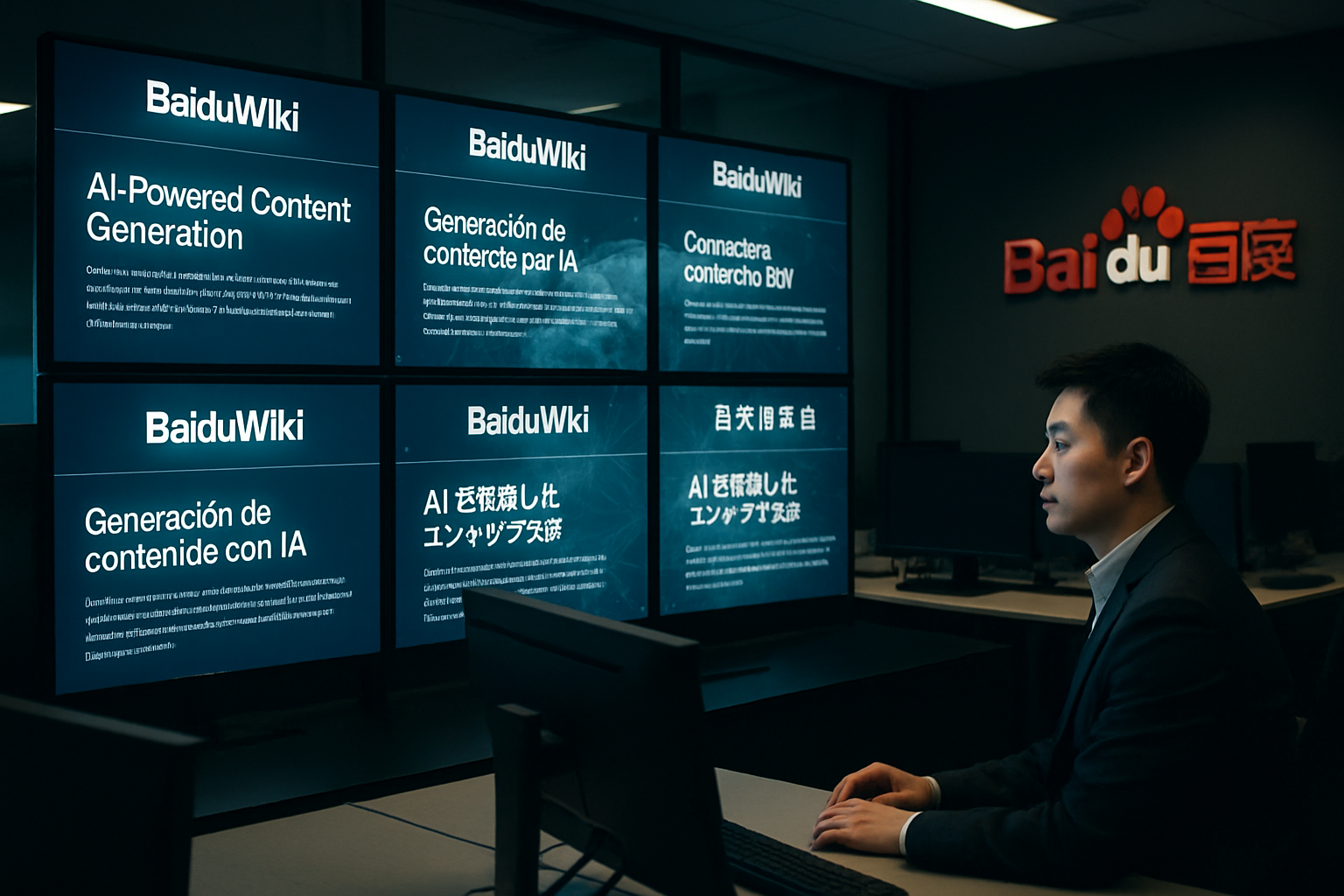
Chinese technology giant Baidu has quietly launched BaiduWiki, an artificial intelligence-powered encyclopedia service designed to rival Wikipedia, marking the company's ambitious bid to attract international users and challenge Western dominance in online knowledge platforms.
The Wikipedia-style service went live on Monday, February 10, 2026, according to digital archive records from the Wayback Machine. Available in English, Spanish, French, Russian, and Japanese, BaiduWiki represents Baidu's most significant push into the global information ecosystem since its search engine peaked in international markets.
A now-deleted post on Baidu's official social media account briefly announced the launch before being removed, suggesting the company may have intended a softer rollout of the controversial platform. Industry analysts view the move as part of Baidu's broader strategy to capitalize on global opportunities amid intensifying competition in the AI space.
AI-Driven Content Generation at Scale
BaiduWiki leverages Baidu's advanced large language models to generate and curate encyclopedic content, promising to "bridge information gaps for local and worldwide audiences." The platform employs sophisticated natural language processing to create articles across multiple languages simultaneously, potentially allowing for faster content creation than traditional crowd-sourced methods.
Unlike Wikipedia's collaborative editing model, BaiduWiki relies primarily on AI systems to synthesize information from multiple sources, with human oversight for quality control and fact-checking. This approach could theoretically enable the platform to cover topics and languages underserved by existing encyclopedias, particularly in regions where volunteer editor communities remain small.
The service appears designed to address what Baidu executives have described as "information asymmetries" in global knowledge distribution, where certain perspectives and sources may receive limited representation in existing platforms.
Strategic Timing Amid AI Revolution
BaiduWiki's launch comes during a critical period for AI development globally. The platform enters the market as Chinese AI companies, including the breakthrough success of DeepSeek, are challenging American technological dominance and demonstrating capabilities that rival Western alternatives.
The timing coincides with ongoing supply chain challenges affecting the AI industry. Global memory shortages have driven semiconductor prices up sixfold, affecting major manufacturers like Samsung, SK Hynix, and Micron. These constraints are expected to persist until 2027, when new fabrication facilities come online, potentially creating opportunities for companies like Baidu that have invested heavily in AI infrastructure.
Baidu's move also occurs against a backdrop of increasing regulatory scrutiny of information platforms. European authorities have intensified enforcement actions against tech platforms, while countries like Spain have implemented criminal executive liability for platform violations, and France has conducted cybercrime raids on AI platforms.
Competitive Landscape and Market Positioning
Wikipedia, operated by the nonprofit Wikimedia Foundation, has long dominated the online encyclopedia space with its collaborative, volunteer-driven model. The platform serves billions of users worldwide and has become synonymous with free, accessible knowledge despite ongoing debates about editorial bias and content accuracy.
BaiduWiki's AI-first approach represents a fundamental departure from this model, potentially offering several advantages: faster content generation, consistent quality standards, and the ability to maintain multiple language versions simultaneously. However, it also raises questions about algorithmic bias, source transparency, and the potential for state influence over information curation.
The platform enters a market where information credibility has become increasingly scrutinized. Recent developments in AI-generated content have sparked global discussions about misinformation, deepfakes, and the weaponization of artificial intelligence for propaganda purposes.
International Expansion Challenges
Baidu faces significant hurdles in its global expansion efforts. The company's search engine, once a prominent player in international markets, has largely retreated to focus on China's domestic market. Rebuilding international user trust and brand recognition will require substantial investment and careful navigation of geopolitical sensitivities.
The multilingual approach suggests Baidu is targeting specific regional markets where it believes it can establish a foothold. The selection of English, Spanish, French, Russian, and Japanese indicates focus on major linguistic communities while avoiding some regions where political tensions might complicate market entry.
Competition extends beyond Wikipedia to include other knowledge platforms and search engines that have integrated AI-powered information synthesis. Google's AI-enhanced search results, Microsoft's Copilot integration, and other major tech companies' knowledge products create a crowded field for information services.
Regulatory and Geopolitical Implications
BaiduWiki's international launch occurs amid heightened scrutiny of Chinese technology companies in Western markets. Concerns about data privacy, content moderation, and potential state influence over information platforms could complicate the service's adoption in regions where Chinese tech companies face regulatory restrictions.
The platform's content generation methods will likely face examination from regulators increasingly focused on AI governance. Recent developments include the UN's establishment of an Independent International Scientific Panel on Artificial Intelligence with 40 experts, and coordinated European efforts to implement comprehensive AI accountability frameworks.
Different countries have varying approaches to AI-generated content regulation. India recently implemented comprehensive AI content rules requiring mandatory labeling and three-hour government takedown capabilities, while European authorities are pursuing criminal liability for platform executives who fail to manage AI-generated harmful content.
Technical Innovation and Infrastructure
Baidu's investment in AI infrastructure positions the company to potentially deliver sophisticated encyclopedic content at scale. The company has been among China's leaders in natural language processing and knowledge graph technologies, capabilities that directly translate to encyclopedia creation.
However, the global memory crisis affecting semiconductor supply chains could impact BaiduWiki's ability to scale internationally. The platform's success will depend on efficient use of computing resources and strategic partnerships to ensure reliable service delivery across different geographic regions.
The service's multilingual capabilities represent a significant technical achievement, requiring sophisticated translation and localization systems that can maintain factual accuracy and cultural sensitivity across different languages and regions.
Future Implications for Knowledge Access
BaiduWiki's success or failure could influence the broader landscape of online knowledge platforms. If successful, the AI-driven approach might inspire similar developments from other technology companies, potentially transforming how encyclopedic content is created and curated globally.
The platform also represents a test case for AI-generated educational content. As educational institutions worldwide grapple with integrating artificial intelligence into learning environments, BaiduWiki could provide insights into the effectiveness and reliability of AI-created reference materials.
For global information access, BaiduWiki potentially offers benefits in covering underserved topics and languages, but also raises fundamental questions about information authority, editorial independence, and the role of artificial intelligence in shaping human knowledge systems.
The platform's development will likely be closely monitored by researchers, policymakers, and competitors as it navigates the complex challenges of building trust in AI-generated information while expanding across diverse international markets. Its success could signal a new phase in the evolution of digital knowledge platforms, where artificial intelligence becomes the primary curator of human information rather than simply a supporting tool.