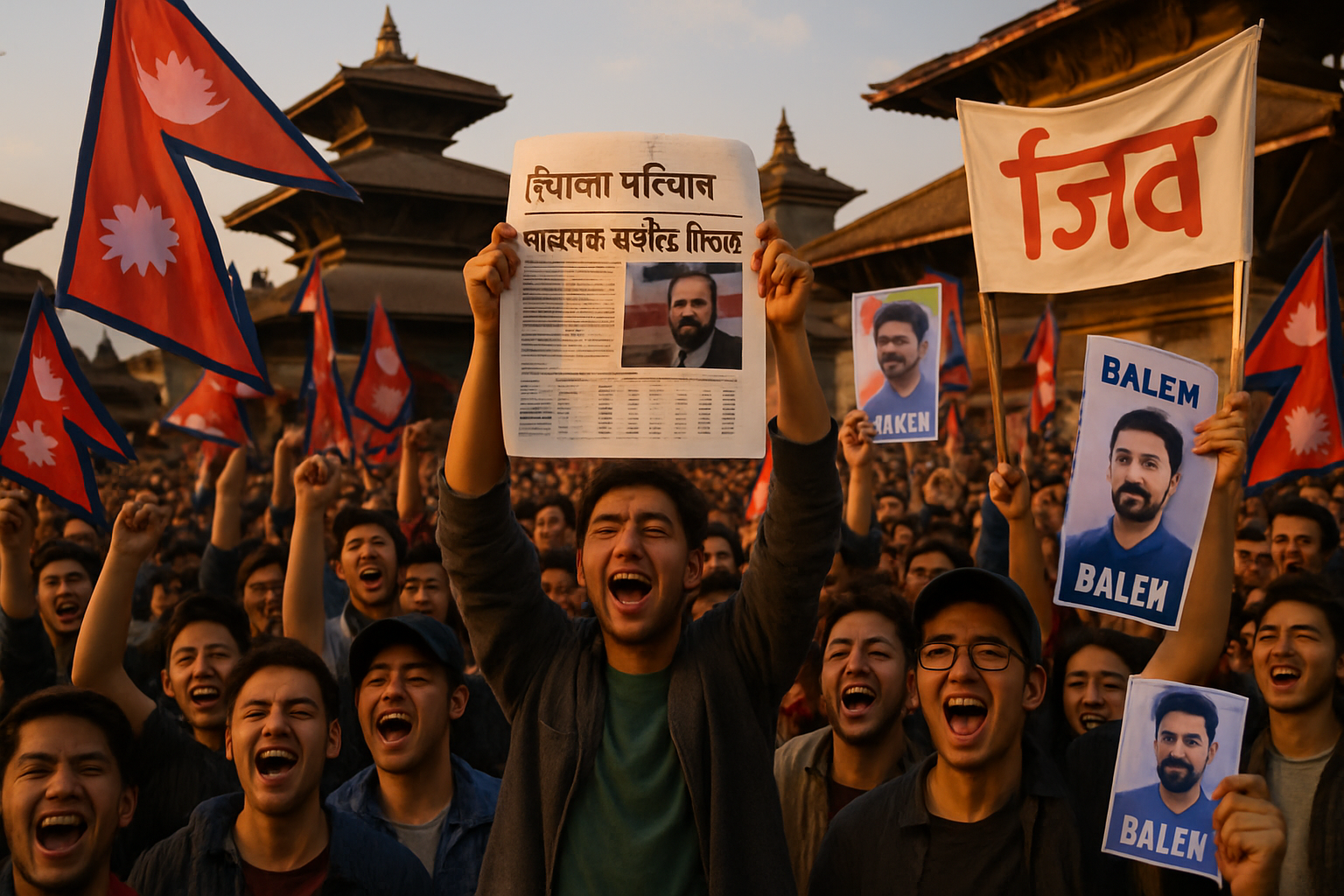
Former rapper turned politician Balendra "Balen" Shah is poised to become Nepal's next prime minister after early results indicate his Rastriya Swatantra Party (RSP) is heading for a landslide victory in the country's parliamentary elections, marking the most significant political transformation in the Himalayan nation since its transition to democracy.
The 35-year-old former hip-hop artist and current Kathmandu mayor has emerged as the frontrunner in Nepal's first parliamentary election since the September 2025 youth-led uprising that toppled the government of K.P. Sharma Oli. Early tallies suggest Shah's party has secured a commanding lead, with the Election Commission confirming he received 68,348 votes in his constituency, decisively defeating former Prime Minister Sharma KP Oli who garnered only 18,734 votes.
Youth Revolution Transforms Political Landscape
The elections represent the culmination of a remarkable democratic transformation that began with Generation Z protests in September 2025. What initially started as demonstrations against social media restrictions evolved into a broader anti-corruption and anti-inequality movement that ultimately forced the resignation of the Oli government after claiming 77 lives and injuring over 2,000 protesters.
Shah, who gained prominence as a leading figure in the 2025 uprising, has successfully channeled the youth movement's energy into electoral politics. His party's platform promises job creation, reduction of forced migration, and comprehensive anti-corruption measures - issues that resonate strongly with Nepal's young demographic.
"This victory belongs to the people of Nepal, especially the young generation who demanded change and accountability from their leaders."
— Balendra Shah, RSP Leader
The Rastriya Swatantra Party's success has been driven primarily by voters aged 18-30, who comprise a significant portion of Nepal's 19 million eligible voters. This "Generation Z" electorate has prioritized transparency, development results, and anti-corruption measures over traditional party loyalty, fundamentally altering Nepal's political dynamics.
Following the Bangladesh Model
Nepal's democratic transition closely mirrors the recent success in Bangladesh, where youth-led protests resulted in the peaceful transfer of power through elections. International observers have noted similarities between the two South Asian nations' experiences, with both countries seeing young, charismatic leaders emerge from protest movements to achieve electoral success.
The elections were conducted under enhanced security measures with thousands of police and military personnel deployed across the country's mountainous terrain. International observers praised the electoral process, with polling stations in remote areas accessible only by helicopter ensuring broad participation across Nepal's diverse geography.
From Hip-Hop to Himalayan Politics
Shah's journey from rapper to potential prime minister represents a unique trajectory in South Asian politics. Known in the music scene as "Balen," he transitioned from performing hip-hop to local governance as Kathmandu's mayor before emerging as a national political figure during the 2025 protests.
His political rise reflects broader generational changes across South Asia, where young leaders are challenging established political dynasties. Shah's background as an artist and his use of social media to connect with voters has distinguished him from traditional politicians in a country where politics has long been dominated by established families and parties.
Economic Promises and Development Agenda
Central to Shah's campaign has been addressing Nepal's chronic unemployment problem and reducing the country's dependence on labor migration. Millions of Nepali workers currently work abroad, sending crucial remittances home but leaving the domestic economy underdeveloped.
The RSP has promised to create domestic employment opportunities, invest in infrastructure development, and implement policies to encourage young Nepalis to build careers within the country rather than seeking opportunities overseas. These commitments have resonated particularly strongly in rural areas where economic opportunities remain limited.
"We will build a Nepal where our youth don't have to leave home to find their future. The talent and energy of our people will drive our nation's development."
— Campaign Promise, RSP Manifesto
Regional and International Implications
The election results carry significant implications for South Asian geopolitics. Nepal's strategic location between India and China makes its political stability crucial for regional security. The emergence of a youth-led government could influence the country's approach to balancing relationships with its two giant neighbors while maintaining Nepal's traditional neutrality.
International observers have closely watched Nepal's democratic transition as a potential template for peaceful political change through youth mobilization. The success of moving from street protests to electoral politics provides encouragement for democratic movements elsewhere in the region and globally.
The election follows the enhanced security and international oversight that characterized the process. Remote mountain polling stations required helicopter access, while thousands of security personnel ensured peaceful voting across the country's 23,000 polling locations.
Challenges Ahead
Despite the electoral triumph, Shah's incoming government will inherit significant challenges. Nepal faces high unemployment rates, infrastructure deficits from natural disasters, and the complex task of managing relationships with both India and China while maintaining the country's sovereignty.
The new administration will also need to address the expectations of the youth demographic that brought it to power. Delivering on promises of job creation, corruption reduction, and good governance will be crucial for maintaining the support that enabled this historic victory.
Additionally, questions remain about how effectively a party born from protest movements can transition to governing. The RSP will need to demonstrate that its grassroots energy can translate into effective policy implementation and institutional management.
A New Chapter for Nepal
As vote counting continues across the country, early indications suggest that Shah's Rastriya Swatantra Party has achieved not just victory but a mandate for transformation. The landslide appears to reflect voters' overwhelming desire for change and their confidence in a new generation of leadership.
The results represent more than a simple change of government - they signal a generational shift in Nepali politics. For the first time, a leader who emerged directly from youth activism rather than traditional political structures is positioned to lead the nation.
This electoral success concludes a remarkable journey from the streets of protest in September 2025 to the corridors of power in March 2026. It demonstrates that in Nepal's young democracy, meaningful change can emerge from grassroots movements and translate into electoral success when channeled through legitimate democratic processes.
As Nepal prepares for this new chapter under youth leadership, the international community watches with interest to see whether this model of democratic transformation can deliver on its promises and provide sustainable governance for the Himalayan nation's 30 million citizens.