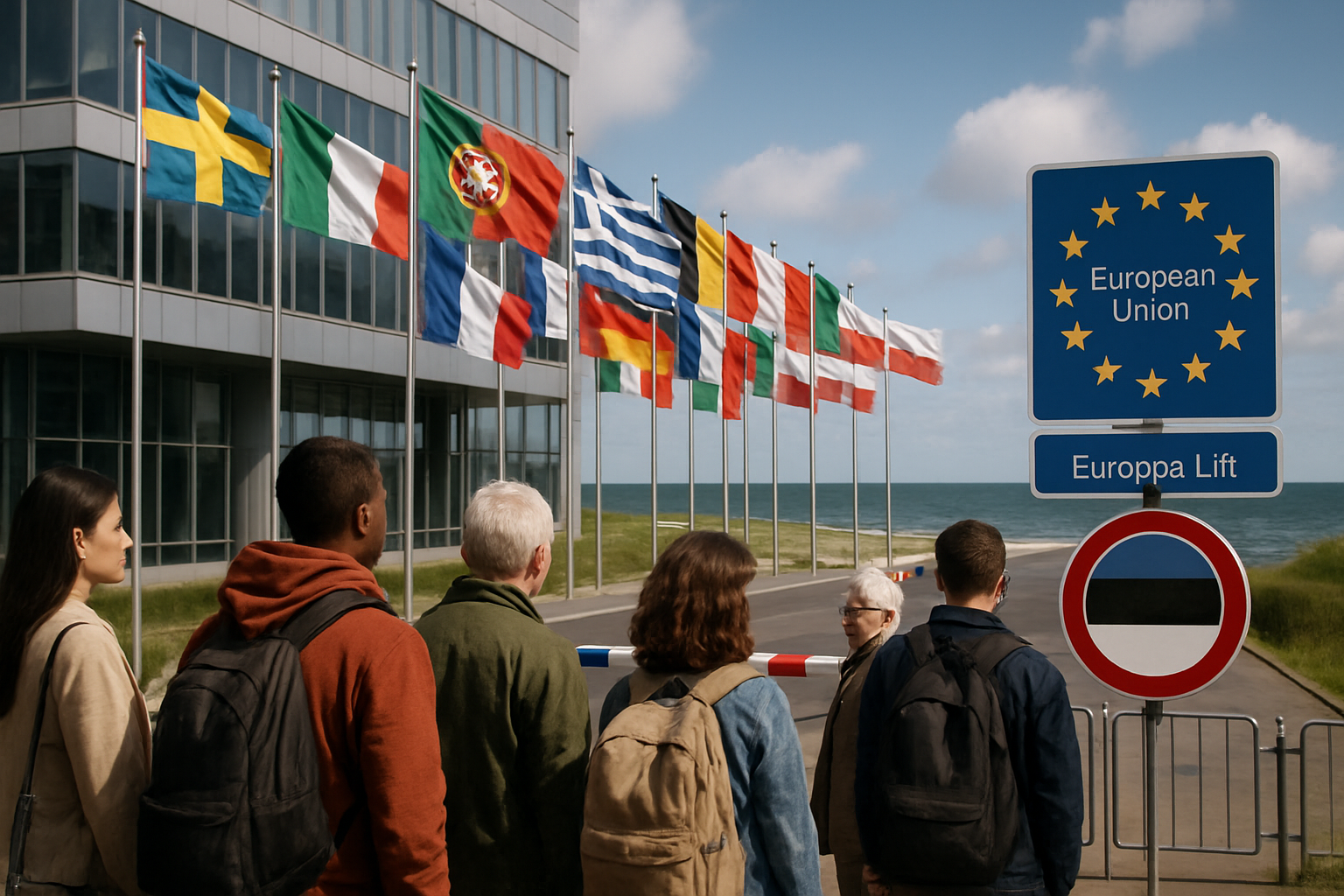
European migration policies face unprecedented scrutiny as Baltic and Nordic states wrestle with competing pressures of national security, humanitarian obligations, and evolving digital governance challenges, while a Lithuanian parliamentary proposal to restrict social media access for minors adds another dimension to the region's policy transformation.
The convergence of immigration control measures and youth digital protection initiatives across Northern Europe reflects broader tensions within the European Union as member states seek to balance sovereignty with collective action. Recent developments in Latvia's migration conference and Lithuania's proposed social media restrictions highlight the complex intersection of demographic challenges, technological governance, and regional security concerns.
Latvia Champions Economic Benefits of Migration
Speaking at a migration conference held at Riga Juridiskā augstskola (Riga Graduate School of Law), Lauma Paegļkalna, Parliamentary Secretary of Latvia's Ministry of Justice, emphasized migration as "an expression of human freedom that is important for economic development." Her remarks come as European Union policies face increasing pressure from nationalist movements across the continent.
Paegļkalna's position reflects Latvia's recognition of demographic realities facing many European nations, where aging populations and labor shortages create economic imperatives for managed immigration. "Migration represents not just individual freedom, but economic necessity for sustainable development," she explained, positioning Latvia as a pragmatic voice in regional policy discussions.
The timing of Latvia's conference coincides with broader European debates about immigration policy effectiveness, particularly following the European Parliament's approval of historic asylum changes in February 2026 that allow member states to deport asylum seekers to "safe" third countries regardless of personal connections to those nations.
Lithuania Proposes Comprehensive Social Media Restrictions
Simultaneously, Lithuanian MP Daiva Ulbinaite of the opposition conservative Homeland Union - Lithuanian Christian Democrats announced plans to propose legislation setting age restrictions for social media platforms, potentially banning users under 16 from accessing these services. The proposal represents one of Europe's most ambitious attempts to regulate minors' digital access.
Ulbinaite's initiative draws inspiration from similar legislative efforts in Australia and reflects growing concern across Northern Europe about social media's impact on youth mental health and development. "We cannot ignore the evidence showing harmful effects of unrestricted social media access on developing minds," she stated, though specific details of the proposed legislation remain under development.
"This represents a fundamental question about how we protect our children while preserving digital freedoms."
— Daiva Ulbinaite, Lithuanian MP, Homeland Union - Lithuanian Christian Democrats
The proposal faces significant implementation challenges, including technical verification methods, platform compliance mechanisms, and potential conflicts with European Union digital rights frameworks. Industry experts question whether age verification systems can be implemented without compromising privacy rights or creating additional vulnerabilities.
Regional Security and Border Management Pressures
Baltic states continue facing unique pressures from their geographic position along the European Union's eastern frontier. Estonia's recent decision to temporarily close two border crossing points with Russia following "border incidents" demonstrates the ongoing security calculations affecting regional policy.
These security concerns intersect with broader migration management challenges as European leaders grapple with 1,600+ systematic ceasefire violations in global conflict zones that drive refugee movements. The Baltic region's experience managing both traditional migration flows and security-driven displacement creates complex policy environments requiring sophisticated responses.
Estonia's approach particularly reflects the intersection of digital innovation and border management, given the country's achievement of 88% renewable electricity and operation of continental Europe's largest battery storage facility, positioning it as a technological leader while maintaining strict security protocols.
European Unity Versus National Sovereignty
The Baltic and Nordic policy debates occur within a broader European context where 89% of Europeans demand greater EU unity while simultaneously witnessing member states assert national sovereignty on sensitive issues. This paradox particularly affects migration policy, where collective European approaches compete with national security imperatives.
Recent European Parliament approvals of "enhanced cooperation" mechanisms allowing smaller groups of member states to advance policies without unanimity reflect institutional adaptation to these tensions. The Baltic experience may provide templates for how smaller European nations navigate between collective action and national priorities.
Latvia's emphasis on migration's economic benefits contrasts sharply with more restrictive approaches elsewhere in Europe, while Lithuania's social media restrictions reflect concerns about protecting national youth culture and development. These divergent approaches within the same region illustrate the complexity of European policy coordination.
Implementation Challenges and Technical Complexities
Both migration management and digital governance face significant implementation obstacles. Lithuania's social media age verification proposal requires technological solutions that currently don't exist at scale, while maintaining privacy protections and avoiding discriminatory impacts on legitimate users.
Similarly, Latvia's pro-migration stance requires sophisticated integration services, language training, and economic coordination that demand substantial public investment and administrative capacity. The success of such policies depends heavily on implementation quality rather than legislative frameworks alone.
Digital governance particularly presents challenges given the global nature of social media platforms and the difficulty of enforcing national regulations on international services. Lithuania's proposal joins similar efforts in France, where authorities have conducted enforcement actions against major tech platforms, and Spain's implementation of criminal executive liability for digital services.
Broader European Policy Evolution
The Baltic and Nordic policy developments reflect broader European institutional evolution, where traditional consensus-building mechanisms face pressure from accelerating global changes. Climate urgency, technological transformation, and geopolitical instability create compressed timelines for policy response that challenge democratic deliberation processes.
European energy transition success stories, particularly Estonia's renewable achievements and regional cooperation models, provide templates for how effective policy coordination might address other challenges. The integration of technological innovation with policy implementation offers pathways for addressing seemingly intractable problems.
Regional cooperation between Baltic and Nordic states increasingly serves as a laboratory for European policy innovation, with successful approaches potentially scaling to continent-wide implementation through enhanced cooperation mechanisms.
International Context and Global Implications
Northern European policy innovations occur within a global context of democratic competition with authoritarian systems, technological sovereignty challenges, and climate adaptation requirements. The region's experience balancing individual freedoms with collective security provides lessons for democratic governance worldwide.
The convergence of migration policy, digital governance, and regional security reflects 21st-century governance challenges that extend beyond traditional policy silos. Success requires integrated approaches that address multiple challenges simultaneously while preserving democratic values and individual rights.
International cooperation through frameworks like the US-EU-Japan partnerships and enhanced European coordination mechanisms provides platforms for sharing successful approaches and coordinating responses to transnational challenges that no single nation can address independently.
As Baltic and Nordic states continue navigating these complex policy intersections, their experiences will likely influence broader European approaches to migration, digital governance, and regional cooperation. The ultimate success of these initiatives may determine whether democratic societies can effectively adapt to accelerating global changes while preserving core values and institutions.