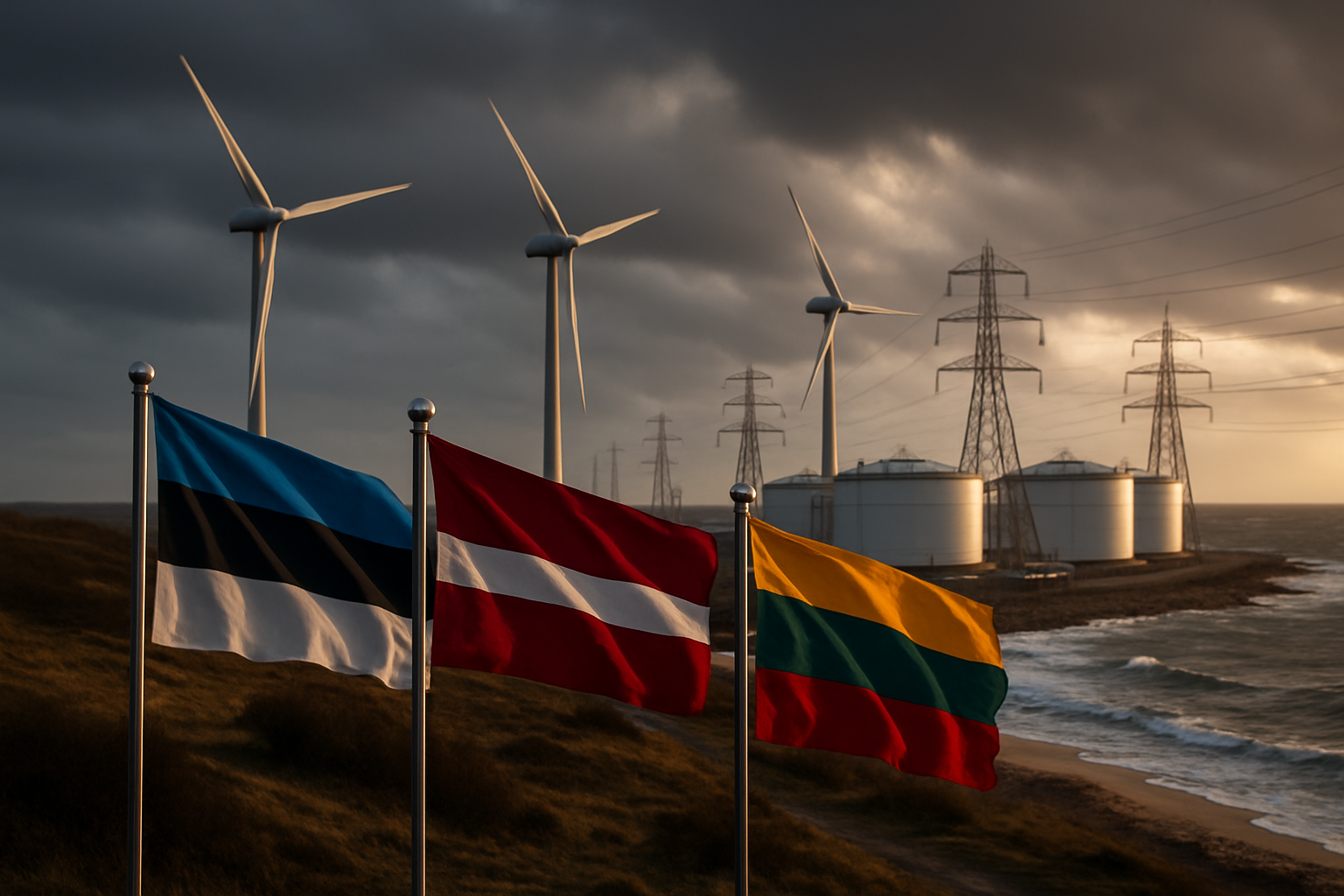
The Baltic States of Estonia, Latvia, and Lithuania are confronting their most significant energy security challenge in decades as fuel prices surge across the region while their governments maintain unwavering support for international sanctions against Russian oil imports.
According to recent price comparisons across Baltic capitals, fuel costs have increased substantially over the past week in Tallinn, Riga, and Vilnius, mirroring a global energy crisis that has pushed oil prices above $100 per barrel for the first time since 2022. The crisis stems from Iran's closure of the Strait of Hormuz, which handles 40% of global seaborne oil transit, triggering the most severe energy disruption since the 1970s oil shocks.
Government Responses to Rising Costs
Lithuanian Finance Minister Kristupas Vaitiekunas has taken a cautious approach to the mounting fuel cost pressures, stating on Friday that it was "too early to discuss specific measures to mitigate rising fuel prices," including potential price caps or subsidies. This measured response reflects the complex balancing act Baltic governments face between protecting consumers and maintaining market stability during the global energy crisis.
The reluctance to implement immediate price controls contrasts sharply with responses elsewhere in Europe, where countries like Hungary have introduced immediate gasoline and diesel price caps to protect consumers from "war-driven price explosions," while France has deployed 500 fuel station inspectors to prevent price manipulation.
Regional Energy Independence Strategy
Estonia has emerged as a leader in regional energy security through its remarkable renewable energy transformation. The country achieved 88% renewable electricity generation in 2024 and operates continental Europe's largest battery storage facility, capable of serving 90,000 households. This infrastructure investment has provided Estonia with greater resilience against global energy market volatility compared to its neighbors.
The Estonian model represents a template for energy independence that other Baltic states are studying carefully. Latvia has intensified its focus on waste sorting for resource sustainability, while Lithuania continues to develop its renewable energy capacity as part of broader European Union climate goals.
Sanctions and Strategic Positioning
Despite the economic pressure from rising fuel costs, all three Baltic states have maintained their strong stance against Russian oil sanctions relief. This position puts them at odds with some EU member states, particularly Hungary, which has praised recent U.S. decisions to temporarily lift some Russian oil sanctions.
The Baltic commitment to maintaining sanctions reflects their unique geopolitical position and historical experience with Russian influence. Estonian intelligence assessments suggest that while Russia currently lacks plans to attack NATO member states in 2026, the Baltic Sea region faces increased security challenges including submarine incursions, GPS jamming, and underwater cable sabotage.
Global Context and Market Pressures
The current energy crisis has created unprecedented challenges for Baltic energy security. Natural gas prices have surged 24% in Europe and 78% in the United States, while Qatar has halted LNG production at key facilities due to Iranian attacks. The International Energy Agency has announced its largest strategic petroleum reserve release in 50-year history—400 million barrels from 32 countries—to stabilize global markets.
Sweden, which shares strong regional cooperation with the Baltic states, predicts electricity price increases of 10-20 öre and gasoline price rises of 1-2 kronor, with the Malmö region being most exposed due to its continental European market integration. These price pressures demonstrate how the global crisis affects the entire Nordic-Baltic region despite their relatively advanced renewable energy infrastructure.
Aviation and Transportation Impact
The energy crisis has created parallel disruptions in aviation and shipping that directly affect Baltic connectivity. Over 18,000 flights have been cancelled worldwide—the most extensive disruption since COVID-19—as eight countries have simultaneously closed their airspace due to Middle East conflicts. Dubai International Airport, the world's busiest, remains shut down due to missile damage.
Major shipping companies including Maersk and MSC have suspended operations in the Persian Gulf, with over 150 oil and LNG tankers stranded worth billions in cargo value. These supply chain disruptions affect not only energy supplies but also consumer goods and industrial materials that transit through affected regions.
Financial Market Implications
The energy crisis has triggered significant financial market volatility globally, with implications for Baltic economies. Pakistan's stock exchange suffered its largest single-day decline in history, while South Korea's market fell 12% requiring circuit breakers. The PayPal IPO was postponed indefinitely due to market conditions, demonstrating how energy security concerns ripple through global financial systems.
Central banks including the European Central Bank and Bank of Japan are coordinating emergency liquidity measures, though traditional monetary policy has limited effectiveness against structural geopolitical disruptions affecting physical energy infrastructure.
Strategic Cooperation and Defense
The current crisis has reinforced the importance of Baltic strategic cooperation initiatives developed over recent months. The three national libraries have agreed to strengthen cooperation specifically to address geopolitical challenges and protect cultural heritage—an unprecedented role for cultural institutions in democratic resilience and regional security.
Enhanced security cooperation includes expanded intelligence sharing, satellite surveillance, and maritime patrols through NATO's Arctic Sentry mission. Lithuania's intelligence services have warned that Moscow could be ready for "limited military conflict" within 3-5 years if a Ukraine ceasefire is achieved, highlighting the ongoing security challenges facing the region.
Nuclear Governance Context
The current energy crisis occurs against a backdrop of deteriorating global nuclear governance. The New START treaty expired on February 5, 2026, marking the first time in over 50 years without US-Russia nuclear constraints. This creates additional uncertainty for Baltic states, which rely on collective security arrangements and international stability for their long-term energy security planning.
Iran continues uranium enrichment at 60% purity with over 400kg of weapons-grade material, approaching multiple weapons capability. UN Secretary-General António Guterres has warned that nuclear risks are at their "highest in decades," creating a template-setting moment for 21st-century diplomacy versus military confrontation.
Long-term Energy Architecture
The current crisis highlights the need for fundamental energy architecture transformation across the Baltic region. While Estonia's renewable energy leadership provides a model, the transition to full energy independence requires years or decades of sustained investment and political commitment.
The crisis has exposed dangerous over-dependence on strategic chokepoints in volatile geopolitical regions. The 21-mile Strait of Hormuz represents a single-point failure for modern logistics, demonstrating why supply diversification and renewable transitions have become urgent security imperatives rather than merely environmental goals.
Regional Resilience Model
Despite current challenges, the Baltic states have demonstrated remarkable resilience through their coordinated approach to energy security. Technology integration initiatives, such as Estonia's hosting of the Tallinn Cyber Diplomacy Winter School with 33 countries participating, showcase how small nations can leverage digital leadership for broader security benefits.
Economic cooperation through initiatives like the Latitude59 tech competition has facilitated €675,000 in investments for regional companies, including Estonian MarkeDroid, Latvia's Adventum Tech, and Lithuanian Luna Robotics. These investments create lasting infrastructure while building international recognition and partnership networks.
Future Outlook
Recovery from the current energy crisis remains uncertain, as it depends on military and diplomatic developments rather than predictable weather patterns or technical disruptions. The aviation industry cannot provide long-term scheduling while multiple airspaces remain closed, and energy markets remain volatile with critical transit routes blocked.
The Baltic states face the greatest test of multilateral cooperation in the modern era, determining not only energy market evolution but also conflict resolution approaches and supply chain resilience with implications extending decades beyond current events. Success in maintaining both energy security and principled foreign policy positions could provide a template for other small nations facing similar challenges.
As expert Samuel Ciszuk noted, this represents "the most severe energy security crisis in decades, exposing single-chokepoint vulnerabilities." For the Baltic states, the crisis reinforces the strategic value of their investments in renewable energy, regional cooperation, and steadfast commitment to international law—positioning them as models of resilience in an increasingly volatile global energy landscape.