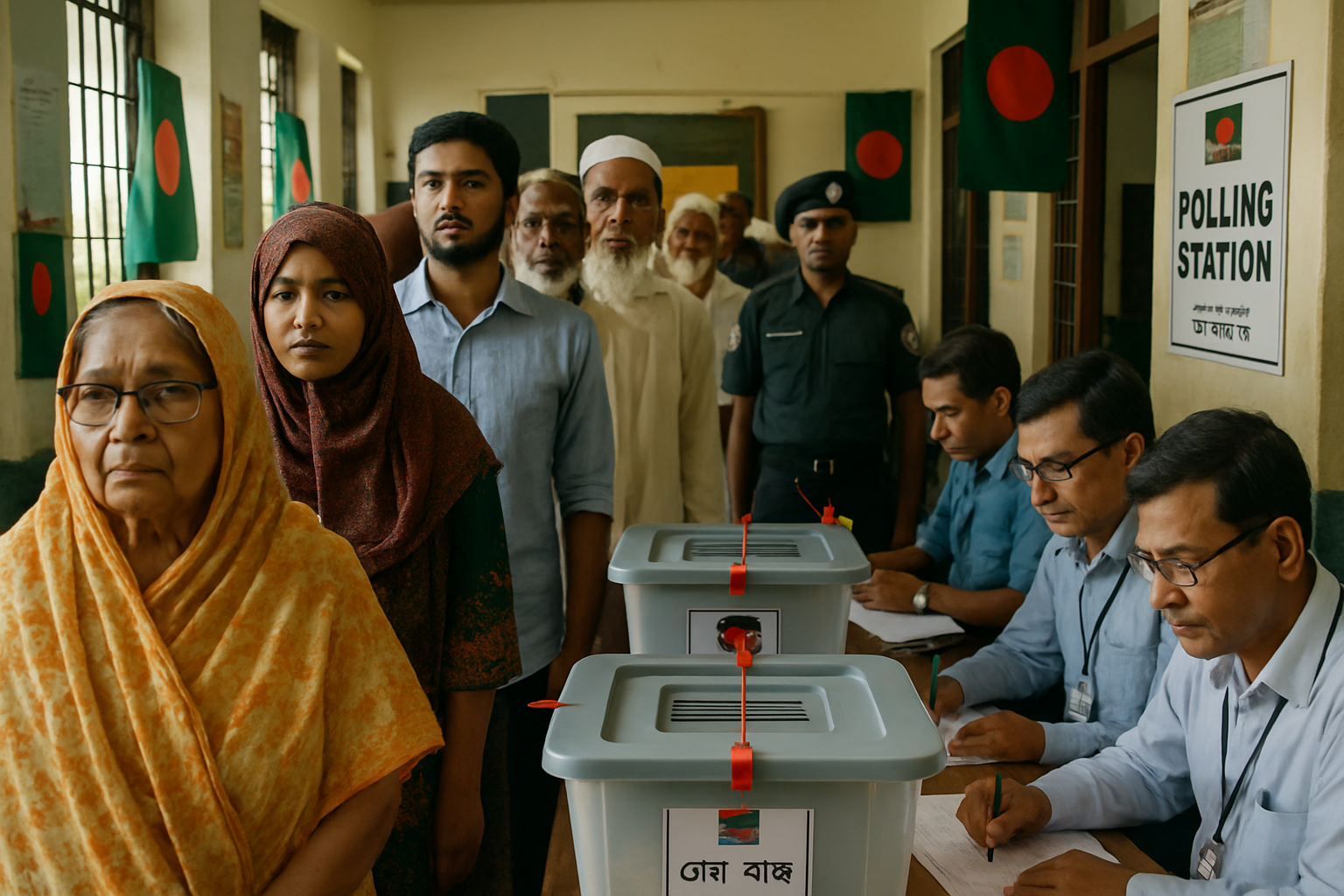
Bangladesh began voting in its 13th National Parliament election on February 12, 2026, marking the first democratic contest since the student-led uprising that ended Sheikh Hasina's 15-year rule in August 2024, as millions of citizens across 299 constituencies cast ballots amid unprecedented security measures.
The elections, which started at 7:30 AM local time and will continue until 4:30 PM, represent a critical test of Bangladesh's democratic consolidation after the mass protests that transformed the nation's political landscape. The contest pits the Bangladesh Nationalist Party (BNP) under Tarique Rahman against a coalition led by Jamaat-e-Islami, with the formerly ruling Awami League banned from participation.
European Union Chief Observer praised the elections as "a big day for Bangladesh democracy," expressing hopes for "participatory, credible and trusted" elections in this "historical moment." Over 394 international observers from 27 EU member states plus Canada, Norway, and Switzerland are monitoring the democratic process—double the number from previous controversial elections.
Massive Security Deployment
Bangladesh has deployed approximately 900,000 security personnel including police, Border Guard Bangladesh (BGB), Ansar, VDP, Coast Guard, and armed forces in what officials describe as the largest peacetime security operation in the nation's history. The comprehensive three-tier security system covers polling centers, mobile teams, and striking forces.
The Election Commission identified 8,770 vulnerable centers requiring special surveillance, with 24,000 polling stations equipped with CCTV cameras and body cameras for enhanced monitoring. Mobile phone restrictions have been implemented, with only five authorized categories permitted access during voting hours.
"We are all looking forward to have a 'participatory, credible and trusted' elections in Bangladesh in this historical moment"
— EU Chief Observer
Political Transformation Since Uprising
The elections represent the culmination of Bangladesh's most significant political transformation since independence. The student-led uprising in July-August 2024 ended Sheikh Hasina's increasingly authoritarian rule, forcing her into exile and banning the Awami League from participating in the electoral process.
The BNP, led by Tarique Rahman (son of former PM Khaleda Zia), enters as the frontrunner seeking a two-thirds majority to implement comprehensive reforms. The party has promised "national reconstruction" including airport development and economic reforms through a Family Cards system.
Opposing them is a coalition led by Jamaat-e-Islami under Shafiqur Rahman, allied with the student-led National Citizen Party that emerged from the uprising. This alliance represents the strongest showing for Islamist forces since Bangladesh's independence in 1971.
Historic First-Time Overseas Voting
In a groundbreaking development, Bangladesh is conducting its first-ever overseas voting through the ICPV (International Cyber Platform for Voting) system. Over 400,000 expatriate ballots have been processed, with particular significance for the British Bangladeshi community.
The Election Commission confirmed that 883,000 postal ballots reached returning officers, including 444,436 overseas expatriate ballots and 438,951 domestic ballots. This historic expansion of voting rights enables the global Bangladeshi diaspora to participate in determining their homeland's political future.
Youth Demographics and Generational Change
A decisive factor in these elections is the youth demographic—55 million voters aged 18-37 represent 44% of the electorate, many participating in democratic processes for the first time. These young voters, dubbed the "uprising generation," were instrumental in the mass mobilization that brought down the Hasina government.
The National Citizen Party, emerging from the student movement, has capitalized on this youth momentum under leaders like Nahid Islam, who cast his vote early and addressed media about the democratic transition. The generational political shift reflects broader demands for accountability, transparency, and effective governance.
International Stakes and Regional Implications
The election results carry significant implications beyond Bangladesh's borders. India is watching closely, hoping the frontrunner BNP can reset bilateral ties despite historical friction. With China's growing influence in the region and Bangladesh's strategic location, the outcome will affect South Asian cooperation frameworks.
Under interim government leader Professor Muhammad Yunus, Bangladesh achieved a breakthrough in US trade relations, securing a 19% tariff rate with zero tariffs for textiles and apparel using US materials. The new government will inherit these diplomatic opportunities while navigating complex regional relationships.
"This is a historic moment for the entire democratic transformation of Bangladesh"
— Professor Muhammad Yunus, Interim Government Chief Adviser
Challenges and Early Reports
Despite the massive security deployment, some incidents have been reported. Political leaders including Jamaat Ameer, Nahid Islam, and BNP's Mirza Fakhrul have cast their votes peacefully, with election officials emphasizing the smooth conduct of voting procedures.
The Election Commission has warned that votes cast for disqualified candidates will be counted as spoiled ballots, and authorities have made arrests related to attempted vote-buying and electoral violations in various constituencies.
Democratic Test and Future Trajectory
Chief Adviser Muhammad Yunus described the elections as "very crucial," emphasizing the challenge of "perfect voting execution." Success could establish Bangladesh as a regional democratic model following unprecedented popular uprising transformation, while failure might impact institutional credibility.
The elections use a dual ballot system—white ballots for parliamentary representatives and pink ballots for the "July National Charter" referendum, allowing voters to directly influence the constitutional framework established during the interim period.
With voting continuing until 4:30 PM across nearly 300 constituencies, results are expected to emerge by February 13. The outcome will determine not only Bangladesh's immediate political leadership but also its approach to democratic consolidation, economic development, and regional cooperation in South Asia.
As one of the world's largest democracies by population, Bangladesh's successful democratic transition would provide encouragement for similar movements globally, while establishing new precedents for peaceful political transformation through mass mobilization and institutional reform.