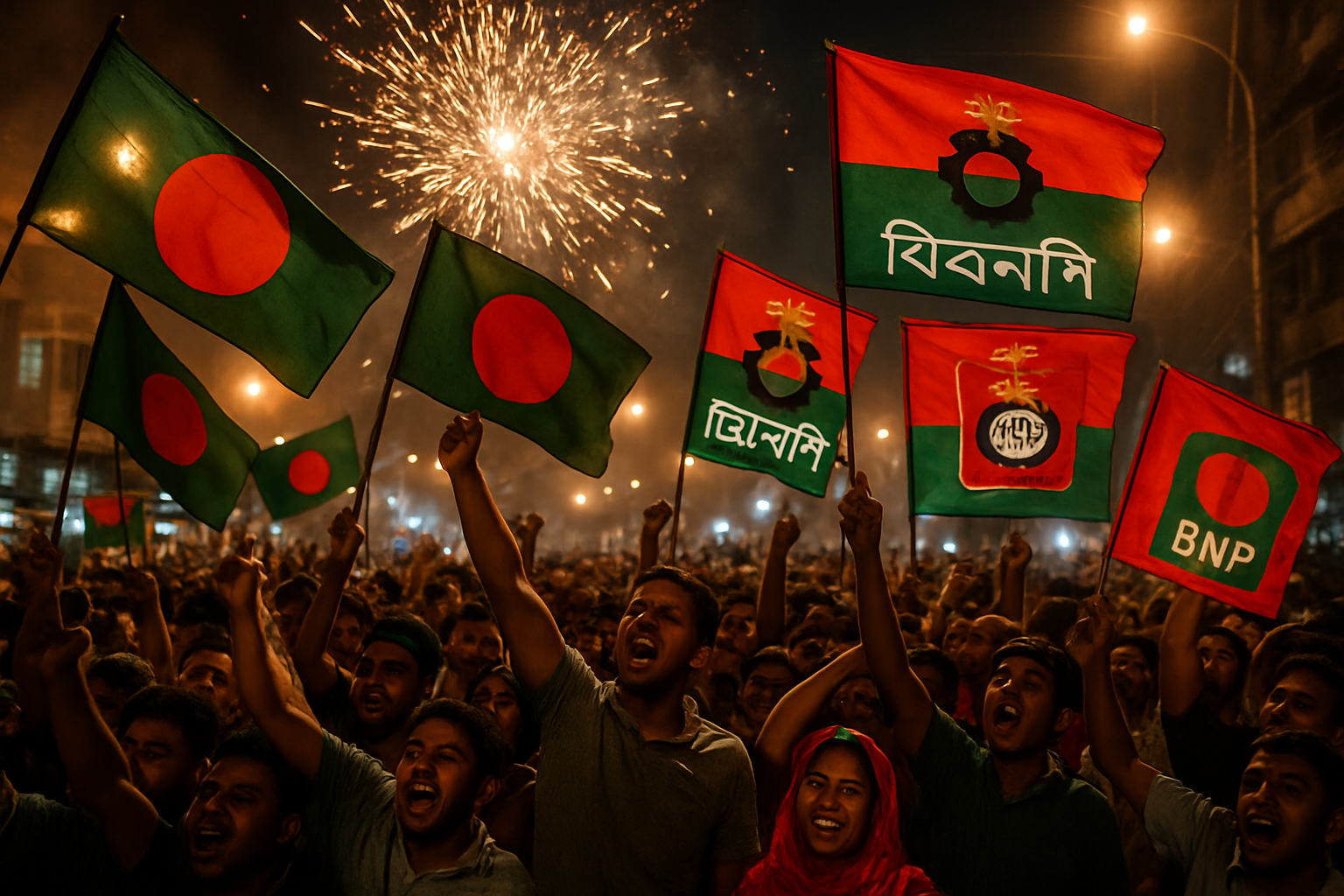
Bangladesh's political landscape underwent a seismic transformation as the Bangladesh Nationalist Party (BNP) achieved a decisive landslide victory in the country's 13th parliamentary election, securing approximately 212 of 299 seats and positioning Tarique Rahman to become Prime Minister after his dramatic return from 17 years of exile in London.
The historic election, held on February 12, 2026, marked the first truly democratic contest since the August 2024 student-led uprising that ended Sheikh Hasina's authoritarian 15-year rule. With the Awami League banned from participation following the violent suppression of the uprising, Bangladesh witnessed a fundamental political realignment that has reshaped the nation's democratic trajectory.
Decisive Electoral Victory
The BNP's triumph was comprehensive and overwhelming. Chief Adviser Professor Muhammad Yunus, who led the interim government through the democratic transition, extended his congratulations to Rahman, stating: "I extend my heartfelt congratulations and best wishes to you as BNP, under your leadership, has secured a massive majority in the 13th national parliamentary election."
Key victories included BNP Secretary General Mirza Fakhrul Islam Alamgir's stunning win in Thakurgaon-3, where he secured 236,308 votes—more than doubling his nearest rival. Rahman himself was elected from both Bogra-6 and Dhaka-17 constituencies, demonstrating the party's broad appeal across urban and rural Bangladesh.
The party's dominance extended nationwide, with the BNP sweeping all six seats in the Barisal division and achieving strong performances across the country's diverse electoral landscape.
The Opposition Response
Bangladesh's largest Islamist party, Jamaat-e-Islami, initially raised concerns about vote counting irregularities but ultimately conceded defeat on Saturday, clearing the path for Rahman's government formation. The party's coalition secured approximately 77 seats, representing their strongest showing since 1971 independence.
The student-led National Citizen Party, which emerged directly from the 2024 uprising movement, won symbolic victories including Nahid Islam's triumph in Dhaka-11. While their seat count remained modest, their participation marked the successful institutionalization of youth-led political activism through democratic processes.
"This clear mandate from the people, in the historical process of democratic transition, will serve as a crucial milestone for the nation's constitutional and democratic continuity and institutional stability."
— Professor Muhammad Yunus, Chief Adviser
International Legitimacy and Historic Firsts
The election's credibility was bolstered by unprecedented international oversight. A total of 394 international observers from 27 countries monitored the process—the largest monitoring mission in Bangladesh's recent history. The European Union deployed over 200 observers, while Japan's Election Observer Mission, led by Watanabe Masato, provided crucial international validation.
In a groundbreaking development, Bangladesh successfully implemented overseas voting for the first time, processing 883,000 postal ballots including 444,436 expatriate votes through the innovative ICPV system. This expansion of democratic participation was particularly significant for the British Bangladeshi community and established Bangladesh as a regional leader in diaspora political engagement.
Despite the deployment of 900,000 security personnel in the largest peacetime operation in Bangladesh's history, the election proceeded largely peacefully across 42,651 polling centers, demonstrating the maturity of the country's democratic institutions.
The Youth Revolution Institutionalized
Perhaps most significantly, the election represented the successful institutionalization of the "uprising generation." With 55 million voters aged 18-37 comprising 44% of the electorate, young Bangladeshis decisively drove the democratic renewal. Their demands for accountability, transparency, and effective governance fundamentally altered the political landscape, moving beyond traditional party loyalties toward performance-based politics.
The 48% turnout across the nation exceeded many expectations and reflected renewed public faith in democratic processes after years of authoritarian rule. Many young voters participated in their first truly competitive election, marking a generational shift in political engagement.
Tarique Rahman's Remarkable Comeback
Rahman's journey from exile to the Prime Minister's office represents one of the most dramatic political comebacks in modern South Asian history. The son of former Prime Minister Khaleda Zia spent 17 years in London before returning to Bangladesh in December 2025, just months before the election.
His return was facilitated by the political transformation following the student uprising that toppled the Hasina government. Rahman's campaign focused on "national reconstruction," promising infrastructure development including new airports and economic reforms such as the Family Cards system.
The 60-year-old leader's victory speech emphasized unity and democratic values: "I firmly believe that your wisdom, democratic values, and public welfare-oriented spirit will guide the nation towards a stable, inclusive, and development-oriented path in fulfilling the great responsibility of state governance."
Challenges Ahead
The new BNP government inherits significant challenges alongside its historic mandate. The implementation of the July Charter—designed to institutionalize the principles of the 2024 uprising—remains a critical test of democratic consolidation. Questions surrounding transitional justice and accountability for the mass killings during the uprising will require careful navigation.
Economically, the government must sustain the diplomatic breakthroughs achieved by the interim administration, including improved US-Bangladesh trade relations that resulted in a 19% tariff rate and zero tariffs for textiles using US materials. Managing relationships with regional powers—particularly given historical tensions with India and the complexity of China's Belt and Road investments—will test Rahman's diplomatic skills.
Global Template for Democratic Transformation
Bangladesh's successful transition from student-led uprising to competitive elections provides a template for peaceful political transformation through youth-led movements. As the world's first election following a successful Gen Z uprising, the Bangladesh model is being closely watched by international observers and neighboring countries facing similar democratic pressures.
The success demonstrates how mass mobilization can achieve sustainable political change through electoral democracy rather than revolutionary upheaval. With Nepal facing similar circumstances in upcoming elections, the Bangladesh precedent may influence broader patterns of democratic renewal across South Asia.
Regional and International Implications
The BNP victory has already prompted international recognition, with Malaysia's Prime Minister Anwar Ibrahim praising the "triumph of democracy" and US officials expressing readiness to work with the new government. The election's success reinforces Bangladesh's potential role as a democratic leader in South Asia.
For the region, the peaceful transfer of power after a mass uprising represents a significant achievement in democratic governance. The successful integration of youth movements into institutional politics may inspire similar democratic transformations across the developing world.
The election also positions Bangladesh as a case study in managing the intersection of technology and democracy, having successfully countered disinformation campaigns while expanding voting access through innovative overseas participation systems.
A New Chapter Begins
As Tarique Rahman prepares to assume office, Bangladesh stands at a crucial juncture. The two-thirds majority provides the BNP with unprecedented power to implement constitutional and institutional reforms, but also places enormous responsibility for delivering on the promises of democratic renewal.
The success of this democratic transformation will be measured not just in electoral victories, but in the government's ability to address citizen demands for accountability, economic development, and institutional strength. With the world watching, Bangladesh has an opportunity to demonstrate that democratic institutions can evolve and strengthen through peaceful popular movements.
The February 2026 election will likely be remembered as a watershed moment—not just for Bangladesh, but as proof that youth-led movements can achieve lasting democratic change through electoral processes rather than revolutionary upheaval. As the country embarks on this new chapter, the expectations are high, but so too is the potential for Bangladesh to emerge as a beacon of democratic renewal in an increasingly complex global landscape.