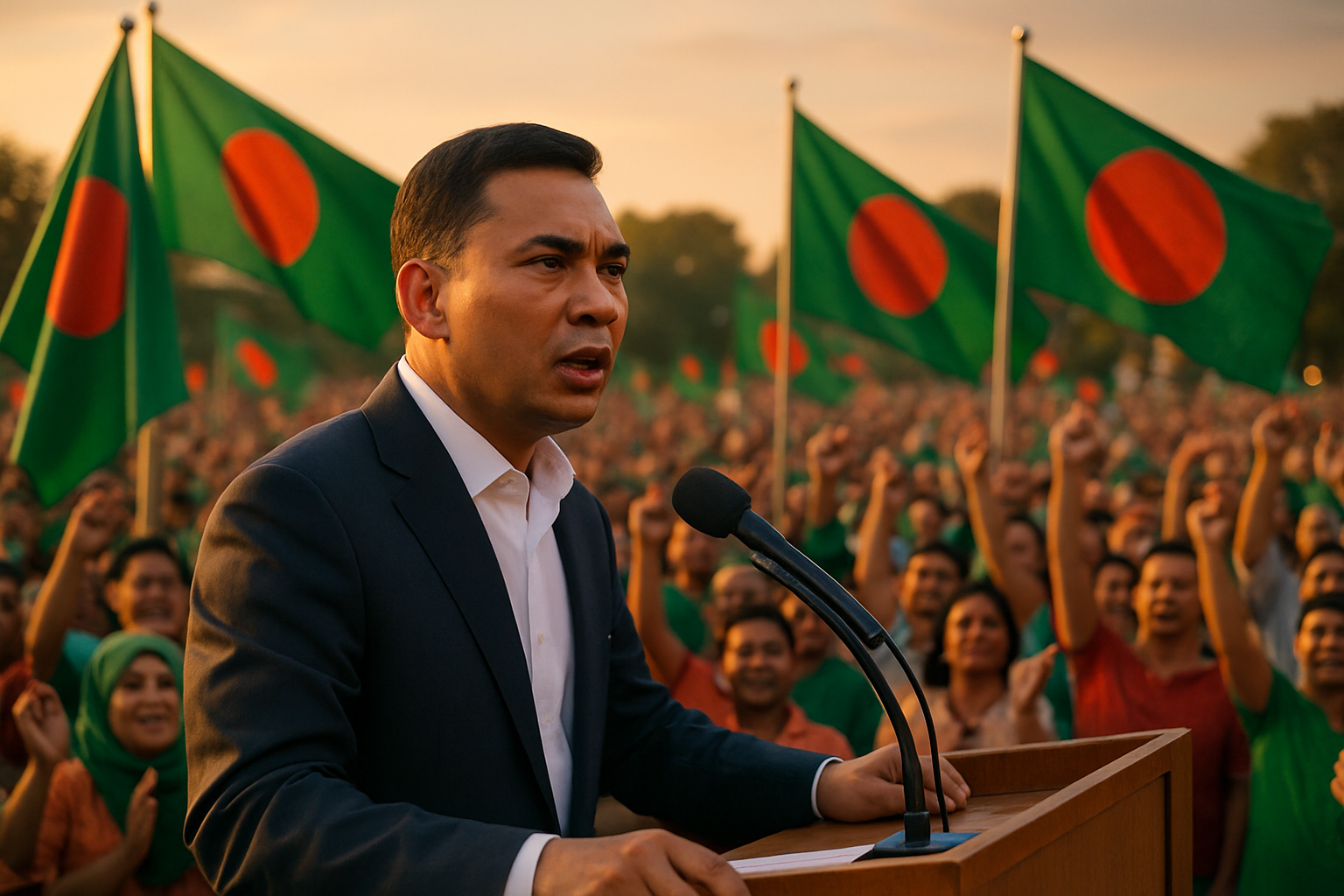
The Bangladesh Nationalist Party (BNP) has achieved a historic landslide victory in the 13th National Parliament election, securing close to a two-thirds majority that positions party Chairman Tarique Rahman to become Prime Minister, ending Sheikh Hasina's 15-year rule and completing Bangladesh's remarkable democratic transformation.
According to unofficial results announced by returning officers across the country, the BNP won 207 seats out of 296 constituencies reported by late Wednesday night. The victory represents the most significant electoral triumph since Bangladesh's democratic transition began with the August 2024 student uprising that toppled the Awami League government.
Historic Democratic Renewal
The February 12 election marks Bangladesh's first truly democratic contest since 2008, conducted under unprecedented international oversight with 394 observers from 27 countries providing crucial legitimacy. The Election Commission confirmed the process as "unwavering commitment to peaceful, credible and participatory election," with voting proceeding smoothly across 42,651 polling centers despite initial security concerns.
Chief Election Commissioner AMM Nasir Uddin emphasized the historic nature of the democratic transition, noting this represented the world's first election following a successful Generation Z uprising. The 48% voter turnout exceeded expectations, demonstrating renewed public faith in democratic processes after years of authoritarian rule.
"This election represents more than a routine power transfer - it's the successful institutionalization of a youth-led democratic revolution through peaceful electoral processes."
— Dr. Sohela Nazneed, Political Analyst
BNP's Commanding Victory
The scale of BNP's triumph extends far beyond simple majority requirements, with the party achieving what spokesman Mahdi Amin described as "confident of forming next government with more than two-thirds majority." Key victories included BNP Secretary General Mirza Fakhrul Islam Alamgir's landslide win in Thakurgaon-3 with 236,308 votes, decisively defeating his Jamaat opponent.
Tarique Rahman, who returned from 17-year London exile in December 2025, was unofficially declared elected from both Bogra-6 and Dhaka-17 constituencies, providing symbolic validation of his political resurrection. The party's comprehensive success extended across all regions, with BNP sweeping all six seats in Barisal division and maintaining strong performances in traditional strongholds.
International recognition came swiftly, with the United States congratulating Bangladesh on the democratic achievement. According to sources, U.S. officials praised the peaceful conduct and the BNP's decisive mandate as evidence of Bangladesh's democratic maturity.
Opposition Performance and Electoral Dynamics
The 11-party alliance led by Bangladesh Jamaat-e-Islami secured 77 seats according to preliminary results, with the student-led National Citizen Party winning 6 of those seats. Despite pre-election predictions of a stronger Islamist showing, the results demonstrate voters' preference for BNP's broad-based appeal over ideologically driven alternatives.
Notably, National Citizen Party convener Nahid Islam won the Dhaka-11 constituency with 93,872 votes, defeating BNP candidate MA Quayum by more than 2,000 votes. This represents one of the few constituencies where the student-led movement successfully translated grassroots activism into electoral success.
The election saw some procedural challenges, with the Election Commission postponing results in three constituencies - Sherpur-2, Chittagong-2, and Chittagong-4 - due to legal issues involving winning candidates. Additionally, concerns were raised by the National Citizen Party about vote count discrepancies in several constituencies, though these did not affect the overall outcome.
International Oversight and Legitimacy
The election's credibility was enhanced by the largest international observation mission in Bangladesh's recent history. The European Union deployed over 200 observers across all divisions, while Japan's Election Observer Mission, led by former ambassador Watanabe Masato, provided additional oversight from February 6-14.
A groundbreaking achievement was the successful implementation of overseas voting for the first time in Bangladesh's history. Over 883,000 postal ballots were processed, including 444,436 from expatriate Bangladeshis through the new ICPV system. This historic expansion of democratic participation was particularly significant for the British Bangladeshi community, despite some registration challenges.
The massive security deployment of nearly 900,000 personnel - the largest peacetime operation in Bangladesh's history - ensured peaceful conduct despite isolated incidents. The comprehensive three-tier security system, supported by extensive CCTV surveillance and international monitoring, demonstrated the state's commitment to democratic processes.
Youth Demographics and Generational Change
Perhaps most significantly, the election represented a decisive generational shift in Bangladesh politics. With 55 million voters aged 18-37 comprising 44% of the electorate, the "uprising generation" drove democratic renewal with unprecedented political engagement.
The National Citizen Party's emergence directly from the 2024 student protests showcased how grassroots movements can successfully transition into institutional politics, even if their electoral impact remained limited compared to established parties. This generation's emphasis on accountability, transparency, and governance effectiveness fundamentally altered campaign dynamics and voter expectations.
"People are excited that democracy is returning after 17 years of authoritarianism. This represents historic renewal beyond simple power transfer."
— Chief Adviser Professor Muhammad Yunus
Economic and Diplomatic Context
The election occurred amid significant economic diplomacy success by the interim government led by Nobel laureate Muhammad Yunus. The achievement of a breakthrough U.S.-Bangladesh trade agreement - featuring a 19% tariff rate and zero tariffs on textiles using U.S. materials - signals shifting international relations and potential Indo-Pacific strategic realignment.
This diplomatic progress, combined with the peaceful electoral transition, positions Bangladesh to leverage its democratic legitimacy for enhanced international cooperation and economic development partnerships. The BNP's victory provides a stable mandate for implementing policies that can sustain these gains while addressing domestic development challenges.
Regional and Global Implications
Bangladesh's successful democratic transition carries profound implications for South Asian regional dynamics and global democratic governance. As the world's eighth-largest population completes this remarkable transformation from authoritarian rule to competitive democracy, it provides both inspiration and practical lessons for similar movements worldwide.
The election represents a crucial test case for whether popular uprisings can successfully institutionalize democratic change through peaceful electoral processes. With Nepal facing similar circumstances and scheduled for elections next month, Bangladesh's experience offers a potential template for democratic consolidation in the post-uprising period.
Regional powers, including India, China, and the United States, will closely monitor how the new BNP government manages foreign policy relationships while maintaining domestic priorities. The party's historical tensions with India and its approach to regional cooperation frameworks like SAARC will significantly influence South Asian geopolitical dynamics.
Challenges and Opportunities Ahead
As Tarique Rahman prepares to assume the Prime Ministership, his government faces the complex task of balancing transitional justice demands with national reconciliation. Questions remain about how the BNP will handle mass killing trials from the July 2024 uprising and implementation of the "July National Charter" that institutionalized uprising principles through the concurrent referendum.
The new government must also sustain the diplomatic and economic gains achieved during the interim period while addressing longstanding development challenges. Managing relationships with the military, ensuring institutional stability, and meeting heightened public expectations for governance effectiveness will test the BNP's capacity for democratic leadership.
Youth Adviser Asif Mahmud's concerns about potential obstacles to accountability processes highlight the delicate balance required between political transition and justice. The international community's continued engagement will be crucial for supporting Bangladesh's democratic consolidation while respecting national sovereignty.
Historical Significance
The February 12, 2026 election represents the most significant democratic transformation in Bangladesh since independence. The successful completion of the world's first post-Generation Z uprising election, combined with unprecedented international oversight and the historic implementation of overseas voting, establishes new benchmarks for democratic participation and legitimacy.
The violence-free conduct, despite previous contested elections, demonstrates remarkable institutional maturity and social commitment to democratic processes. The fundamental political realignment away from Awami League dominance toward BNP leadership, with a constitutionally sufficient two-thirds mandate, provides unprecedented opportunity for governance effectiveness.
As Bangladesh embarks on this new democratic chapter under Tarique Rahman's leadership, the nation's experience offers hope for peaceful political transformation globally while highlighting the ongoing challenges of sustaining democratic institutions amid complex regional and international pressures. The success of this transition will influence democratic movements and governance patterns far beyond Bangladesh's borders, potentially reshaping South Asian political dynamics for generations to come.