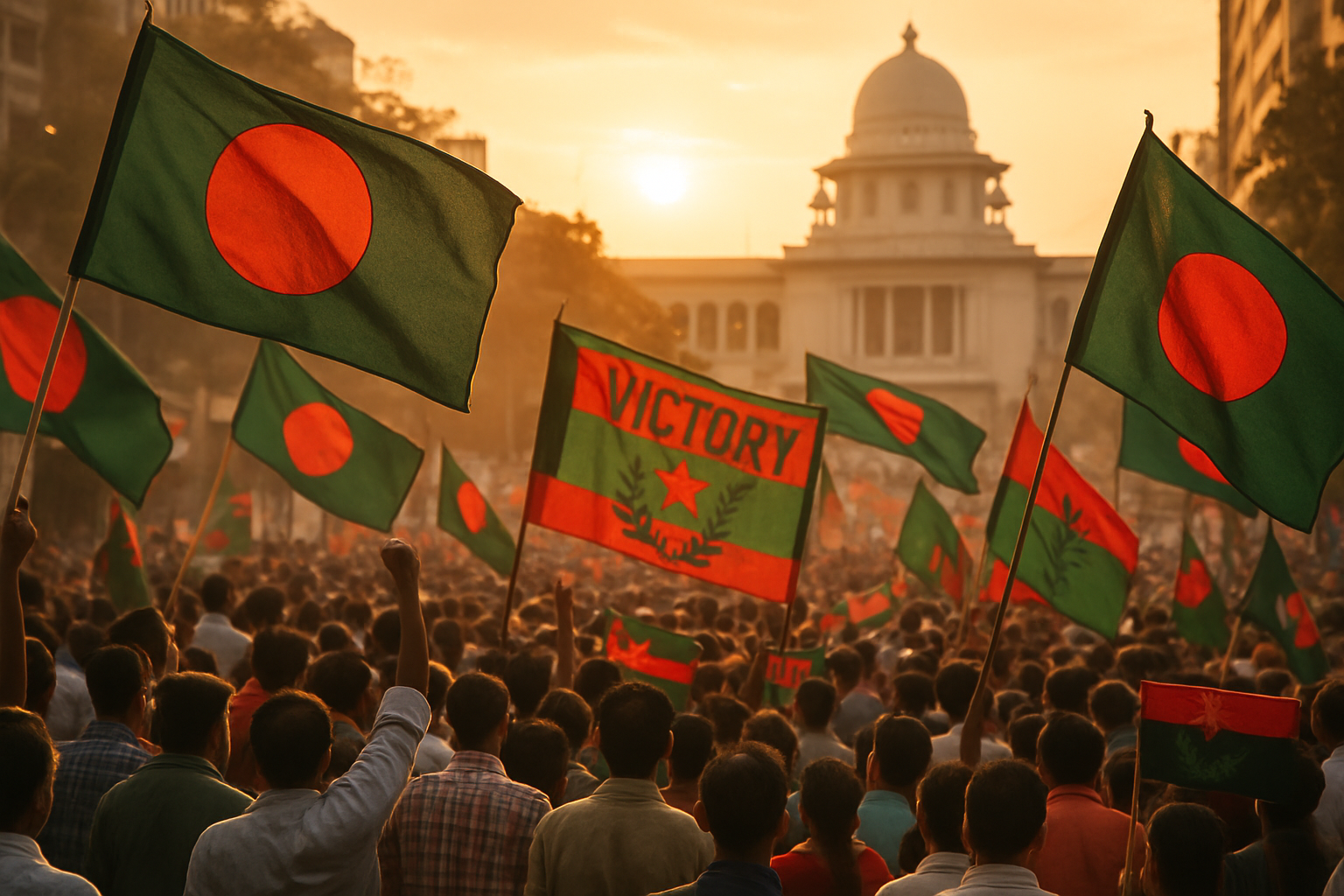
The Bangladesh Nationalist Party (BNP) achieved a decisive landslide victory in Bangladesh's historic February 12 parliamentary election, securing at least 212 of 299 seats and positioning Tarique Rahman to become the country's next Prime Minister after his remarkable return from 17 years of London exile.
The victory marks a dramatic political transformation for Bangladesh, completing the democratic transition that began with the Gen Z-led uprising in August 2024 that ended Sheikh Hasina's 15-year authoritarian rule. With nearly two-thirds of parliamentary seats, the BNP has secured a constitutional mandate that will enable significant policy reforms and institutional changes.
Electoral Breakthrough
According to Election Commission figures announced Friday afternoon, the BNP alliance captured 212 seats compared to 77 for the Islamist-led Jamaat-e-Islami coalition. The student-led National Citizen Party, which emerged directly from the 2024 uprising, secured symbolic victories including Nahid Islam's triumph in Dhaka-11 constituency.
The election represented the first truly competitive vote since 2008, conducted under unprecedented international oversight with 394 observers from 27 countries - the largest monitoring mission in Bangladesh's recent history. Historic overseas voting enabled 883,000 postal ballots, including 444,436 expatriate votes through the breakthrough ICPV system.
"After a gap of two decades, the Bangladesh Nationalist Party is set to return to state power," EC Secretary Akhtar Ahmed announced at the Election Commission building in Agargaon.
— EC Secretary Akhtar Ahmed
Key BNP victories included Secretary General Mirza Fakhrul Islam Alamgir's landslide win in Thakurgaon-3 with 236,308 votes, more than doubling his nearest rival. Tarique Rahman was unofficially elected from both Bogra-6 and Dhaka-17 constituencies, while the party swept all six seats in Barisal division.
International Recognition and Concerns
US Secretary of State Marco Rubio congratulated the BNP and Tarique Rahman following the landslide victory, stating the United States looks forward to working with the newly elected government. Malaysia's Prime Minister Anwar Ibrahim praised the "triumph of democracy," while several regional leaders expressed hopes for enhanced cooperation.
However, exiled former Prime Minister Sheikh Hasina, living in India, branded the election a "pre-planned election of deception and farce," alleging widespread manipulation. Her rejection of the results has prompted calls for her extradition from India to face trial for war crimes.
The Jamaat-led opposition coalition has also raised allegations of vote counting irregularities, with Jamaat Ameer Dr. Shafiqur Rahman claiming attempts to "alter results" in the parliamentary polls. These allegations come despite the extensive international monitoring that provided democratic legitimacy to the process.
Tarique Rahman's Remarkable Journey
Tarique Rahman's path to power reads like a political saga spanning nearly two decades. The son of two former Prime Ministers - his mother Khaleda Zia and stepfather late President Ziaur Rahman - he spent 17 years watching Bangladesh from London exile, burdened by legacy, loss, and controversy.
His return to Bangladesh in December 2025 marked a dramatic political comeback. Having faced imprisonment and exile under Sheikh Hasina's administration, Rahman's victory represents one of the most remarkable political resurrections in South Asian history.
"This election is extremely important for national reconstruction. We promise comprehensive development including airport infrastructure and our Family Cards economic support system."
— Tarique Rahman, BNP Chairman
Youth Demographic Drives Change
The election outcome was significantly influenced by Bangladesh's "uprising generation" - 55 million voters aged 18-37 representing 44% of the electorate. This demographic, which led the successful movement against Hasina's rule, demanded accountability, transparency, and effective governance over traditional party loyalties.
The peaceful conduct of the election across 42,651 polling centers, despite a massive 900,000 security deployment, demonstrated the maturity of Bangladesh's democratic institutions and the successful transformation of street protests into electoral politics.
Challenges Ahead
The incoming BNP government faces significant challenges, including implementing the July Charter that institutionalizes the uprising's principles, managing transitional justice questions regarding mass killing trials, and sustaining the diplomatic gains achieved under Nobel laureate Muhammad Yunus's interim government.
The new administration must also navigate complex regional relationships, particularly with India where tensions historically exist with BNP, while managing China's Belt and Road Initiative projects and potential enhanced partnership with the United States following breakthrough trade agreements.
Economically, the government inherits both opportunities and challenges. The interim administration achieved major US trade breakthroughs with 19% tariff rates and zero tariffs for textiles using US materials, signaling potential strategic realignment in the Indo-Pacific region.
Regional and Global Implications
The successful election provides a template for peaceful political change through mass mobilization, representing the world's first election following a successful Gen Z uprising. The democratic transformation has attracted international attention as a potential model for youth-led political movements globally.
Regional powers are closely monitoring the outcome. India faces the challenge of recalibrating its Bangladesh policy after supporting Hasina's administration, while China must adapt its strategic partnerships under new leadership. The United States sees opportunities for enhanced cooperation in its Indo-Pacific strategy.
The election's success amid such massive international oversight - described by observers as ensuring "unwavering commitment to peaceful, credible and participatory election" - reinforces Bangladesh's position as South Asia's third-largest democracy and a potential model for democratic consolidation.
Historic Democratic Milestone
The February 12 election represents more than a routine power transfer - it marks the successful institutionalization of a youth-led democratic revolution through peaceful electoral processes. The transition from authoritarian rule through popular uprising to competitive elections demonstrates how mass movements can achieve sustainable political change through democratic institutions.
With international legitimacy provided by the unprecedented observation mission and historic overseas voting participation, Bangladesh has established new standards for electoral democracy in South Asia. The peaceful transfer of power scheduled for the coming days will complete one of the most significant democratic transformations since independence.
As Tarique Rahman prepares to lead the nation of over 175 million people, his journey from exile to power symbolizes both personal redemption and national renewal - a political transformation that began on the streets with students and culminates in the halls of power through the ballot box.