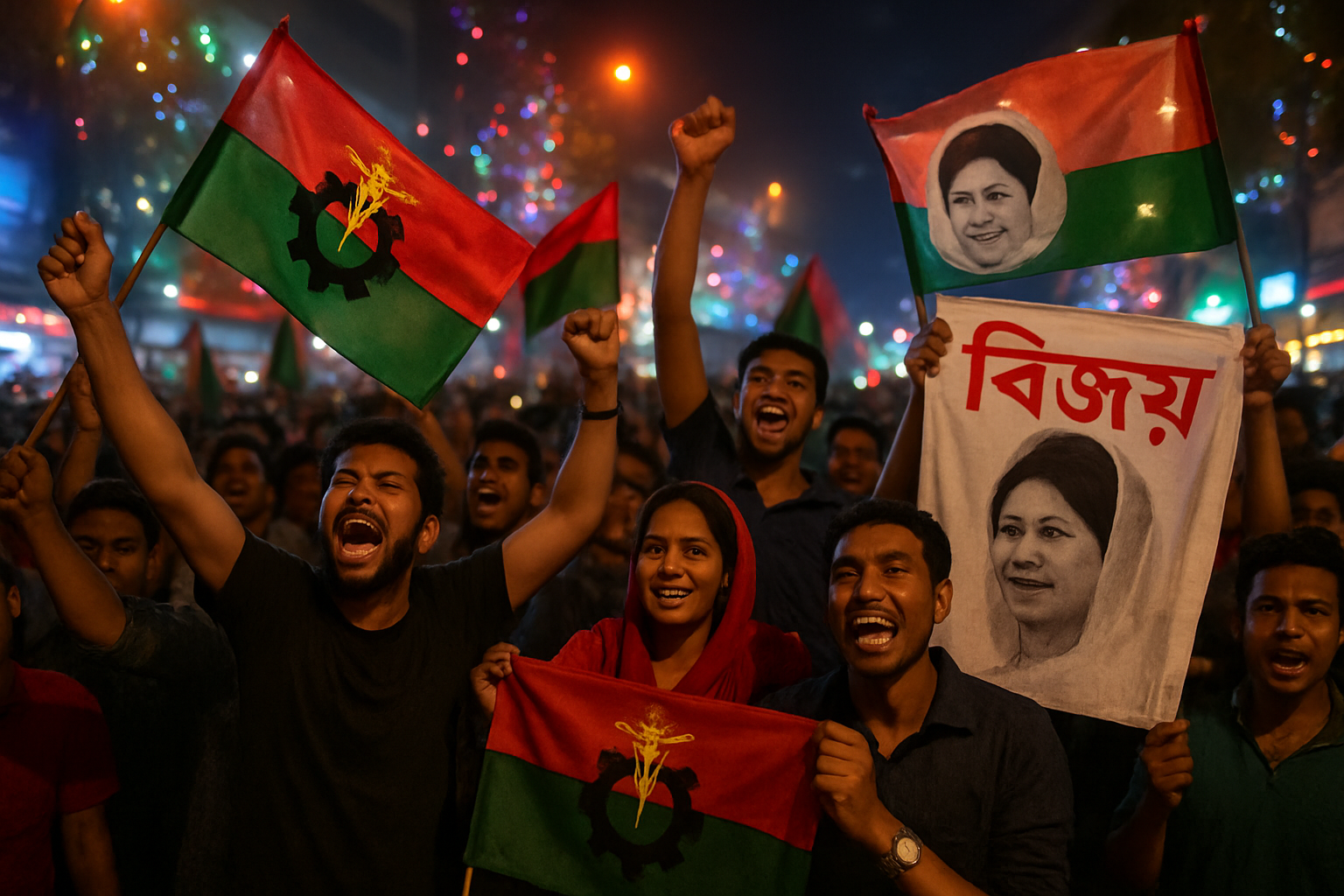
The Bangladesh Nationalist Party (BNP) secured a commanding victory in the country's historic February 12, 2026 elections, marking the end of Sheikh Hasina's 15-year authoritarian rule and completing Bangladesh's remarkable democratic transformation following the August 2024 student uprising.
With results from multiple constituencies confirming BNP's leading position, party spokesman Mahdi Amin declared late Thursday that the BNP was "confident of forming the next government with more than two-thirds majority in the 13th national election." The victory represents the culmination of an extraordinary 18-month journey from authoritarian rule to democratic renewal.
Key BNP Victories Across the Nation
The BNP's triumph was evident across multiple constituencies, with several high-profile victories cementing the party's return to power. In Thakurgaon-3, BNP Secretary General Mirza Fakhrul Islam Alamgir achieved a landslide victory, securing 236,308 votes after results from all 185 polling centers were announced, decisively defeating his Jamaat-e-Islami opponent.
Acting Chairman Tarique Rahman, who returned from 17 years of London exile in December, has been unofficially declared elected from two constituencies – Bogra-6 and Dhaka-17. This dual victory underscores the extent of BNP's electoral success and provides Rahman with a strong mandate for his return to Bangladeshi politics.
Other significant BNP victories included Dr. Reza Kibria in Habiganj-1, who received 111,073 votes, more than doubling his nearest rival's support. In Brahmanbaria-6, BNP-backed candidate Jonayed Saki defeated the Jamaat-e-Islami candidate with 94,231 votes – more than double his opponent's total.
"This election represents more than a routine power transfer – it's the successful institutionalization of the democratic ideals that drove millions to the streets in 2024."
— Dr. Sohela Nazneen, Political Analyst
Historic Context and Democratic Significance
The election marks Bangladesh's first free and fair democratic contest since 2008, ending nearly two decades of increasingly authoritarian rule under the Awami League. The transformation began with the July 2024 student uprising that ultimately forced Sheikh Hasina to flee to India, where she remains in exile after being convicted by the International Crimes Tribunal in November 2025.
Under the interim government led by Nobel laureate Professor Muhammad Yunus, Bangladesh conducted what international observers have called one of the most transparent and well-monitored elections in the country's history. A total of 394 international observers from 27 countries provided the largest monitoring mission in Bangladesh's recent history, ensuring democratic legitimacy.
The election also featured groundbreaking overseas voting for the first time, with 883,000 postal ballots processed, including 444,436 from expatriate Bangladeshis worldwide. This historic expansion of democratic participation particularly benefited the British Bangladeshi community and established Bangladesh as a regional leader in diaspora political engagement.
Youth-Led Democratic Revolution
Central to BNP's victory was the support of Bangladesh's "uprising generation" – the 55 million voters aged 18-37 who comprised 44% of the electorate. These young voters, many participating in their first genuinely competitive election, were instrumental in driving the democratic renewal that began with the student protests.
The election saw the emergence of the National Citizen Party, formed directly from the 2024 student movement, which allied with Jamaat-e-Islami to present the strongest Islamist challenge since Bangladesh's 1971 independence. However, this coalition appears to have fallen short against the BNP's broad-based appeal.
As interim government Youth Adviser Asif Mahmud noted, "This is a historic moment – people can vote freely after years of suppression." The peaceful conduct of the election, with minimal violence reported, marked a stark contrast to previous contested elections and demonstrated the maturity of Bangladesh's democratic institutions.
International Implications and Regional Impact
The successful completion of Bangladesh's democratic transition has significant implications for South Asian politics and international relations. The world's eighth-largest democracy has provided a template for peaceful political change through mass mobilization, challenging authoritarian rule through sustained civic pressure rather than military intervention.
During the interim period, the Yunus government achieved a major diplomatic breakthrough with the United States, securing a 19% tariff rate and zero tariffs on textiles and apparel using US materials. This economic diplomacy success signals potential strategic realignments in the Indo-Pacific region and improved US-Bangladesh relations.
Regional powers have watched the transition closely, with India expressing concerns about potential BNP policies given historical tensions, while China and other nations assess how the change might affect existing partnerships and the Belt and Road Initiative projects in Bangladesh.
Challenges Ahead for the New Government
While celebrating victory, the incoming BNP government faces substantial challenges. The party must navigate questions about transitional justice, including how to handle trials related to the mass killings during the July uprising and implementation of the "July Charter" that institutionalizes the uprising's democratic principles.
Economic challenges remain significant, with Bangladesh needing to sustain the diplomatic and trade gains made during the interim period while addressing domestic development needs. The new government must also manage relationships with the military and ensure continued institutional stability.
"The BNP's victory provides Bangladesh with an opportunity for genuine democratic consolidation, but success will depend on how well they can balance competing demands while maintaining the democratic momentum."
— Professor Muhammad Yunus, Interim Chief Adviser
A Model for Democratic Transition
Bangladesh's successful transition from student-led uprising to electoral democracy represents a unique achievement in contemporary global politics. The country has demonstrated that sustained popular pressure can achieve democratic transformation through institutional means, providing hope for similar movements worldwide.
The election's success, conducted with massive security deployment but minimal violence, extensive international oversight, and innovative overseas voting, establishes new benchmarks for electoral democracy in South Asia. The peaceful transfer of power from the interim government to the elected BNP administration will complete one of the most remarkable democratic transformations of the 21st century.
As vote counting continues and final results are tallied, Bangladesh stands as proof that youth-led movements for democracy can achieve lasting institutional change through peaceful means, offering a powerful example for democratic movements facing authoritarian rule across the globe.