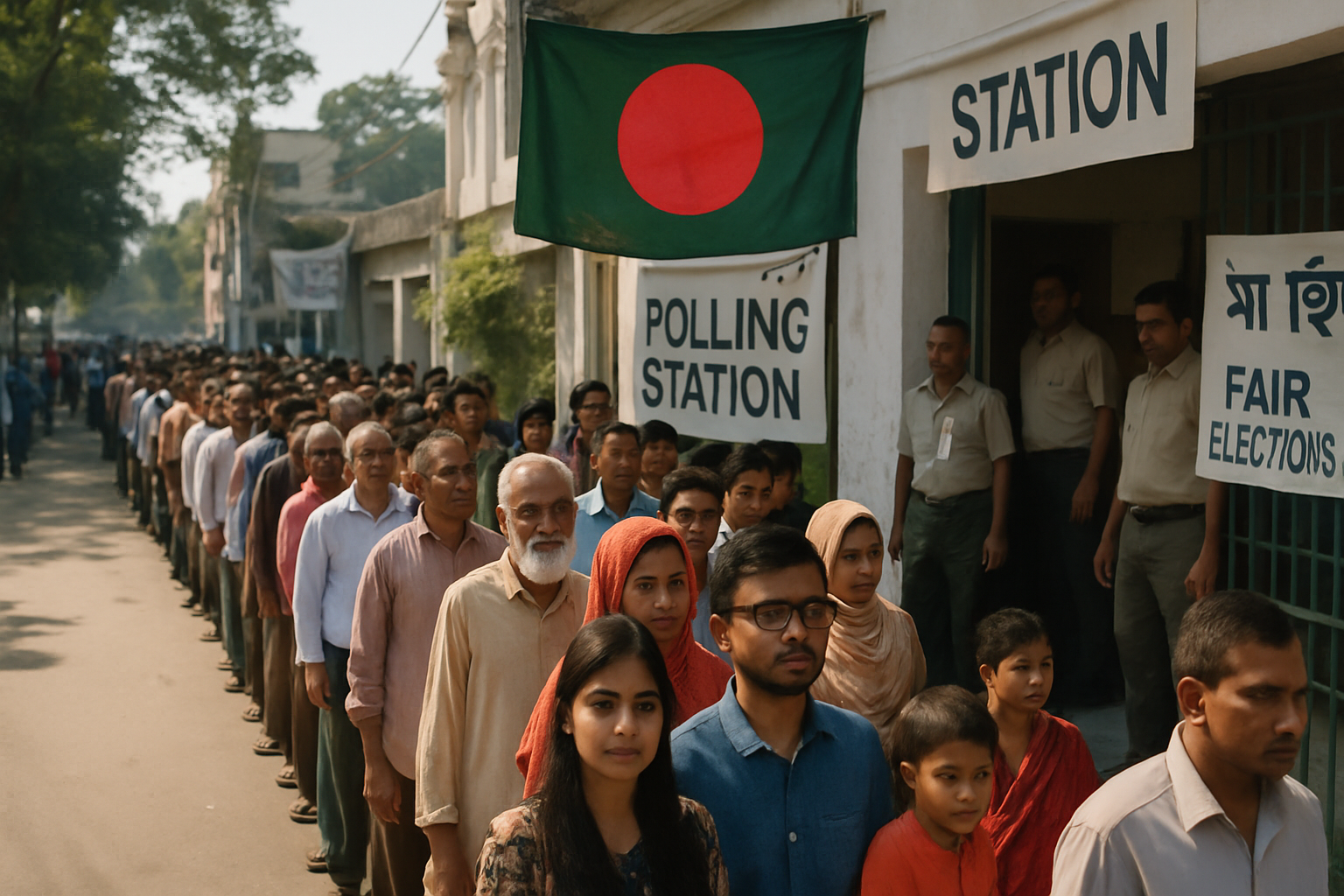
Counting began Thursday evening in Bangladesh's pivotal national election after tens of millions of people voted for a new government following the 2024 ouster of long-time premier Sheikh Hasina in a tumultuous Gen Z-driven uprising that ended 17 years of authoritarianism.
Election officials reported a turnout of nearly 48% by the time polls closed at 4:30 PM, with Akhtar Ahmed, senior secretary of the Election Commission, confirming that nearly half the electorate had voted across 36,031 of the 42,651 polling centers. This turnout significantly exceeded the entire 42% participation rate from Bangladesh's controversial 2024 election, signaling renewed public faith in the democratic process.
A Nation Reclaiming Democracy
The election represents the world's first democratic transition following an uprising led by Generation Z, with Nepal scheduled to follow a similar path next month. As Dr. Sohela Nazneed, Senior Fellow at the Institute of Development Studies in Brighton, explained to France 24: "People in Bangladesh are excited that democracy is returning and that there's a free and fair election after 17 years of authoritarianism."
The political landscape has been fundamentally transformed since the August 2024 student-led protests that forced Sheikh Hasina to flee to India, where she remains in exile. More than 2,000 candidates are vying for parliamentary seats, notably excluding any representatives from Hasina's now-banned Awami League party, which dominated Bangladeshi politics for over a decade.
"This is the world's first election after an uprising led by under-30s, or Gen Z, to be followed by Nepal next month."
— International Election Observers
The Contenders and Coalition Dynamics
The election pits the centre-right Bangladesh Nationalist Party (BNP), led by Tarique Rahman who returned from 17 years of London exile, against a coalition led by the Islamist Jamaat-e-Islami. Significantly, Jamaat has joined forces with a party born directly from the student uprising, the National Citizen Party, creating the strongest Islamist political showing since Bangladesh's independence in 1971.
Tarique Rahman, 60, expressed confidence that his BNP could regain power in the South Asian nation of 175 million people. The party has promised "national reconstruction," including airport development and a Family Cards system for economic support. Rahman's historic return to Bangladeshi politics after nearly two decades in exile has energized BNP supporters nationwide.
Youth Demographic Drives Change
The "uprising generation" of voters aged 18-37 represents a decisive 55 million people, comprising 44% of the electorate. This demographic shift reflects unprecedented generational political transformation, moving away from traditional party loyalties toward demands for accountability, transparency, and governance effectiveness.
Nearly 5 million first-time voters participated, underlining the youth-driven nature of this democratic renewal. The National Citizen Party, emerging directly from the 2024 protests, has capitalized on this youth momentum, representing a new political force demanding systemic change.
International Oversight and Legitimacy
The election enjoyed unprecedented international oversight, with 394 observers from 27 countries providing the largest monitoring mission in Bangladesh's recent history. The European Union deployed over 200 observers, while Japan's Election Observer Mission, led by Watanabe Masato, added crucial international legitimacy to the democratic process.
For the first time in Bangladesh's history, the election included overseas voting through the ICPV system, enabling 883,000 postal ballots from the diaspora, including 444,436 from expatriates. This breakthrough particularly benefited the British Bangladeshi community and represents a significant expansion of democratic participation.
Security and Challenges
Despite the largely peaceful conduct, the election was not without incidents. At least three people were injured in a grenade attack near a polling station in Gopalganj district, highlighting ongoing security challenges amid heightened political tensions. Bangladesh deployed nearly a million police and soldiers—the largest peacetime security operation in the nation's history—to maintain law and order.
The day saw isolated violence, including crude bomb explosions and Molotov cocktail attacks, but these incidents did not significantly disrupt the overall democratic process. One death was reported in Bhairab, Kishoreganj, though the circumstances remained under investigation.
Constitutional and Institutional Reforms
Beyond choosing parliamentary representatives, voters also participated in a referendum on constitutional and institutional reforms proposed by the interim government to address what it described as a "completely broken political system." The dual ballot system featured white ballots for parliamentary candidates and pink ballots for the "July National Charter" referendum, institutionalizing the principles of the 2024 uprising.
Chief Adviser Muhammad Yunus, the Nobel Prize-winning economist leading the interim government, has pledged a peaceful transfer of power following the election results expected on Friday. Yunus emphasized the "very crucial" nature of the electoral period, calling for "perfect voting execution."
Economic and Regional Implications
The election outcome carries significant implications for Bangladesh's economic trajectory and regional relationships. During the interim period, Yunus's government achieved a breakthrough trade agreement with the United States, securing a 19% tariff rate with zero tariffs for textiles and apparel using US materials—a major diplomatic and economic victory.
Analysts emphasize that a decisive result is crucial for steady governance in the nation of 175 million people, as the deadly anti-Hasina protests triggered months of unrest and disrupted key industries, including Bangladesh's massive garments sector, the world's second-largest exporter.
A Template for Democratic Transition
The successful conduct of these elections could establish Bangladesh as a regional democratic model for South Asia, demonstrating how popular uprisings can be institutionalized through peaceful democratic processes. The international community is closely watching this transition as a potential template for democratic consolidation following mass mobilization movements.
As votes continue to be counted, Bangladesh stands at a historic crossroads. The high turnout, international oversight, and peaceful conduct suggest that the nation's youth-led democratic revolution has successfully translated into institutional change. The results, expected Friday, will determine not only Bangladesh's political future but also provide lessons for democratic movements worldwide.
This election represents more than a routine political transition—it embodies the hopes of a generation that dared to challenge authoritarianism and the promise of a democracy renewed through the determination of its youngest citizens.