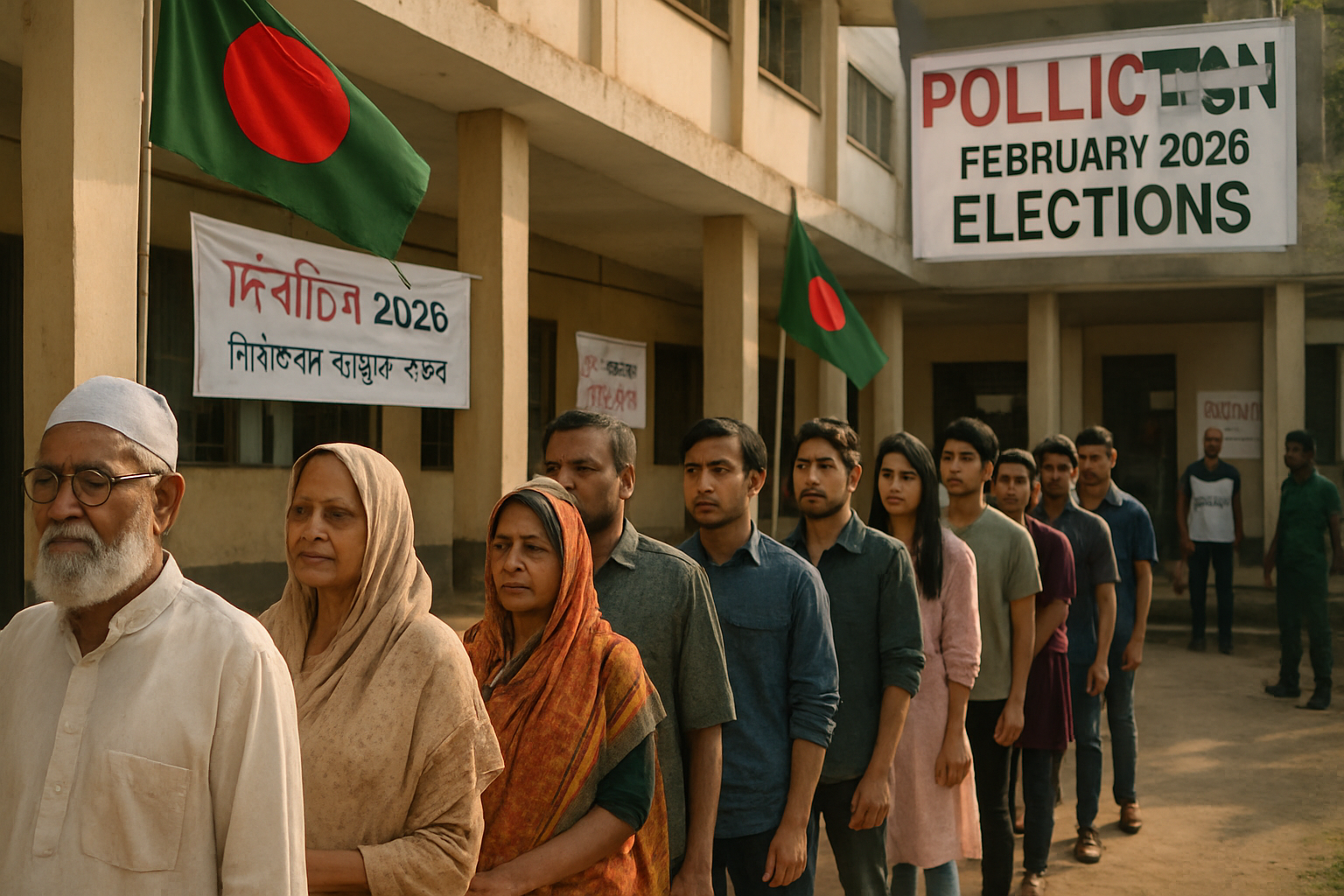
Bangladesh conducted landmark parliamentary elections on February 12, 2026, marking the nation's first democratic vote since a massive student-led uprising ended Sheikh Hasina's 15-year autocratic rule in August 2024, with early reports showing strong voter turnout despite isolated incidents of violence.
The historic Thirteenth National Parliamentary Election represents a critical test of Bangladesh's democratic transition, featuring unprecedented international oversight with 394 observers from 27 countries and the first-ever overseas voting system enabling diaspora participation. Voting commenced at 7:30 AM across 42,958 polling stations in 299 constituencies, with one constituency postponed due to a candidate's death.
Democratic Renewal After Uprising
Chief Adviser Professor Muhammad Yunus, who led the interim government following Hasina's ouster, cast his vote at 10 AM at Gulshan Model School and College, emphasizing the election's significance for completing Bangladesh's "first phase of transition to democracy." After a decade and a half without free elections, Bangladeshi citizens exercised their franchise in what many described as a "festive atmosphere."
The elections follow the dramatic events of August 2024, when massive student protests demanding quota system reforms escalated into a nationwide uprising that forced Hasina to flee to India. The student-led movement, primarily driven by Generation Z activists, successfully transformed the political landscape and banned the previously ruling Awami League from participating in these elections.
"This is a historic moment for Bangladesh. After years of suppression, our people can finally vote freely for their future."
— Nahid Islam, National Citizen Party Leader
Political Transformation and Key Players
The election featured a fundamentally transformed political landscape, with the Bangladesh Nationalist Party (BNP) under Tarique Rahman emerging as the frontrunner seeking a two-thirds majority for comprehensive national reconstruction. Rahman, son of former Prime Minister Khaleda Zia, returned from 17 years of self-exile in London in December to lead the campaign.
The main opposition came from a coalition between Jamaat-e-Islami, led by Shafiqur Rahman, and the student-led National Citizen Party emerging from the 2024 uprising. This alliance represents the strongest Islamist political showing since Bangladesh's 1971 independence, capitalizing on the youth momentum that toppled the previous government.
The youth demographic proved decisive, with 55 million voters aged 18-37 representing 44% of the electorate - the very "uprising generation" that demonstrated against Hasina's rule. This generational shift demanded accountability, transparency, and effective governance from the new political order.
International Oversight and Democratic Legitimacy
The election featured the largest international observation mission in Bangladesh's recent history, providing crucial democratic legitimacy. The European Union deployed over 200 observers from 27 member states, joined by delegations from Canada, Norway, and Switzerland. Japan's Election Observer Mission, led by former ambassador Watanabe Masato, monitored the process from February 6-14.
For the first time in Bangladesh's electoral history, overseas voting was implemented through the ICPV system, processing 883,000 postal ballots including 444,436 from expatriates. This breakthrough enabled global diaspora participation, particularly significant for the British Bangladeshi community, though some faced registration challenges.
The massive security deployment involved 900,000 personnel - the largest peacetime operation in Bangladesh's history - including police, Border Guard Bangladesh, Ansar forces, and armed forces. A three-tier security system protected 8,770 vulnerable centers, with 24,000 CCTV cameras and body camera surveillance ensuring electoral integrity.
Early Results and Voter Participation
By noon on February 12, Election Commission Senior Secretary Akhtar Ahmed reported a 32.88% voter turnout at polling centers across the country, demonstrating strong civic participation despite initial slow start. Army Chief General Waker-Uz-Zaman urged citizens to vote "without fear," expressing optimism about the election's fairness.
Home Affairs Adviser Jahangir Alam described voting as "largely peaceful," urging objective media reporting to counter rumors and propaganda. However, isolated incidents marred the generally smooth process, including a crude bomb explosion at a Munshiganj polling center where supporters of competing candidates clashed.
Independent candidate Tasnim Jara raised concerns about polling agents being barred from centers, calling for Election Commission intervention to ensure transparency. Despite these challenges, international observers praised the overall conduct as meeting democratic standards.
Economic Stakes and International Relations
The election outcome will determine Bangladesh's economic trajectory and international relationships. The interim government under Professor Yunus achieved a significant trade breakthrough with the United States, securing a 19% tariff rate with zero tariffs for textiles and apparel using US materials, signaling shifted international relations during the transition.
Regional powers are closely monitoring the results. India watches BNP's potential victory with concern despite historical friction, while China considers the implications for its Belt and Road Initiative investments. The United States has expressed support for democratic consolidation, viewing Bangladesh as a key partner in Indo-Pacific strategy.
Challenges and Controversies
The campaign period was not without tensions. Youth Adviser Asif Mahmud raised concerns about potential obstacles to mass killing trials and July Charter implementation under a future BNP government, highlighting ongoing disagreements over transitional justice.
Several incidents of electoral violations were reported, including arrests for vote-buying. Jamaat-e-Islami worker Habibur Rahman was sentenced to two days in jail with 6,000 taka confiscated after being caught distributing cash to voters.
The Election Commission faced criticism over vehicle requisitioning procedures and logistical challenges, though these were largely resolved through emergency protocols. Mobile phone restrictions limited communication to five authorized categories to prevent electoral manipulation.
Dual Ballot System and Constitutional Reform
Voters cast two ballots - white for parliamentary representatives and pink for the "July National Charter" referendum, which seeks to institutionalize the principles of the 2024 uprising. This referendum represents an attempt to prevent future authoritarian backsliding by enshrining democratic values and youth participation in governance.
The dual ballot system reflects the uprising's legacy, with student leaders seeking to transform street protests into sustainable institutional changes. The charter addresses issues of governance accountability, press freedom, and protection for peaceful assembly that were central to the movement that toppled Hasina.
Historical Significance and Global Implications
These elections represent more than a routine democratic exercise - they constitute the world's first election following a successful Generation Z-led revolution. The Bangladesh model is being closely watched by other nations facing similar youth-driven democratic movements, with Nepal scheduled for elections next month under comparable circumstances.
The successful conduct of elections amid complex security challenges and political transformation provides a template for democratic consolidation following popular uprisings. International observers noted the remarkable transition from authoritarian rule to competitive democracy in just 18 months.
The stakes extend beyond Bangladesh's borders. Success could establish the country as a regional democratic model, encouraging similar movements across South Asia. Failure might threaten institutional credibility and regional stability in a strategically vital region.
Results and Future Trajectory
Results are expected on February 13, with the Election Commission conducting ballot counting under international supervision. The outcome will determine whether Bangladesh can complete its democratic transformation and provide a model for peaceful political change through mass mobilization.
Professor Yunus emphasized that this represented a "very crucial week" requiring "perfect voting execution." The interim government stands ready to hand power to the elected authorities, completing what many see as one of the most significant democratic transitions in recent South Asian history.
As voting concluded at 4:30 PM, Bangladesh had demonstrated its commitment to democratic governance despite enormous challenges. The election represents not just a choice between political parties, but a test of whether the ideals that drove the 2024 uprising can be institutionalized through democratic processes, setting a precedent for youth-led democratic movements worldwide.