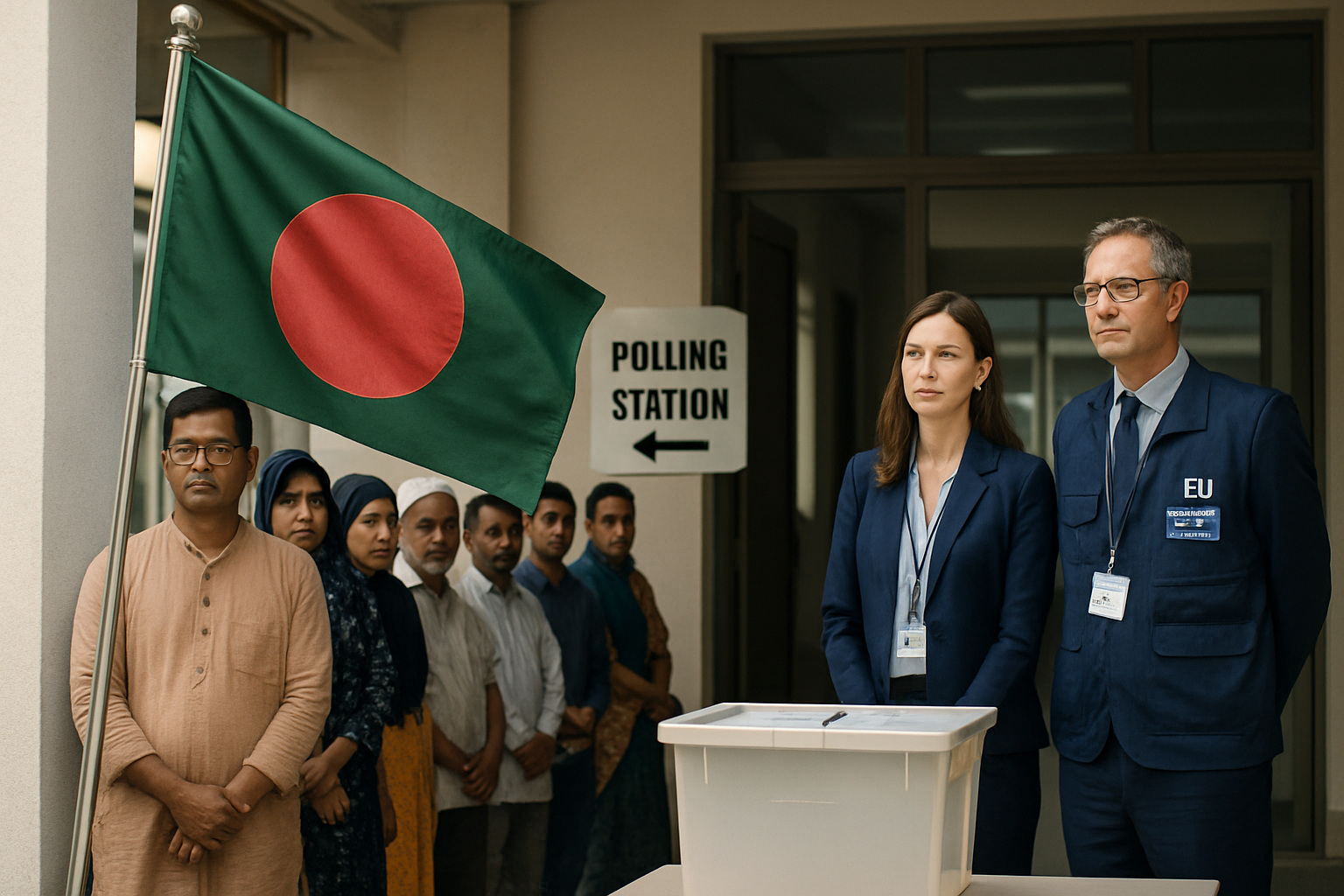
Bangladesh stands on the brink of a pivotal democratic moment as 200 international observers, led by the European Union, deploy across the nation to monitor the country's 13th National Parliamentary Election scheduled for February 12, 2026.
The extensive monitoring mission, comprising representatives from the EU's 27 member states along with observers from Canada, Norway, and Switzerland, represents unprecedented international oversight of Bangladesh's electoral process. The deployment comes as the nation experiences a dramatic transformation following the end of Sheikh Hasina's autocratic rule through the 2024 uprising that reshaped the political landscape.
International Oversight at Historic Scale
The European Union Election Observation Mission Bangladesh 2026 announced the deployment following comprehensive training sessions in Dhaka. All short-term observers have completed detailed instruction on monitoring voting processes, vote counting, and result compilation procedures. The 90 short-term observers deployed nationwide will work alongside core team members to ensure transparent election monitoring.
"The EU observer team is set to participate in monitoring electoral activities with full preparation," stated the mission in its official announcement. The observers will personally monitor election preparations, campaign activities, and the voting process itself, providing crucial international legitimacy to Bangladesh's democratic transition.
This marks the largest international election observation mission in Bangladesh's recent history, reflecting global recognition of the election's significance for the country's democratic future. The comprehensive coverage extends beyond traditional monitoring to include evaluation of media coverage, campaign conduct, and post-election processes.
Political Landscape Transformed
The election unfolds against the backdrop of fundamental political realignment following Sheikh Hasina's departure. The Bangladesh Nationalist Party (BNP), led by Tarique Rahman, son of former Prime Minister Khaleda Zia, emerges as a frontrunner with widespread support. Rahman, who has been in exile, represents a generational shift in Bangladeshi politics.
The BNP's main challenger is Jamaat-i-Islami, led by Shafiqur Rahman and allied with the student-led National Citizen Party. This alliance reflects the powerful role of student movements in Bangladesh's recent democratic awakening, particularly following their instrumental role in the 2024 uprising that ended Hasina's rule.
Tens of thousands of flag-waving supporters attended rival rallies across Dhaka during the final day of campaigning, as parties sought to harness the legacy of the mass uprising and present competing visions for the country's 170 million citizens. The campaign atmosphere has been marked by intense competition, with parties invoking the democratic ideals that drove the popular movement against authoritarian rule.
Mass Migration for Democratic Participation
A remarkable demonstration of civic engagement has transformed Dhaka's landscape as residents leave the capital en masse to return to their hometowns for voting. With just two days remaining before the election, the capital city appeared unusually quiet, with significantly reduced traffic and none of the familiar congestion that typically characterizes Bangladesh's bustling commercial hub.
The exodus began in early morning hours and continued throughout the day, as millions of Bangladeshis traveled across the country to exercise their democratic rights in their registered constituencies. This mass movement reflects the profound significance citizens attach to this election, viewing it as an opportunity to consolidate the democratic gains achieved through the 2024 uprising.
The travel rush has created logistical challenges but also demonstrates unprecedented popular engagement with the electoral process. Transportation systems have been strained but are functioning, with authorities coordinating to ensure citizens can reach their voting locations.
Stakes Beyond Borders
The election carries implications far beyond Bangladesh's borders, representing a critical test of democratic consolidation in South Asia. Success in conducting free and fair elections could establish Bangladesh as a regional model for democratic transitions, while failure might impact institutional credibility and regional stability.
International observers from Japan, including a mission led by Watanabe Masato from February 6-14, provide additional oversight alongside the European effort. The Ministry of Foreign Affairs and Embassy officials' participation underscores the global attention focused on Bangladesh's democratic experiment.
The election outcome will determine foreign policy orientation, economic development direction, and Bangladesh's role in regional South Asian cooperation. Success could influence neighboring countries' approaches to diaspora political participation, particularly given the historic overseas voting implementation that has engaged the global Bangladeshi community.
Challenges and Opportunities
Despite the enthusiasm surrounding the democratic transition, significant challenges remain. The Election Commission has implemented comprehensive preparations while addressing concerns about vehicle requisitioning from private owners for electoral purposes. Over 400,000 expatriate postal ballots have been processed under the historic first-time overseas voting system, though some registration challenges have emerged, particularly affecting the British Bangladeshi community.
The success of overseas voting could establish precedents for neighboring countries and demonstrate innovative approaches to diaspora political engagement. However, the scale of the undertaking has created logistical complexities that test Bangladesh's administrative capabilities.
Campaign tensions have emerged around concerns about potential obstacles to mass killing trials and implementation of the July Charter under a future BNP government, reflecting ongoing debates about transitional justice and democratic accountability. Youth Adviser Asif Mahmud raised these concerns, highlighting the delicate balance between democratic renewal and addressing past injustices.
A Democratic Landmark in the Making
As Bangladesh prepares for February 12, the election represents far more than a routine transfer of power. Chief Adviser Professor Muhammad Yunus described the coming week as "very crucial," with the main challenge being achieving "perfect" voting execution. The stakes include not only domestic governance but Bangladesh's emergence as a stable democratic model in a region facing various governance challenges.
The comprehensive international monitoring, unprecedented overseas voting participation, and mass civic engagement combine to create conditions for what could become a landmark democratic exercise. Success would validate the sacrifices made during the 2024 uprising and establish Bangladesh's transition as a template for democratic consolidation.
The deployment of 200 international observers represents more than technical oversight—it symbolizes global confidence in Bangladesh's democratic potential and commitment to supporting the country's transformation. As voters prepare to make their choices, the world watches to see whether this historic election will fulfill its promise of democratic renewal for one of South Asia's most populous nations.