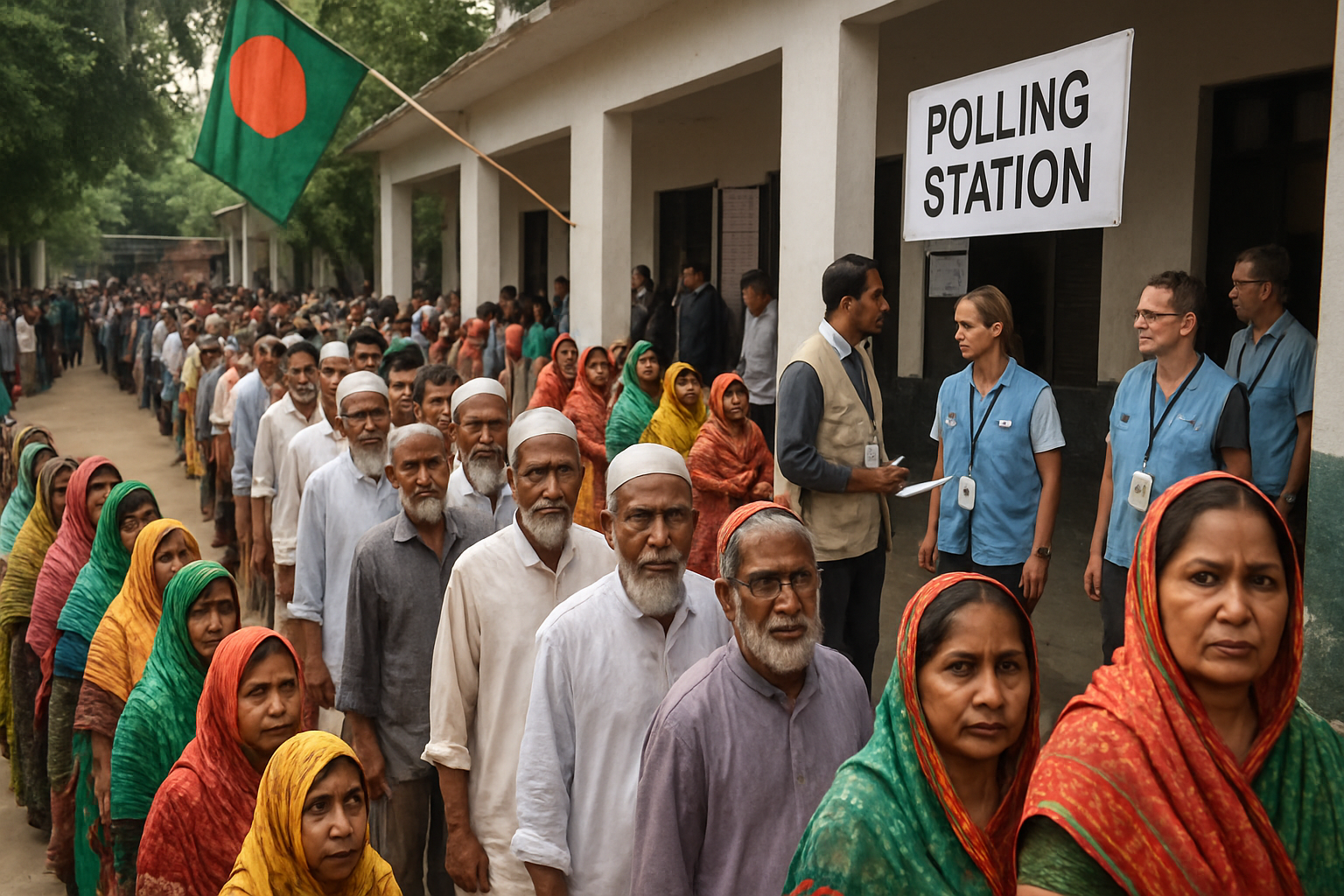
Bangladesh completed its historic first free and fair election in 17 years on February 12, 2026, with nearly 48% voter turnout and unprecedented international oversight, as early counting showed the Bangladesh Nationalist Party (BNP) taking an early lead over its rivals following the Gen Z-led uprising that toppled Sheikh Hasina's authoritarian government.
The election, described by voters as feeling "like Eid," marked a watershed moment for the nation of 175 million people, representing their first genuine democratic choice since the student-led protests that ended Sheikh Hasina's 15-year rule in August 2024. The Awami League, banned from participation following last year's uprising, was notably absent from ballots across the country's 299 constituencies.
Unprecedented Democratic Participation
Election Commission officials reported that nearly half of Bangladesh's 128 million eligible voters had cast their ballots by midday, creating what observers described as a "festive atmosphere" at polling centers nationwide. The remarkable turnout exceeded expectations despite logistical challenges and represented a dramatic increase from previous contested elections.
"This is a historic moment for our democracy. People are voting freely after years of suppression,"
— Nahid Islam, National Citizen Party Leader
The election was conducted under the largest security deployment in Bangladesh's peacetime history, with nearly 900,000 personnel from police, Border Guard Bangladesh (BGB), Ansar, and armed forces ensuring peaceful voting. Despite isolated incidents, including a minor explosion in Munshiganj and some voter registration irregularities, the day proceeded remarkably smoothly.
International Legitimacy and Oversight
A record 394 international observers from 27 countries monitored the democratic process, representing the largest election observation mission in Bangladesh's recent history. The European Union deployed over 200 observers, while Japan sent a dedicated Election Observer Mission led by Watanabe Masato, providing crucial international legitimacy to the democratic transition.
This massive international presence stood in stark contrast to previous elections under Sheikh Hasina's rule, which were widely criticized as neither free nor fair. The comprehensive monitoring covered vote counting, electoral administration, and campaign conduct, with observers praising the overall peaceful nature of the process.
Political Transformation and Early Results
Early counting from polling stations across the country showed BNP, led by Tarique Rahman who returned from 17 years of exile in London, taking significant leads in multiple constituencies. Rahman, the son of former Prime Minister Khaleda Zia, appeared positioned to become the next Prime Minister after successfully casting the election as a referendum on democratic renewal.
In Bogra district, BNP candidates were leading in all seven constituencies, with Tarique Rahman securing victory in Bogra-6 (Sadar) constituency, according to unofficial results from returning officers. The party's strong performance reflected months of campaigning on themes of "national reconstruction" and economic recovery.
Jamaat-e-Islami, in alliance with the student-led National Citizen Party that emerged from the 2024 uprising, appeared positioned as the main opposition, representing the strongest Islamist showing since Bangladesh's independence in 1971. This marked a fundamental realignment in the country's political landscape.
Dual Ballot Innovation
In an unprecedented move, voters cast ballots on two separate papers: white ballots for parliamentary representatives and pink ballots for a constitutional referendum on the "July National Charter." This referendum sought to institutionalize the principles of the 2024 uprising and address what activists called the "completely broken political system."
However, many voters expressed confusion about the referendum, with observers at nearly 20 polling centers in Dhaka reporting that most participants had little understanding of its purpose. Despite this confusion, the dual-ballot system proceeded without major disruptions.
Historic Overseas Voting
For the first time in Bangladesh's history, the election included overseas voting through the ICPV system, with over 883,000 postal ballots processed, including 444,436 from expatriate Bangladeshis. This breakthrough particularly excited the British Bangladeshi community, though some reported registration challenges.
The successful implementation of overseas voting could establish Bangladesh as a regional leader in diaspora political participation, potentially influencing neighboring countries to adopt similar systems.
Youth-Led Democratic Renewal
The election represented a victory for Bangladesh's "uprising generation" – the 55 million voters aged 18-37 who constitute 44% of the electorate. Many cast their first votes in a genuinely competitive election, having come of age during Sheikh Hasina's increasingly authoritarian rule.
The National Citizen Party, born directly from the student protests, successfully channeled this youth energy into electoral politics, demonstrating how grassroots movements can transition into institutional democratic participation.
Challenges and Minor Incidents
Despite the overall peaceful conduct, the election wasn't without challenges. In Dhaka-13 constituency, one woman voter alleged someone had voted on her behalf, leading to Election Commission intervention. Vote-buying arrests were made, including a Jamaat worker sentenced to two days in jail with 6,000 taka confiscated.
Some concerns emerged about potential obstacles to transitional justice processes, with Youth Adviser Asif Mahmud raising questions about how a future BNP government might handle mass killing trials and July Charter implementation.
Violence-Free Milestone
Remarkably, this marked the first time since 1991 that an election day in Bangladesh passed without fatalities due to electoral violence – a historic achievement that underscored the changed political atmosphere following the uprising.
"The collective efforts and responsible roles of all stakeholders helped ensure a peaceful electoral environment across the country,"
— Election Commission Statement
International and Regional Implications
The successful conduct of free and fair elections positions Bangladesh as a potential model for democratic transitions following popular uprisings. With Nepal scheduled to hold similar elections next month after its own youth-led political changes, Bangladesh's experience is being closely watched across South Asia.
The election also takes place amid improved U.S.-Bangladesh relations, with the interim government of Nobel laureate Muhammad Yunus achieving a breakthrough trade agreement providing 19% tariff rates and zero tariffs for textiles using U.S. materials.
Looking Forward
As vote counting continues under international supervision, the results are expected to be announced on February 13. The stakes extend far beyond Bangladesh's borders, as the world's eighth-largest population country's successful democratic transition could influence regional stability patterns and provide encouragement for democratic movements globally.
The interim government, led by Chief Adviser Professor Muhammad Yunus, stands ready to hand over power to the elected authorities, completing what many consider the most remarkable democratic transformation in South Asia in recent decades.
Whether Bangladesh can successfully consolidate this democratic renewal will depend on the new government's ability to address citizen demands for accountability, transparency, and effective governance while managing complex regional relationships and economic development challenges. The world watches as Bangladesh attempts to prove that student-led uprisings can indeed create sustainable democratic institutions through peaceful electoral processes.