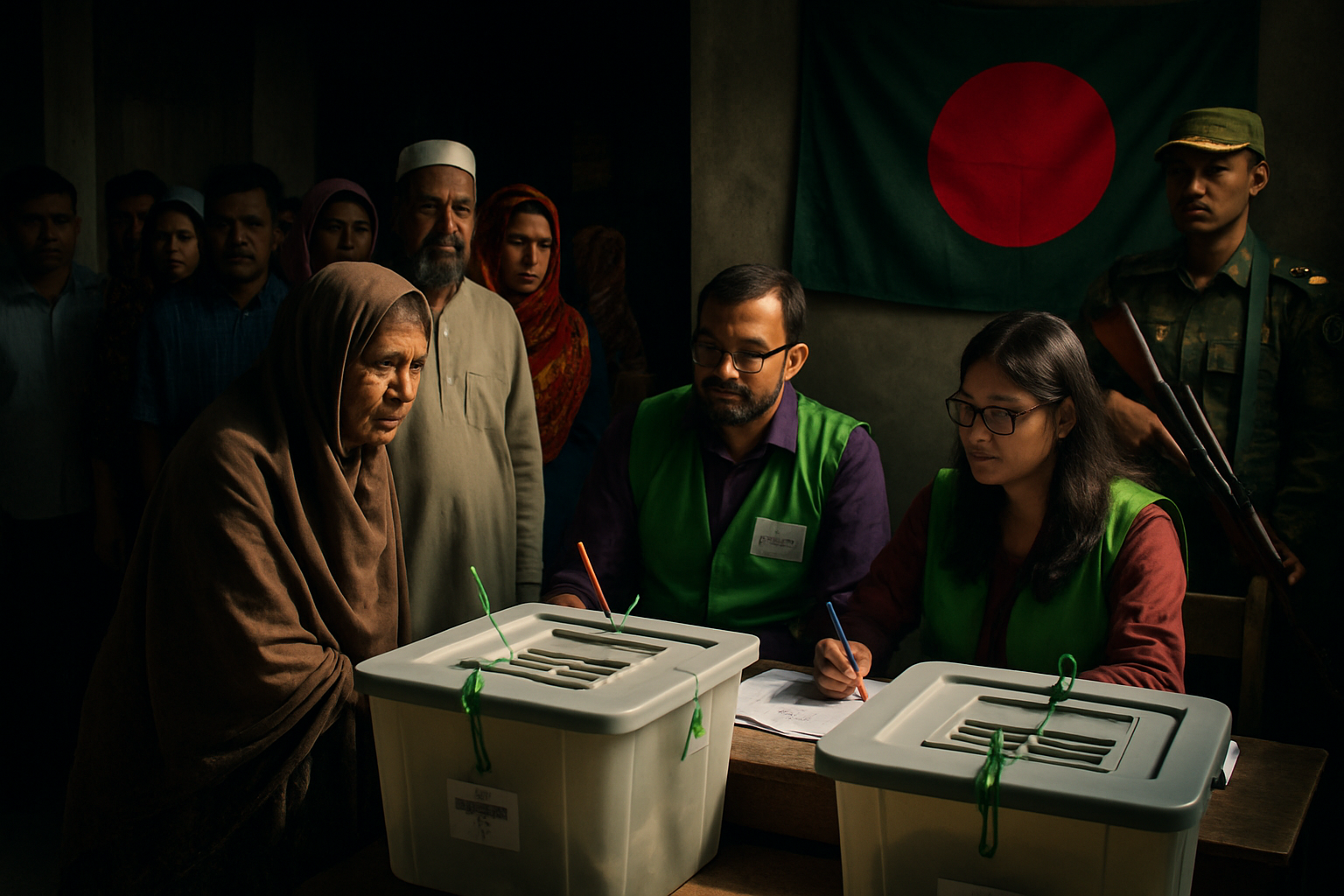
Bangladesh enters the final phase of preparations for its critical February 12, 2026 parliamentary elections, with comprehensive security deployments, vehicle movement restrictions, and intensive polling station preparations underway as expatriate voters arrive to participate in the historic democratic exercise.
Chief Adviser Professor Muhammad Yunus addressed the nation on Tuesday evening, declaring that once the elections are held, the elected government will swiftly assume charge, marking the conclusion of the interim government's responsibilities. "We will joyfully and proudly hand over responsibilities to the newly elected government, wish them every success, bid farewell, and return to our respective work," Yunus stated, emphasizing the significance of this democratic transition.
Extensive Security Measures Implemented
The Rajshahi Metropolitan Police (RpMP) has enforced comprehensive vehicle movement restrictions following directives from the Election Commission. According to a public notice signed by RpMP Commissioner Md Majid Ali, the decision forms part of broader security protocols designed to ensure a peaceful electoral environment.
The Khulna Police Range has deployed 16,755 police personnel across 10 districts of the division, demonstrating the unprecedented scale of security arrangements for the elections. This massive deployment represents one of the most comprehensive security operations in Bangladesh's recent electoral history.
Coast Guard forces have been strategically positioned with 100 platoons deployed at 332 polling centers across 69 coastal unions, ensuring security coverage extends to Bangladesh's vulnerable coastal regions. The Khulna Metropolitan Police (KMP) held extensive briefing parades, with commissioners instructing officers to carry out their responsibilities with "honesty, dedication and impartiality."
Technology and Surveillance Infrastructure
In Tangail, authorities have installed 2,360 CCTV cameras across polling stations, with election officials stating that surveillance coverage has been given "special priority at high-risk centers." This technological infrastructure represents a significant advancement in electoral monitoring capabilities, designed to ensure transparency and accountability throughout the voting process.
The comprehensive surveillance system reflects Bangladesh's commitment to conducting free, fair, and credible elections, with real-time monitoring capabilities that will allow officials to respond quickly to any irregularities or security concerns.
Challenges and Disruptions
Despite extensive preparations, the electoral process has faced some challenges. In Netrakona, miscreants set fire to four polling centers during the night, with Officer-in-Charge Mamun Sarkar of Sadar Police Station confirming that "miscreants set fire to three polling centres in sadar upazila at night around 3:30 AM." This incident highlights ongoing security concerns and the need for vigilant protection of electoral infrastructure.
The attacks on polling facilities underscore the volatile political atmosphere surrounding these crucial elections, though authorities have moved swiftly to address security gaps and ensure backup arrangements for affected areas.
Historic Overseas Voting Initiative
A significant development in these elections is the historic first-time implementation of overseas voting for Bangladeshi expatriates. Election Commission officials confirmed this marks "the first time expatriates have been allowed to vote while residing overseas," with Bangladeshi expats arriving in Sylhet and other regions to cast their votes.
This groundbreaking initiative enables the global Bangladeshi diaspora to participate directly in the democratic process, representing a major advancement in electoral inclusivity. The overseas voting system has processed over 400,000 expatriate ballots under the International Citizens Postal Voting (ICPV) system, particularly benefiting the substantial British Bangladeshi community.
Warnings Against Misinformation
Chief Adviser Yunus issued strong warnings against the spread of rumors and misinformation, stating that "a specific group is deliberately trying to spread rumors and misinformation to create doubt, fear, and confusion in the minds of citizens." He emphasized that their "sole objective is to disrupt the peaceful electoral environment and weaken public trust."
The interim government's focus on combating disinformation reflects the critical importance of maintaining public confidence in the electoral process, particularly given the politically charged atmosphere surrounding these elections.
"New propaganda is now being spread to create confusion among the people. I urge all citizens to remain vigilant against these attempts and rely only on official sources for election-related information."
— Professor Muhammad Yunus, Chief Adviser
International Oversight and Regional Implications
The elections are being conducted under unprecedented international observation, with over 200 EU-led international observers deployed nationwide, including representatives from 27 EU member states plus Canada, Norway, and Switzerland. Japan has also deployed an Election Observer Mission led by Watanabe Masato, providing crucial international oversight for democratic legitimacy.
This represents the largest international election observation effort in Bangladesh's recent history, reflecting the global significance of these elections for democratic consolidation in South Asia. The success or failure of these elections will have implications far beyond Bangladesh's borders, potentially serving as a model for democratic transitions in the region.
Political Context and Stakes
These elections represent the first since the Gen Z-led uprising that ended Sheikh Hasina's 15-year Awami League rule in August 2024, with the Awami League banned from participation, creating a fundamental political realignment. The BNP, led by Tarique Rahman, is widely seen as the frontrunner, with their main rivals being Jamaat-i-Islami led by Shafiqur Rahman, who have allied with the student-led National Citizen Party.
The political transformation reflects the legacy of the 2024 uprising that fundamentally altered Bangladesh's political landscape. Campaign activities have featured tens of thousands at rival rallies across Dhaka, with parties invoking the uprising's legacy and promising various forms of national reconstruction.
Economic and Infrastructure Considerations
The elections occur against the backdrop of significant economic challenges and infrastructure developments. Recent achievements include a major breakthrough in US-Bangladesh trade relations, with a new agreement providing a 19% tariff rate and zero tariffs for textiles and apparel using US cotton and materials. This economic diplomacy success during the political transition signals shifting international relations and potential Indo-Pacific strategic realignment.
Democratic Consolidation Test
Chief Adviser Yunus described the coming period as "very crucial" for Bangladesh, with the main challenge being the "perfect execution" of the voting process. The elections represent a critical test of post-uprising institutional capacity and democratic consolidation following the unprecedented popular mobilization that transformed the country's political landscape.
Success in conducting free, fair, and peaceful elections could establish Bangladesh as a regional democratic transition model, while failure might threaten institutional credibility and the democratic gains achieved through the popular uprising.
The outcome will determine not only Bangladesh's political trajectory but also its foreign policy orientation, economic development direction, and role in regional South Asian cooperation. International observers are closely monitoring the process for its implications on democratic governance, regional security partnerships, and great power competition dynamics in the Indo-Pacific region.
As Bangladesh prepares for this pivotal moment in its democratic journey, the comprehensive preparations, international oversight, and high stakes underscore the election's significance as potentially the most consequential in the nation's recent history, with implications extending far beyond its borders into the broader landscape of South Asian and global democratic development.