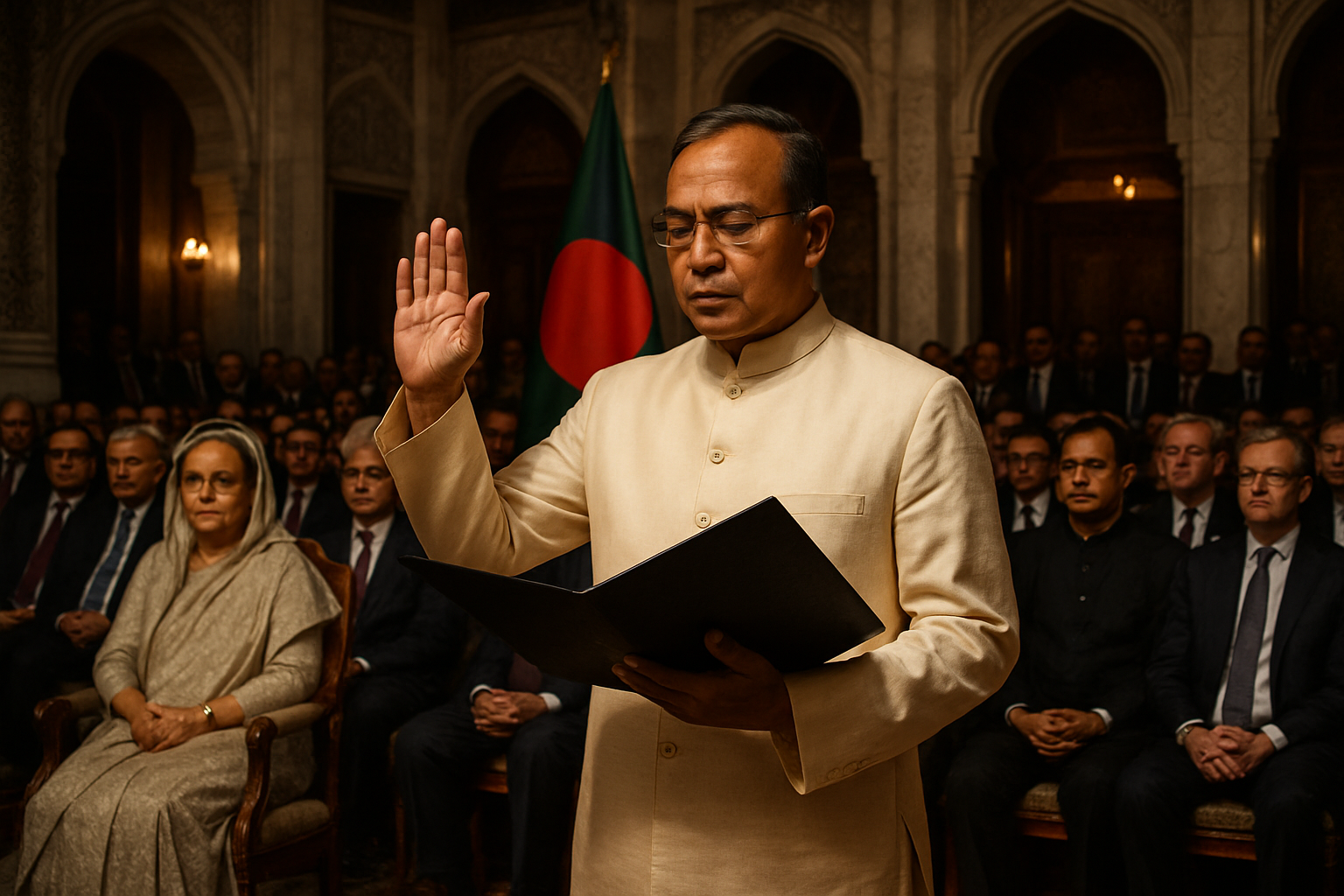
Bangladesh completed its historic democratic transformation on Tuesday as Tarique Rahman was sworn in as Prime Minister, ending Sheikh Hasina's 15-year authoritarian rule and marking the world's first successful transition from a student-led uprising to electoral democracy.
Rahman formally took office during a ceremony in Dhaka following his Bangladesh Nationalist Party's (BNP) decisive victory in last week's parliamentary elections, where the party secured a commanding two-thirds majority with 212 of 299 seats. The swearing-in ceremony at Bangabhaban Darbar Hall was attended by international dignitaries from 13 countries, including representatives from China, India, and Pakistan.
From Exile to Power: A Political Comeback
The 50-year-old Rahman's ascension to power caps one of the most remarkable political comebacks in recent history. He returned to Bangladesh in December 2025 after spending 17 years in exile in London, where he had fled following corruption charges widely viewed as politically motivated.
Rahman's journey to the Prime Minister's office began with the August 2024 student uprising that toppled Hasina's government after violent crackdowns killed over 1,400 protesters. The interim government led by Nobel laureate Muhammad Yunus successfully managed the transition to democratic elections, which were held on February 12, 2026.
"Today marks not just a change of government, but the birth of a new Bangladesh built on the principles of democracy, accountability, and justice," Rahman declared during his first address as Prime Minister.
— Tarique Rahman, Prime Minister of Bangladesh
Historic Electoral Victory
The BNP's landslide victory was unprecedented in its scope and international legitimacy. The elections were monitored by 394 international observers from 27 countries, representing the largest monitoring mission in Bangladesh's recent history. For the first time, the country implemented overseas voting through the ICPV system, allowing 883,000 postal ballots including 444,436 from expatriate Bangladeshis.
The youth demographic proved decisive in the electoral outcome. An estimated 55 million voters aged 18-37, representing 44% of the electorate and dubbed the "uprising generation," drove the democratic renewal with demands for accountability and transparency over traditional party loyalty.
BNP Secretary General Mirza Fakhrul Islam Alamgir exemplified the party's dominance by winning his Thakurgaon-3 constituency with 236,308 votes, more than doubling his nearest rival. Rahman himself was elected from both Bogra-6 and Dhaka-17 constituencies, demonstrating his broad national appeal.
Opposition Landscape and Political Realignment
The elections marked a fundamental realignment of Bangladesh's political landscape. The Awami League, which had dominated politics for over a decade and a half, was banned from participation due to its role in violently suppressing the 2024 uprising. This created space for other political forces to emerge as the primary opposition.
Jamaat-e-Islami secured 77 seats, representing their strongest showing since Bangladesh's independence in 1971. The student-led National Citizen Party, which emerged directly from the 2024 protests, won symbolic victories including Nahid Islam's triumph in Dhaka-11, representing the institutionalization of youth-led political activism through electoral processes.
International Recognition and Challenges Ahead
The new government received widespread international recognition. Malaysian Prime Minister Anwar Ibrahim praised the election as a "triumph of democracy," while Indian Prime Minister Modi offered congratulations despite scheduling conflicts that prevented his attendance at the swearing-in ceremony. The United States, building on trade breakthroughs achieved during the interim government that reduced tariffs to 19% with zero rates on textiles using US materials, expressed readiness to work with the new administration.
However, Rahman acknowledged the significant challenges facing his administration. "We inherit a fragile economy, ineffective institutions, and weak law and order from the previous regime," he stated, calling for national unity and promising to implement the July Charter that institutionalizes the principles of the 2024 uprising.
Cabinet Formation and Policy Priorities
Rahman announced his initial cabinet appointments, keeping the defense portfolio for himself while appointing experienced administrators to key economic positions. The appointments signal a focus on both internal security and economic recovery, reflecting the dual challenges facing the new administration.
The government faces immediate pressure to address transitional justice concerns, with calls for accountability regarding the mass killings during the 2024 uprising. Additionally, Rahman must navigate complex regional relationships, particularly with India, where tensions have historically existed between the BNP and New Delhi.
Global Template for Democratic Change
Bangladesh's democratic transformation has drawn international attention as a potential template for peaceful political change through youth-led movements. The successful transition from street protests to electoral victory through an interim government provides a model that other countries facing similar challenges may seek to emulate.
The role of the interim government under Muhammad Yunus was crucial in maintaining institutional continuity and international legitimacy. The Nobel laureate's administration not only conducted free and fair elections but also achieved significant diplomatic breakthroughs, including improved relations with the United States and successful implementation of overseas voting systems.
Economic Priorities and Development Agenda
One of Rahman's immediate priorities will be addressing Bangladesh's economic challenges. The country faces inflation pressures, unemployment concerns, and the need for institutional rebuilding after years of authoritarian governance. The new government has promised comprehensive economic reforms, including the implementation of a Family Cards system and infrastructure development projects such as airport construction.
The international community will be watching closely how the new administration balances economic development with democratic governance, particularly given Bangladesh's strategic importance as the world's eighth-largest population and its critical position in South Asian geopolitics.
Regional Implications and Future Prospects
Rahman's victory has significant implications for South Asian politics and democracy. The successful democratic transition could influence similar movements in neighboring countries, while also affecting regional cooperation frameworks and international partnerships.
The new Prime Minister's approach to foreign policy will be particularly scrutinized, especially regarding relationships with major powers including China, India, and the United States. The interim government's diplomatic successes, including trade agreements and international recognition, provide a foundation for the new administration to build upon.
As Rahman assumes office, he inherits not just the machinery of government but also the hopes and expectations of millions of Bangladeshis who participated in the democratic transformation. The success of his administration will determine whether Bangladesh's remarkable journey from uprising to electoral democracy can serve as a lasting template for peaceful political change in the 21st century.