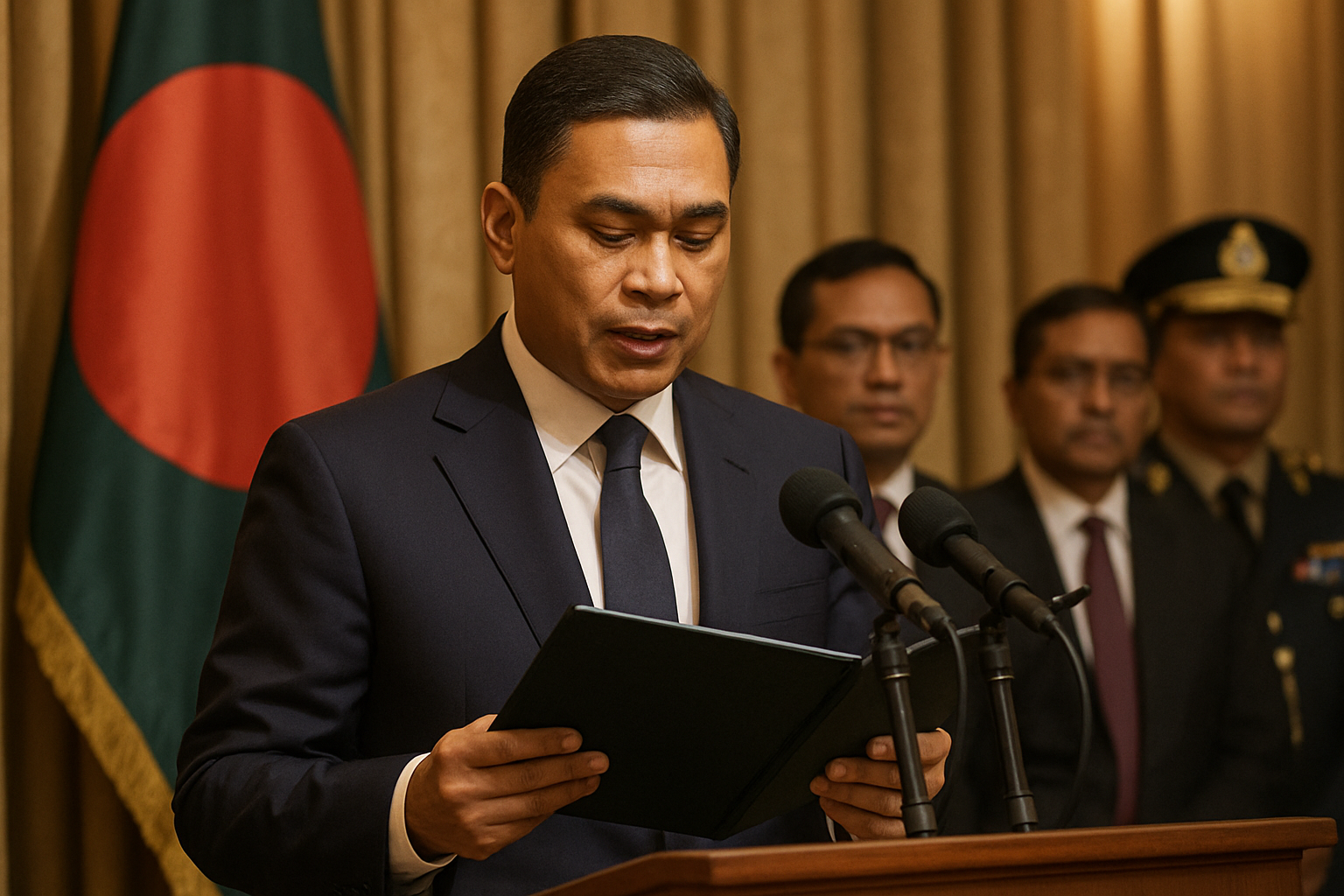
Tarique Rahman was sworn in as Bangladesh's new Prime Minister on Tuesday, February 17, 2026, completing a remarkable democratic transformation following his Bangladesh Nationalist Party's (BNP) landslide victory in the country's first free and fair election since the August 2024 student uprising ended Sheikh Hasina's 15-year authoritarian rule.
The 60-year-old son of former Prime Minister Khaleda Zia and assassinated President Ziaur Rahman takes office after returning from a 17-year London exile in December 2025, leading his party to a commanding two-thirds majority with 212 of 299 parliamentary seats in the February 12 election.
President Mohammed Shahabuddin administered the oath of office at Bangabhaban Darbar Hall in a ceremony attended by international dignitaries, marking the end of an interim government led by Nobel Peace Prize laureate Muhammad Yunus that oversaw the peaceful transition to democracy.
Historic Democratic Milestone
"I will faithfully discharge the duties of the office of prime minister of the government, in accordance with the law," Rahman declared during the swearing-in ceremony, witnessed by representatives from 13 countries including high-ranking officials from India, China, Pakistan, and regional neighbors.
The ceremony represents the culmination of what international observers have called the world's first successful democratic transition following a Gen Z-led uprising. The August 2024 student-led movement, which resulted in over 1,400 deaths, successfully toppled Sheikh Hasina's increasingly authoritarian Awami League government and established the foundation for democratic renewal.
The election itself was a testament to Bangladesh's democratic resilience, conducted with unprecedented international oversight including 394 observers from 27 countries - the largest monitoring mission in the nation's recent history. Historic overseas voting enabled 883,000 postal ballots, including 444,436 from expatriate communities, marking the first time the Bangladeshi diaspora could participate in parliamentary elections.
Youth-Led Political Transformation
The decisive victory was driven by what analysts term the "uprising generation" - 55 million voters aged 18-37 who comprised 44% of the electorate. These young voters, many participating in their first genuinely competitive election, demanded accountability, transparency, and effective governance over traditional party loyalty.
BNP Secretary General Mirza Fakhrul Islam Alamgir exemplified the party's comprehensive victory, winning his Thakurgaon-3 constituency with a massive 236,308 votes - more than doubling his nearest rival. The party swept all six seats in Barisal division and demonstrated broad national appeal across rural and urban constituencies.
The opposition landscape was fundamentally altered, with the Awami League banned from participation due to its role in violent suppression of the 2024 uprising. Jamaat-e-Islami emerged as the main opposition with 77 seats - their strongest showing since 1971 independence - while the student-led National Citizen Party won symbolic victories including Nahid Islam's triumph in Dhaka-11.
"Today we begin a new chapter in Bangladesh's democratic journey. We inherit fragile institutions and a damaged economy, but we have the mandate and determination to rebuild our nation."
— Tarique Rahman, Prime Minister of Bangladesh
International Recognition and Strategic Implications
The new government has received widespread international recognition, with Malaysian Prime Minister Anwar Ibrahim praising the "triumph of democracy" and US officials expressing readiness for enhanced cooperation. Indian Prime Minister Narendra Modi, despite being unable to attend the ceremony due to scheduling conflicts, sent a congratulatory message signaling potential improvement in historically tense India-Bangladesh relations.
The peaceful transition builds upon diplomatic gains achieved during the interim government period, including a breakthrough US trade agreement that reduced tariffs to 19% and eliminated barriers for textiles using American materials. These achievements demonstrate the potential for improved international relations under the new administration.
European Union observers termed the elections "acceptable" and "competitive," while the comprehensive international monitoring provided crucial democratic legitimacy. Germany and other EU nations have pledged closer ties with the new government, recognizing the successful democratic transformation.
Challenges and Opportunities Ahead
Prime Minister Rahman faces significant challenges in governing a nation emerging from years of authoritarian rule. He has acknowledged inheriting "fragile economy, ineffective institutions, and weak law and order" from the previous regime, while also managing heightened expectations from the young voters who drove his victory.
Key priorities include implementing the July Charter - a framework institutionalizing the principles of the 2024 uprising - addressing transitional justice questions regarding mass killing trials, and rebuilding economic confidence. The garment sector, critical to Bangladesh's export economy, requires urgent attention after disruptions during the political transition.
The two-thirds parliamentary majority provides Rahman with unprecedented legislative authority to enact major reforms, potentially including constitutional changes. However, the new Prime Minister has emphasized the need for national unity and called for cooperation from opposition parties in addressing the country's challenges.
Regional and Global Template
Bangladesh's successful democratic transition has global significance as a template for peaceful political transformation through youth-led movements. The country's experience demonstrates how mass mobilization can be successfully institutionalized through electoral processes, providing hope for democratic movements worldwide.
The election's success despite massive security deployment of 900,000 personnel - the largest peacetime operation in Bangladesh's history - with minimal violence showcases the maturity of democratic institutions even under pressure. The peaceful conduct across 42,651 polling centers reinforced confidence in the electoral system.
Regional implications are substantial, with the success potentially influencing democratic movements across South Asia. The template of youth-led political transformation achieving power through electoral means offers an alternative to both violent revolution and prolonged authoritarian rule.
Economic Recovery and Development Vision
The new government inherits both challenges and opportunities in economic development. The interim government's achievements in improving US-Bangladesh trade relations provide a foundation for broader economic diplomacy. Oil exports and other sectors show potential for growth with political stability restored.
Capital market response has been positive, with the Dhaka Stock Exchange experiencing its biggest surge in recent years following the election results, demonstrating investor confidence in the political transformation. However, Rahman acknowledged the need for comprehensive economic reforms to address infrastructure deficits and institutional weaknesses.
The administration faces the complex task of balancing domestic development needs with international cooperation requirements, managing relationships with major powers including India, China, and the United States while maintaining the country's traditionally non-aligned foreign policy stance.
Looking Forward
As Prime Minister Rahman begins his tenure, the international community is watching closely to see how Bangladesh's democratic renewal translates into effective governance. The successful completion of the world's first Gen Z uprising-to-election transition provides a powerful precedent for democratic consolidation in the 21st century.
The coming months will test whether the remarkable political transformation that brought Rahman to power can deliver the accountable, transparent governance that Bangladesh's young voters demanded. Success could establish Bangladesh as a beacon of democratic resilience in South Asia and beyond.
With international support, domestic unity, and the mandate of a historic electoral victory, the new government has the opportunity to write a new chapter in Bangladesh's democratic story - one that demonstrates how people's movements can create lasting institutional change through peaceful means.