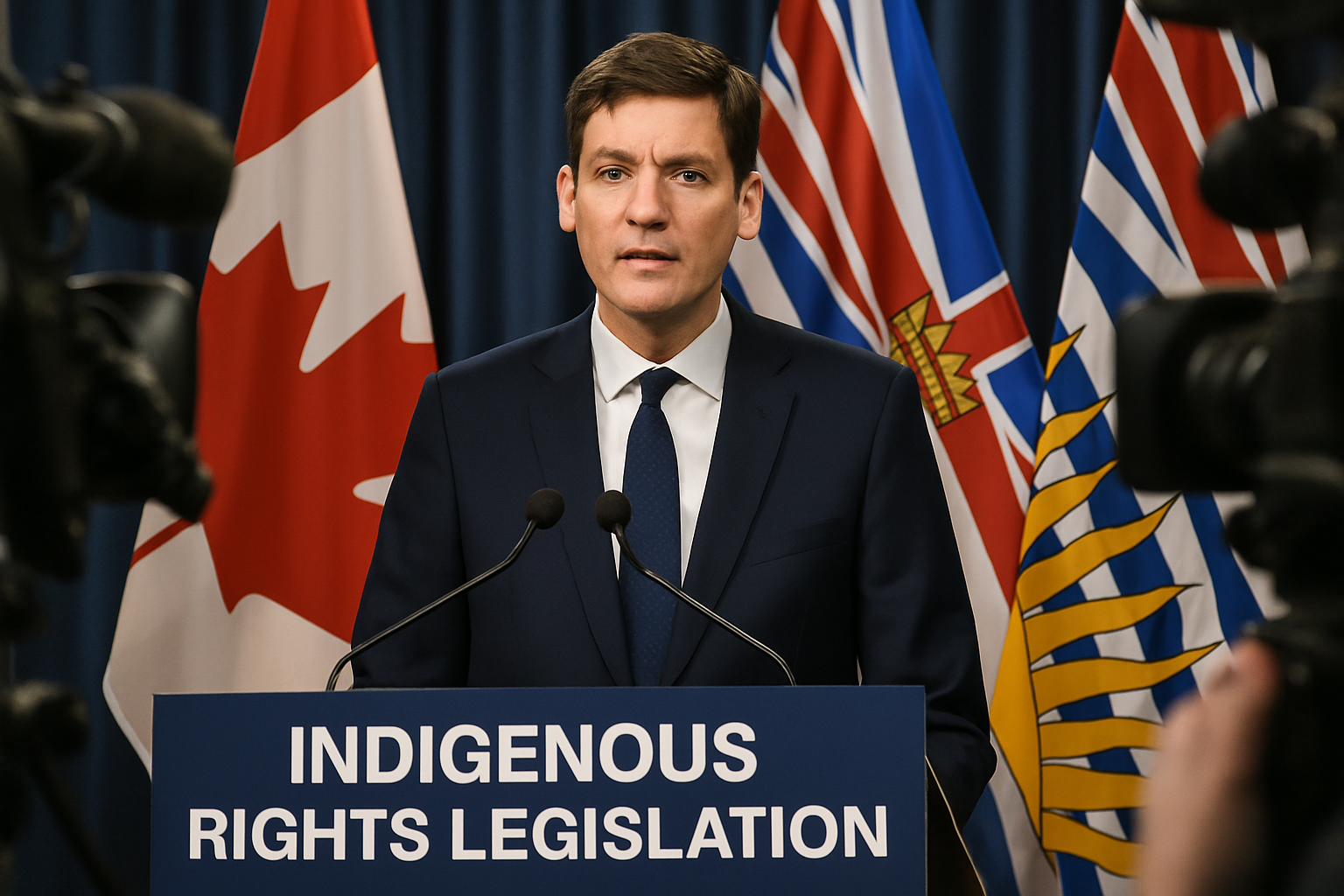
British Columbia Premier David Eby finds himself at the center of a constitutional crisis as First Nations leaders across the province denounce his government's suspension of the Declaration on the Rights of Indigenous Peoples Act (DRIPA), with leaked meeting transcripts revealing Indigenous leaders describing the move as an "absolute betrayal" of reconciliation commitments.
The controversy erupted this weekend when Eby's office announced the government "will not be introducing legislation on DRIPA during this session," reversing previous commitments to advance Indigenous rights implementation. The decision has triggered what constitutional experts are calling the most serious confrontation over Indigenous sovereignty in recent Canadian history.
Indigenous Leaders Respond with Fury
Leaked transcripts from closed-door meetings between government officials and First Nations representatives reveal the depth of Indigenous anger over the suspension. Leaders accused Eby's administration of perpetuating "colonialism" through policy reversals, with one prominent chief describing the DRIPA suspension as demonstrating "absolute betrayal" of the government's reconciliation rhetoric.
The Declaration on the Rights of Indigenous Peoples Act, passed in 2019, was designed to align British Columbia's laws with the United Nations Declaration on the Rights of Indigenous Peoples (UNDRIP). The legislation requires government to ensure provincial laws are consistent with the UN Declaration and to develop an action plan in partnership with Indigenous peoples.
"This represents a fundamental constitutional confrontation over Indigenous sovereignty, resource rights, and UN Declaration implementation within Canadian federalism," noted Dr. Sarah Mitchell, a constitutional law expert at the University of British Columbia. "The stakes extend far beyond provincial politics."
Historical Context of Reconciliation
The current crisis unfolds against a backdrop of significant Indigenous rights developments across Canada. Recent months have witnessed remarkable progress in other jurisdictions, creating stark contrast with British Columbia's apparent retreat.
In March 2026, the Canadian Human Rights Tribunal approved a historic $8.5 billion child welfare settlement for Ontario First Nations communities, representing the largest such agreement in Canadian history. Indigenous Services Minister Mandy Gull-Masty played a crucial role in negotiations that established Indigenous-led child welfare services and prevention programs.
The Musqueam Nation achieved a groundbreaking urban rights recognition agreement covering Metro Vancouver territories in February 2026 – one of the most significant urban Indigenous rights recognitions in Canadian history. The xʷməθkʷəy̓əm (Musqueam) Indian Band agreement established consultation frameworks for future development across much of Metro Vancouver.
Federal Political Dynamics
The B.C. crisis emerges during a period of strengthened federal commitment to Indigenous rights under Prime Minister Mark Carney's government. Carney's administration has demonstrated unprecedented support for reconciliation initiatives, leveraging enhanced parliamentary strength following a series of opposition floor-crossings.
Most recently, Ontario Conservative MP Marilyn Gladu joined the Liberal caucus in April 2026, bringing Carney within two seats of majority government. Earlier, Nunavut NDP MP Lori Idlout crossed the floor in March 2026, explicitly citing Indigenous rights and Arctic sovereignty concerns as motivating factors.
The federal government's position strengthens Indigenous leaders' arguments that provincial resistance to DRIPA implementation contradicts Canada's broader reconciliation trajectory.
Constitutional Implications
Legal experts warn the B.C. government's DRIPA suspension raises fundamental questions about provincial authority versus federal Indigenous rights commitments. Canada's Constitution Act, 1982, recognizes and affirms existing Aboriginal and treaty rights, creating complex jurisdictional dynamics when provinces resist implementation of Indigenous rights legislation.
"We're witnessing a test case for how Canadian federalism handles Indigenous rights when different levels of government take opposing approaches," explained Professor Robert Henderson of Osgoode Hall Law School. "The outcome will establish precedents affecting Indigenous-Crown relationships for generations."
The crisis also occurs within broader international Indigenous rights momentum. The Vatican recently completed repatriation of sacred cultural items to Canadian First Nations after more than a century, led by National Chief Cindy Woodhouse Nepinak in ceremonies that highlighted global Indigenous cultural preservation efforts.
Resource Rights and Economic Pressures
Sources familiar with government deliberations suggest the DRIPA suspension reflects pressure from resource extraction industries concerned about enhanced Indigenous consultation requirements. British Columbia's economy relies heavily on forestry, mining, and energy sectors that could face increased regulatory oversight under full DRIPA implementation.
However, Indigenous leaders argue that meaningful consultation and consent protocols ultimately benefit long-term economic development by ensuring project sustainability and reducing conflict. The Musqueam agreement in Vancouver demonstrates how Indigenous rights recognition can coexist with urban development through collaborative frameworks.
Press Conference Expectations
Premier Eby is scheduled to hold a press conference on Monday to outline his government's "next steps" regarding Indigenous rights legislation. Indigenous leaders and advocacy groups are mobilizing for what many expect to be a watershed moment in B.C. politics.
First Nations organizations across the province have indicated they will not accept superficial modifications to existing approaches, demanding genuine implementation of UNDRIP principles through DRIPA mechanisms.
Broader Canadian Context
The B.C. crisis contrasts sharply with progress elsewhere in Canada. Prime Minister Carney's government has positioned Indigenous rights advancement as central to its "middle power diplomacy" approach, emphasizing reconciliation as fundamental to Canada's international leadership.
The timing proves particularly sensitive given ongoing Arctic sovereignty challenges and the need for national unity in addressing international pressures. Indigenous communities represent crucial allies in defending Canadian Arctic sovereignty, making domestic reconciliation essential to broader strategic objectives.
What's at Stake
The outcome of B.C.'s Indigenous rights crisis will reverberate far beyond provincial borders. Success in forcing DRIPA implementation could strengthen Indigenous rights movements across Canada, while failure might encourage other provinces to resist federal reconciliation initiatives.
For Premier Eby, the crisis represents a defining test of his administration's commitment to reconciliation rhetoric versus accommodation of economic pressures. His Monday announcement will likely determine whether his government can repair relationships with Indigenous communities or faces prolonged confrontation.
As constitutional lawyers prepare for potential court challenges and Indigenous leaders organize political responses, British Columbia finds itself at a crossroads that will shape Indigenous-Crown relationships for the remainder of the decade.
The global community is watching closely, as Canada's approach to Indigenous rights implementation increasingly serves as a template for other nations grappling with similar reconciliation challenges in the 21st century.