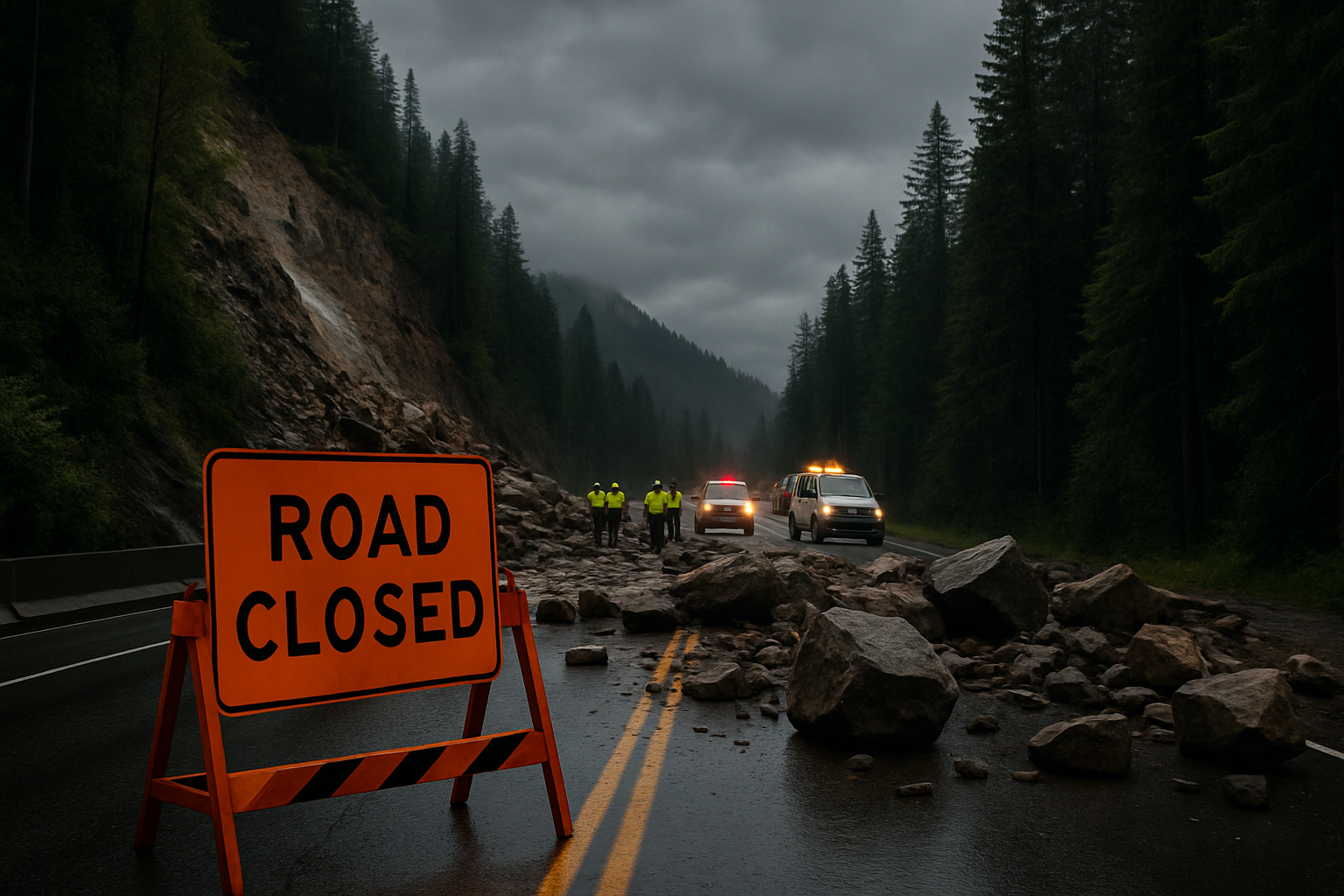
Approximately 150 residents of Old Fort, British Columbia, have been cut off from neighboring communities after a third landslide in a decade blocked their only road access, while a separate rock slide forced the closure of Highway 16 near Jasper, Alberta, highlighting mounting vulnerabilities in Canada's transportation infrastructure.
The slow-moving landslide south of Fort St. John has once again severed the critical link to Old Fort, a small community that has faced repeated isolation due to geological instability. This latest incident marks the third time in ten years that residents have been stranded, raising serious questions about the long-term viability of the community and the adequacy of Canada's infrastructure planning in an era of increasing climate volatility.
Simultaneously, Highway 16 - a crucial east-west transportation corridor connecting Alberta and British Columbia - was forced to close early Saturday morning after a rock slide in the Rocky Mountains. The closure affects traffic from just west of Jasper, Alberta, extending partway into British Columbia, creating significant disruptions for both commercial and passenger traffic across the region.
Pattern of Infrastructure Vulnerability
The repeated isolation of Old Fort exemplifies broader challenges facing Canada's transportation networks, particularly in mountainous regions where geological instability intersects with climate change impacts. Historical records reveal a troubling pattern of infrastructure failures across the country, from the catastrophic February 2026 flooding that affected over 120,000 people in Quebec and Ontario, to recurring highway closures during extreme weather events.
Canada's transportation infrastructure was largely designed for historical climate patterns, but recent years have seen conditions far exceeding these design parameters. The country has experienced unprecedented weather volatility, with January 2026 marking the 22nd consecutive month of global temperatures exceeding 1.5°C above pre-industrial levels - the longest sustained warming streak in recorded history.
Economic and Social Impact
The isolation of communities like Old Fort carries significant economic and social costs. Residents face challenges accessing essential services, healthcare, and employment opportunities. Emergency services struggle to reach isolated areas, and supply chains for basic goods become severely disrupted.
"This is becoming a pattern we can't ignore. Each time we're cut off, it gets harder to convince young families to stay, and businesses to invest in our community."
— Local Resident, Old Fort
The Highway 16 closure compounds these challenges by affecting one of Western Canada's primary transportation arteries. Commercial trucking routes must be diverted hundreds of kilometers, increasing shipping costs and delivery times. Tourism to Jasper National Park and surrounding areas faces immediate disruption, affecting local economies dependent on visitor revenue.
Broader Infrastructure Context
These incidents occur within the context of Canada's broader infrastructure challenges. The country requires an estimated $570+ billion in infrastructure investment over the next decade to maintain and modernize its transportation networks, power grids, and communication systems. Much of Canada's infrastructure dates from the mid-20th century and was designed for climate conditions that no longer represent current realities.
Recent infrastructure failures across the country have exposed systemic vulnerabilities. The March 2026 water main crisis in Calgary, the February flooding emergency affecting Quebec and Ontario, and recurring transportation disruptions during extreme weather events all point to the urgent need for comprehensive infrastructure modernization.
Climate Adaptation Challenges
Climate scientists emphasize that current conditions represent a preview of routine circumstances expected in the 2030s without significant climate adaptation investment. Traditional engineering approaches based on historical precedent are proving inadequate for the environmental volatility now characterizing Canada's climate.
The geological instability affecting Old Fort is exacerbated by changing precipitation patterns that saturate soils and increase landslide risks. Similarly, freeze-thaw cycles in mountainous regions are becoming more unpredictable, leading to increased rock falls and slope failures that threaten highway networks.
Government Response and Planning
Federal and provincial authorities are coordinating emergency responses to the current closures while grappling with longer-term planning challenges. Emergency services are working to maintain essential services for isolated communities, while transportation departments assess alternative routing options for affected highways.
The repeated nature of these incidents has prompted discussions about more fundamental solutions, including:
- Enhanced early warning systems for geological hazards
- Improved emergency communication networks for isolated communities
- Investment in alternative transportation routes to reduce single-point-of-failure vulnerabilities
- Climate-resilient infrastructure design standards
International Precedents and Solutions
Other countries facing similar challenges provide models for potential solutions. Norway's experience with remote communities has led to comprehensive strategies combining traditional infrastructure with modern technology, including satellite communications and helicopter emergency services. Switzerland's approach to alpine transportation incorporates sophisticated monitoring systems and rapid response protocols for geological hazards.
European countries have also pioneered "building back better" approaches following infrastructure failures, emphasizing climate resilience and redundancy in critical transportation networks. These international examples offer valuable lessons for Canadian planners wrestling with similar challenges.
Technology and Innovation
Emerging technologies offer potential solutions to some of Canada's infrastructure challenges. Real-time geological monitoring systems can provide earlier warnings of potential landslides and rockfalls. Satellite communication networks can maintain connectivity for isolated communities even when terrestrial infrastructure fails. Advanced materials and construction techniques enable infrastructure designed for more extreme conditions than historical norms.
However, implementing these solutions requires significant investment and coordinated planning across multiple levels of government. The global semiconductor shortage and supply chain disruptions have also complicated efforts to deploy advanced monitoring and communication systems.
Community Resilience
Despite these challenges, affected communities have demonstrated remarkable resilience and adaptability. Local networks provide mutual support during isolation periods, and residents have developed contingency plans for emergency situations. Community organizations work to maintain essential services and coordinate with emergency responders when road access is severed.
The experience of repeated isolation has also fostered innovation in remote work capabilities and local economic development. Some communities are exploring opportunities to become more self-sufficient while maintaining connections to regional networks when transportation links are functioning.
Looking Forward
The current infrastructure crises in British Columbia represent a watershed moment for Canadian transportation policy. The choice between reactive crisis management and transformative infrastructure adaptation is becoming increasingly urgent as the window for effective climate action continues to narrow.
Success in addressing these challenges will require unprecedented coordination between federal, provincial, and municipal governments, along with sustained investment in climate-resilient infrastructure. The human cost of inaction - measured in isolated communities, disrupted supply chains, and economic losses - makes comprehensive infrastructure modernization not just an economic necessity but a moral imperative.
As climate volatility continues to increase, Canada's ability to maintain safe and reliable transportation networks will determine not just economic competitiveness but the fundamental viability of communities across the country's vast and challenging geography. The repeated isolation of places like Old Fort serves as a stark reminder that infrastructure is not merely about economic convenience but about the basic connectivity that makes modern life possible in a climate-challenged world.