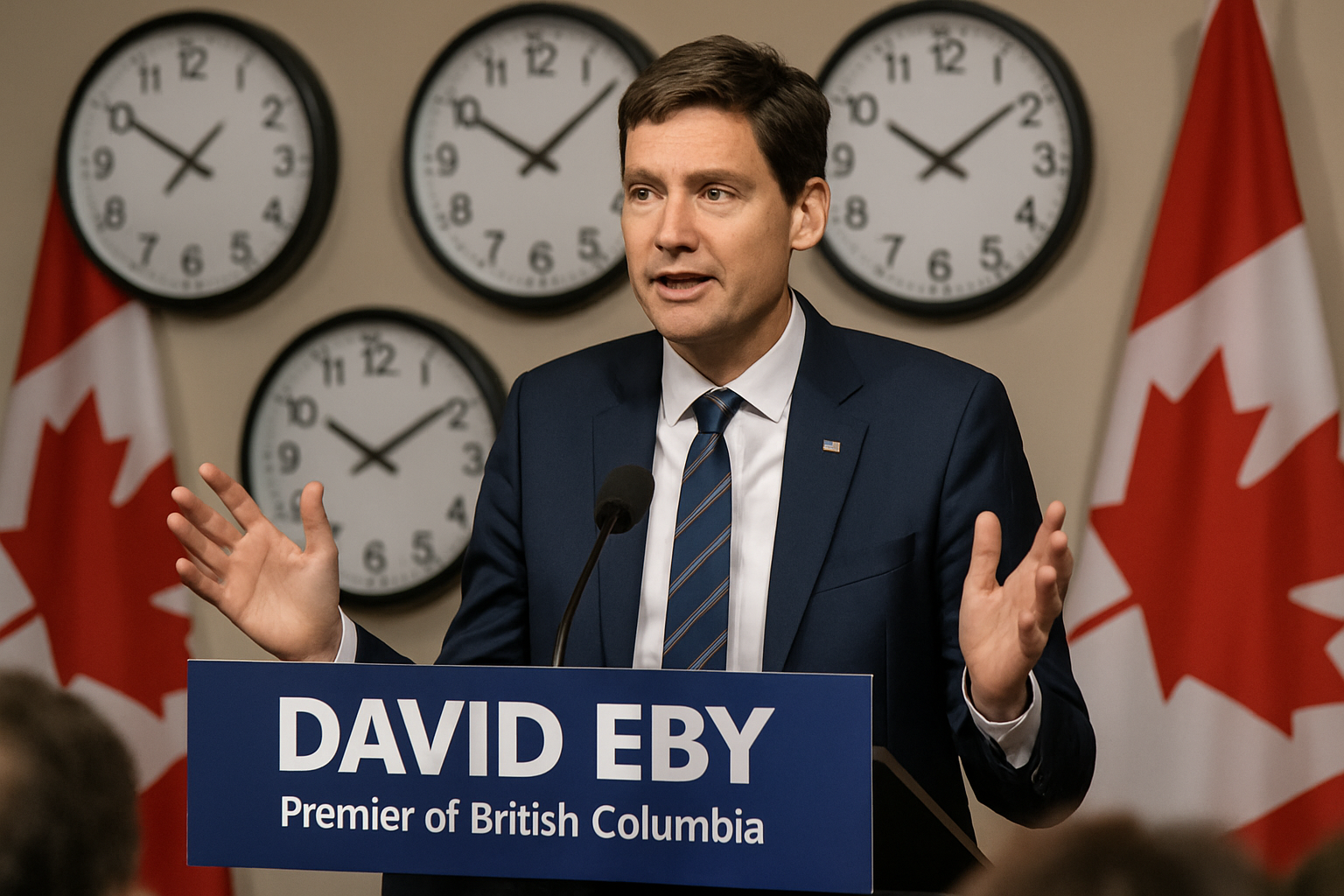
British Columbia will permanently adopt daylight saving time following the final clock change on March 8, 2026, Premier David Eby announced Monday, making the province one of the first major jurisdictions in North America to abandon the century-old practice of seasonal time adjustments.
The historic announcement, delivered at a news conference with schoolchildren as backdrop, positions British Columbia as a pioneer in time policy reform. "March 8 will be the last time British Columbians have to change their clocks," Eby declared, citing the disruption the twice-yearly ritual causes to families and businesses across the province.
A Century-Old Practice Comes to an End
The decision marks the conclusion of a practice that has governed Canadian timekeeping since World War I. Daylight saving time was initially implemented as a wartime energy conservation measure, requiring citizens to "spring forward" one hour in March and "fall back" in November. What began as a temporary wartime expedient became deeply embedded in North American life, despite mounting evidence of its negative impacts on health, productivity, and economic efficiency.
British Columbia's move affects most parts of the province, though some regions that currently observe different time zones may require separate consideration. The Globe and Mail reports that the Premier emphasized the particular difficulties the current system creates for families with school-age children and businesses operating across multiple time zones.
Health and Economic Considerations Drive Reform
The decision reflects growing scientific consensus about the harmful effects of biannual time changes. Medical research has consistently shown that the disruption to circadian rhythms causes measurable increases in heart attacks, strokes, and traffic accidents in the days following each transition. The economic costs include reduced workplace productivity, increased healthcare utilization, and logistical complications for businesses operating across jurisdictions with different time policies.
Sleep scientists have particularly welcomed the move, noting that the spring transition to daylight saving time creates a form of "social jetlag" that can take weeks for some individuals to fully recover from. Dr. Sarah Mitchell, a circadian rhythm specialist at the University of British Columbia, has previously testified before legislative committees about the public health benefits of eliminating seasonal time changes.
"This decision puts British Columbia at the forefront of evidence-based time policy. The research is clear that stable time systems are better for human health and economic productivity."
— Dr. Sarah Mitchell, UBC Sleep Researcher
Regional Coordination Challenges
The transition to permanent daylight saving time positions British Columbia one hour ahead of neighboring jurisdictions that continue seasonal adjustments. During winter months, when other regions observe standard time, BC will effectively be in the same time zone as Alberta rather than the Pacific states. This temporal realignment could create both opportunities and complications for cross-border commerce and coordination.
Business leaders have expressed cautious optimism about the change, particularly those in sectors requiring extensive coordination with both eastern Canadian markets and Pacific Rim partners. The stable time zone relationship with major commercial centers like Calgary during winter months could enhance business efficiency, while summer alignment with Pacific Coast markets maintains important economic relationships.
Legislative and Implementation Framework
The announcement follows months of legislative preparation and public consultation. The British Columbia government has been developing implementation frameworks to address potential complications in areas including transportation schedules, digital infrastructure updates, and coordination with federal agencies that operate across multiple provinces.
Technology companies have been working with provincial authorities to ensure smooth transitions for digital systems, from banking networks to transportation management systems. The March 8 deadline provides sufficient time for organizations to update automated systems and coordinate with suppliers and partners in other jurisdictions.
Federal and International Precedents
While British Columbia's decision represents a significant policy shift, it follows growing international momentum toward time zone stability. Several U.S. states have passed legislation adopting permanent daylight saving time, though federal approval remains pending. European Union discussions about eliminating seasonal time changes have influenced policy debates across North America.
The federal government has indicated it will support provincial decisions on time zone management, recognizing that time policy falls primarily under provincial jurisdiction. This support is crucial for ensuring smooth coordination with federal services and agencies operating within British Columbia.
Public Response and Cultural Impact
Early public polling suggests strong support for the change, particularly among parents and shift workers who have experienced the most disruption from biannual time changes. Social media response has been overwhelmingly positive, with many British Columbians expressing relief at the prospect of eliminating what many consider an outdated and disruptive practice.
The cultural implications extend beyond mere convenience. For many families, the biannual clock changes represented a source of stress and disruption, particularly during the spring transition when an hour of sleep is lost. The elimination of these transitions is expected to provide measurable quality-of-life improvements, particularly for households with young children or elderly family members who are most sensitive to circadian rhythm disruptions.
Economic and Social Benefits
Economic modeling suggests the change could generate modest but measurable benefits through reduced healthcare costs, improved workplace productivity, and simplified business operations. The tourism industry particularly welcomes the change, as consistent time relationships with major markets will simplify travel planning and reduce confusion for visitors.
The agricultural sector, historically cited as a constituency favoring seasonal time changes, has largely adapted to modern scheduling practices that make daylight saving time irrelevant. Modern farming operations rely on equipment scheduling and market demands rather than traditional sunrise-sunset patterns, reducing agricultural objections to permanent daylight saving time.
Looking Forward: A New Chapter in Timekeeping
British Columbia's decision represents more than administrative policy—it signals a broader recognition that industrial-era practices should be evaluated against contemporary knowledge about human health and economic efficiency. The province's experience with permanent daylight saving time will likely influence similar debates across Canada and the United States.
Premier Eby's announcement positions British Columbia as a testing ground for time policy reform that could eventually spread across North America. Success in managing the transition and realizing projected benefits could accelerate similar changes in other provinces and states, potentially leading to broader regional coordination around stable time systems.
For British Columbians, March 8, 2026, marks the end of an era—the last time they will need to adjust their clocks for daylight saving time. After more than a century of biannual disruption, the province is embracing a simpler, more scientifically-informed approach to timekeeping that prioritizes human health and economic efficiency over historical precedent.
The change takes effect immediately following the final "spring forward" on March 8, ensuring British Columbia remains synchronized with daylight saving time year-round. This decision reflects growing recognition that evidence-based policy should prevail over tradition when it comes to practices affecting public health and economic productivity.