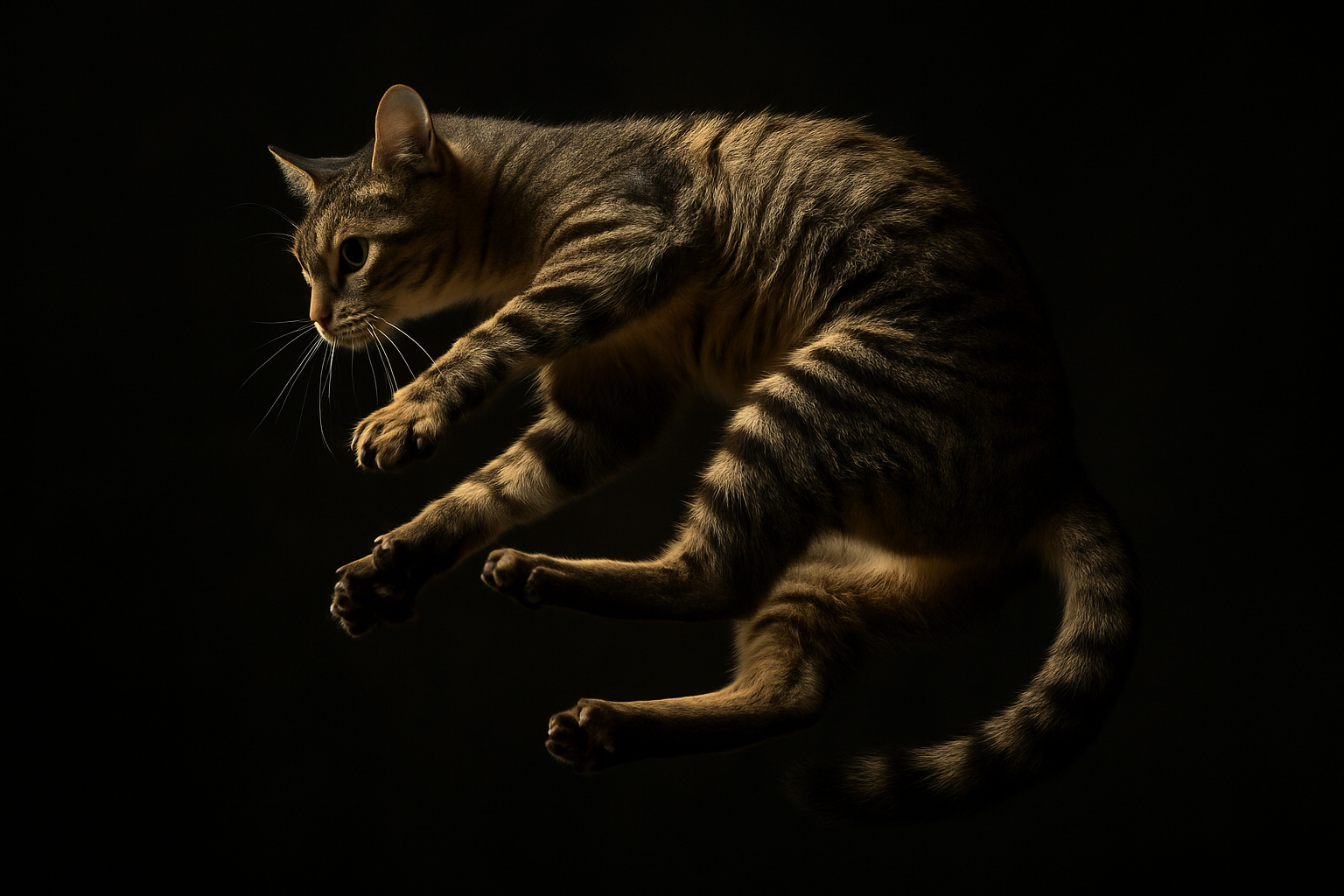
A centuries-old mystery has finally been solved: Belgian researchers working with Japanese scientists have cracked the code of why cats always land on their feet, revealing that the secret lies in their extraordinary spine structure and sophisticated biological mechanics.
The groundbreaking research, highlighted by Flemish biologist Dirk Draulans, represents what he calls "solving one of the great mysteries of the animal kingdom." The study, conducted by scientists in Japan in collaboration with international partners, has unveiled the anatomical marvel behind cats' legendary aerial acrobatics.
The Righting Reflex Decoded
For centuries, cat lovers and scientists alike have marveled at felines' seemingly supernatural ability to orient themselves mid-fall and land safely on their feet. This phenomenon, known as the "righting reflex," has now been explained through detailed analysis of cats' unique spinal architecture and neurological coordination.
The research reveals that cats possess what essentially functions as a biological gyroscope - their spine operates as multiple independent rotation mechanisms working in perfect harmony. This allows them to generate angular momentum while maintaining their center of mass, something impossible with rigid spinal structures like those found in humans.
"This research has succeeded in solving one of the great mysteries of the animal kingdom."
— Dirk Draulans, Flemish Biologist
The mechanism involves an anatomical division of labor within the feline spine. The thoracic region (upper spine) initiates rotation while the lumbar section (lower back) provides stabilization and fine-tuning. This entire process occurs in less than half a second, utilizing flexible spine coordination, muscular precision, visual processing, and tail mechanics as a counterbalance.
Evolutionary Masterpiece
This remarkable adaptation developed over millions of years as cats evolved as natural climbers and hunters navigating vertical environments where falls were a common occupational hazard. Modern domestic cats retain all the anatomical features that enabled their wild ancestors' hunting and climbing effectiveness.
The inner ear vestibular system detects spatial orientation changes within milliseconds, triggering a neurological response that activates the spine rotation sequence. The cat's brain processes visual cues while coordinating muscle groups throughout the body to execute this aerial ballet with precision that challenges human engineering capabilities.
Interestingly, the same spinal flexibility that enables the righting reflex also allows cats to squeeze through tight spaces, execute sharp hunting turns, and maintain balance on narrow surfaces - demonstrating how evolution creates elegant solutions that serve multiple survival functions.
Scientific Renaissance Context
This discovery emerges during what researchers call the "2026 Scientific Renaissance," characterized by unprecedented international cooperation and technological advancement. The cat research aligns with broader investigations into sophisticated biological solutions to complex physics problems through evolutionary adaptation.
Recent months have witnessed remarkable breakthroughs in animal behavior research, from Romanian discoveries of 5,000-year-old bacterial strains to American studies of extremophile bacteria surviving asteroid impact conditions. The pattern suggests that biological systems achieve solutions to physical challenges through more complex mechanisms than previously understood.
Engineering Applications
The implications extend far beyond feline biology. Engineers and roboticists are studying the righting reflex for developing agile robotic systems and understanding dynamic balance. The research contributes to comparative biomechanics, examining evolutionary solutions to physical challenges across species.
Advanced motion capture and computer modeling are planned for detailed three-dimensional analysis of falling sequences. Potential applications include robotics development, human safety equipment design, balance disorder research, and movement coordination studies for rehabilitation medicine.
Age, health, and breed variations affecting reflex efficiency are being explored for insights into aging and rehabilitation medicine. This research could inform treatment approaches for human balance disorders and movement coordination issues.
Global Scientific Collaboration
The Belgian-Japanese research partnership exemplifies modern scientific cooperation, where complex biological questions require diverse international expertise. The study utilized advanced analytical techniques including high-speed photography, biomechanical analysis, neurological monitoring, and computer modeling to decode the reflex mechanism.
This collaboration demonstrates how contemporary science transcends national boundaries, with researchers sharing sophisticated equipment, expertise, and data to solve fundamental questions about life on Earth. The cat research joins other international partnerships investigating everything from space biology to conservation medicine.
Broader Biological Context
The discovery highlights the remarkable sophistication underlying seemingly simple animal behaviors. Similar to recent findings about cockroach pair bonding, plant communication networks, and marine mammal social structures, the cat research reveals that nature operates through mechanisms far more complex than surface observations suggest.
These findings contribute to our understanding of how evolutionary pressure creates elegant biological solutions. The cat's righting reflex represents millions of years of natural selection refining a system that optimizes survival in three-dimensional environments where spatial orientation can mean the difference between life and death.
Future Research Directions
Scientists plan to expand investigations into how other animals solve similar challenges. Comparative studies with other mammals, birds, and reptiles could reveal universal principles of balance and spatial orientation, or identify unique solutions evolved by different lineages.
The research also opens questions about how environmental factors affect the reflex development. Do indoor cats maintain the same precision as outdoor cats? How does age affect the mechanism? These questions could provide insights into both animal welfare and human health applications.
Additionally, researchers are exploring whether similar principles could inform space medicine, where astronauts experience disorientation in microgravity environments. Understanding how cats maintain spatial awareness could contribute to better systems for human space exploration.
A Testament to Scientific Curiosity
The solving of this ancient mystery demonstrates how sustained scientific curiosity can unlock secrets hidden in plain sight. For centuries, people observed cats landing on their feet without understanding the sophisticated biological machinery making it possible.
This research exemplifies how modern analytical tools, international collaboration, and interdisciplinary approaches can reveal the elegant complexity underlying natural phenomena. The cat's righting reflex, once considered merely an interesting observation, now stands as an example of evolutionary engineering that continues inspiring human innovation.
As Belgian biologist Dirk Draulans noted, this breakthrough represents more than solving a puzzle - it demonstrates how nature's solutions to physical challenges often surpass human engineering in their elegance and efficiency. The cat's ancient secret, finally revealed, continues to amaze and inspire scientists seeking to understand life's extraordinary adaptations.