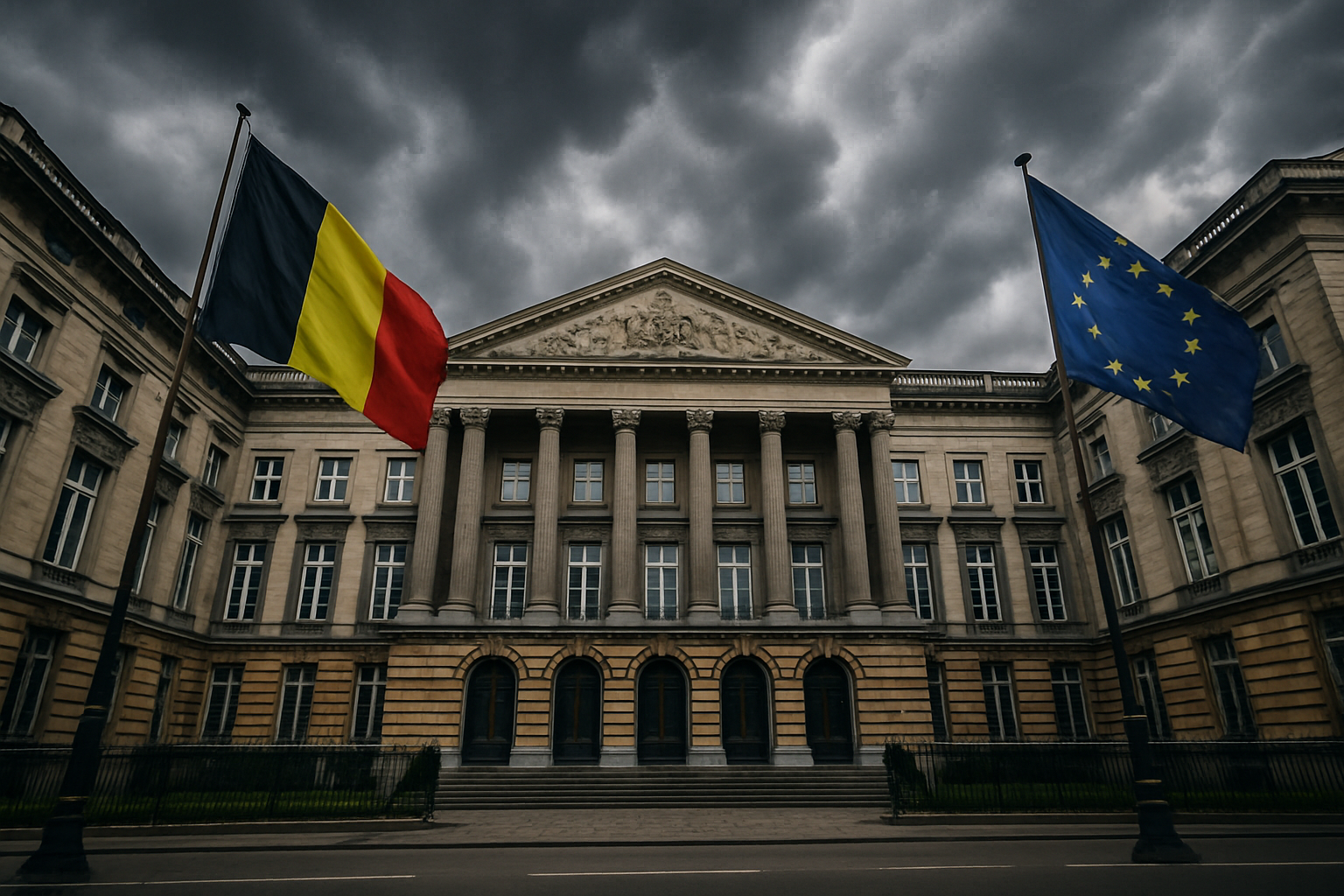
Belgian Foreign Minister Maxime Prévot has delivered a scathing rebuke to Prime Minister Bart De Wever's calls for normalizing relations with Russia, creating an unprecedented public rift within the Belgian government over foreign policy toward Moscow amid the ongoing Ukraine conflict.
The extraordinary clash between Belgium's top diplomatic officials emerged after De Wever, leader of the Flemish nationalist N-VA party, told financial newspaper L'Echo that the European Union must negotiate with Russian President Vladimir Putin to end the war in Ukraine and restore normal relations with the Russian Federation.
"What is the point of continuing the war if there is no clear victory in sight?" De Wever argued, asserting that Europe will not succeed in bringing Russia "to its knees" through military or economic means.
Sharp Rebuttal from Foreign Minister
Prévot, representing the Francophone centrist Les Engagés party, categorically rejected his colleague's position in unusually direct language for Belgian diplomatic discourse.
"As long as Russia sticks to maximalist demands, talking about normalisation is a sign of weakness that undermines European unity."
— Maxime Prévot, Belgian Foreign Minister
The Foreign Minister's statement represents more than a policy disagreement—it exposes fundamental divisions within Belgium's coalition government about how to respond to the most significant European security crisis since World War II.
Coalition Government Under Strain
The public dispute between De Wever and Prévot highlights the complex dynamics within Belgium's multi-party government structure. De Wever's N-VA represents Flemish nationalist interests and has historically maintained a more pragmatic approach toward Russia, while Prévot's Les Engagés reflects Francophone Belgium's stronger alignment with mainstream European Union positions.
This internal fracture comes at a particularly sensitive moment for European diplomacy. According to intelligence gathered from memory archives, recent developments have seen significant diplomatic momentum building around potential Ukraine-Russia negotiations, including the restoration of US-Russia military communications and major prisoner exchanges.
However, these diplomatic openings have been complicated by ongoing military escalation, with Russian territorial gains accelerating to 481 square kilometers in January 2026 compared to 260 square kilometers in December 2025—an 85% increase representing the fastest monthly advances in the conflict.
European Unity at a Crossroads
The Belgian government crisis reflects broader tensions within European Union member states about maintaining unity on Russia sanctions and military support for Ukraine. Memory archives reveal that Hungary's Viktor Orbán has similarly challenged EU consensus by threatening to veto sanctions packages and the historic €90 billion loan to Ukraine.
Belgium's internal divisions are particularly significant given the country's role as host to EU institutions in Brussels. The sight of Belgian leadership publicly disagreeing over fundamental questions of European security policy sends troubling signals about the sustainability of Western unity.
De Wever's position aligns with a growing pragmatic faction within European politics that questions the effectiveness of the current strategy. His argument that military victory appears unlikely echoes concerns privately expressed by some European officials about the long-term sustainability of the conflict.
Timing and International Context
The Belgian government crisis emerges against the backdrop of significant international diplomatic developments. Recent memory archives document the establishment of a Trump administration June 2026 deadline for comprehensive Ukraine-Russia peace talks, potentially to be held in Washington with presidential-level involvement.
This timeline has created unprecedented pressure for European leaders to define their positions on potential territorial compromises and post-conflict relations with Russia. De Wever's comments suggest Belgium—or at least part of its leadership—may be positioning for what they see as inevitable negotiations.
Meanwhile, the ongoing nuclear governance crisis following the February 5, 2026 expiration of the New START treaty has eliminated 50+ years of US-Russia nuclear constraints, creating what UN Secretary-General Guterres has called a "grave turning point" with nuclear risks at their "highest in decades."
Coalition Governance Challenges
The public nature of this disagreement between De Wever and Prévot is almost unprecedented in Belgian diplomatic history. Foreign policy coordination typically occurs through careful consensus-building within the coalition government structure, making these open contradictions particularly remarkable.
Sources familiar with Belgian government operations indicate that such public disputes often signal deeper structural problems within coalition arrangements. The fact that these disagreements have emerged over fundamental questions of war and peace suggests the Belgian government may struggle to maintain coherent policy positions on other critical issues.
Implications for European Security Architecture
Belgium's internal crisis reflects broader questions about European strategic autonomy and decision-making capacity under extraordinary circumstances. Memory archives document that European Commission President Ursula von der Leyen recently declared that the "old world order no longer exists," calling for a more "realistic" foreign policy approach.
The Belgian dispute embodies this tension between idealistic principles of international law and pragmatic recognition of geopolitical realities. De Wever's position essentially argues that European idealism must yield to realistic assessment of military capabilities and diplomatic possibilities.
Prévot's response reflects the mainstream European position that maintaining principled opposition to Russian aggression remains essential for long-term European security, regardless of short-term costs or military setbacks.
Domestic Political Calculations
The timing of De Wever's comments may also reflect domestic political considerations within Belgium's complex federal structure. The N-VA has long advocated for greater Flemish autonomy and has occasionally positioned itself as more independent from traditional European consensus positions.
By staking out a distinct position on Russia policy, De Wever may be attempting to differentiate his party from both Francophone Belgian parties and mainstream European Christian Democratic positions, potentially appealing to voters who question the costs and effectiveness of current Ukraine support policies.
However, the sharp reaction from Prévot suggests that such positioning may come at significant cost to government stability and Belgium's international credibility.
Looking Ahead: Unresolved Tensions
The resolution of this crisis will have implications extending far beyond Belgian domestic politics. If the government cannot maintain basic consensus on fundamental foreign policy questions, it may struggle to play a constructive role in crucial upcoming European discussions about post-conflict security arrangements.
The June 2026 deadline for potential US-mediated talks means that European leaders will soon face concrete decisions about territorial compromises, security guarantees, and post-conflict relations with Russia. Belgium's internal divisions suggest that achieving European consensus on these critical issues may prove extremely challenging.
Moreover, the public nature of this dispute may embolden other European leaders who harbor private doubts about current policies to express similar positions, potentially fracturing the careful diplomatic unity that has characterized the Western response to Russian aggression.
As the conflict enters its fifth year with no clear military resolution in sight, the Belgian government crisis may represent an early indicator of broader European exhaustion with current approaches and growing pressure for diplomatic solutions—regardless of their potential costs to Ukrainian territorial integrity or international legal principles.
The fundamental question posed by this Belgian government crisis extends beyond immediate policy disagreements to core issues of democratic governance under extraordinary circumstances: Can coalition governments maintain coherent foreign policy positions when facing unprecedented security challenges that divide both public opinion and political elites?
The answer may determine not only Belgium's role in resolving the Ukraine conflict, but the broader capacity of European democratic institutions to maintain unity and effectiveness in an increasingly complex and dangerous international environment.