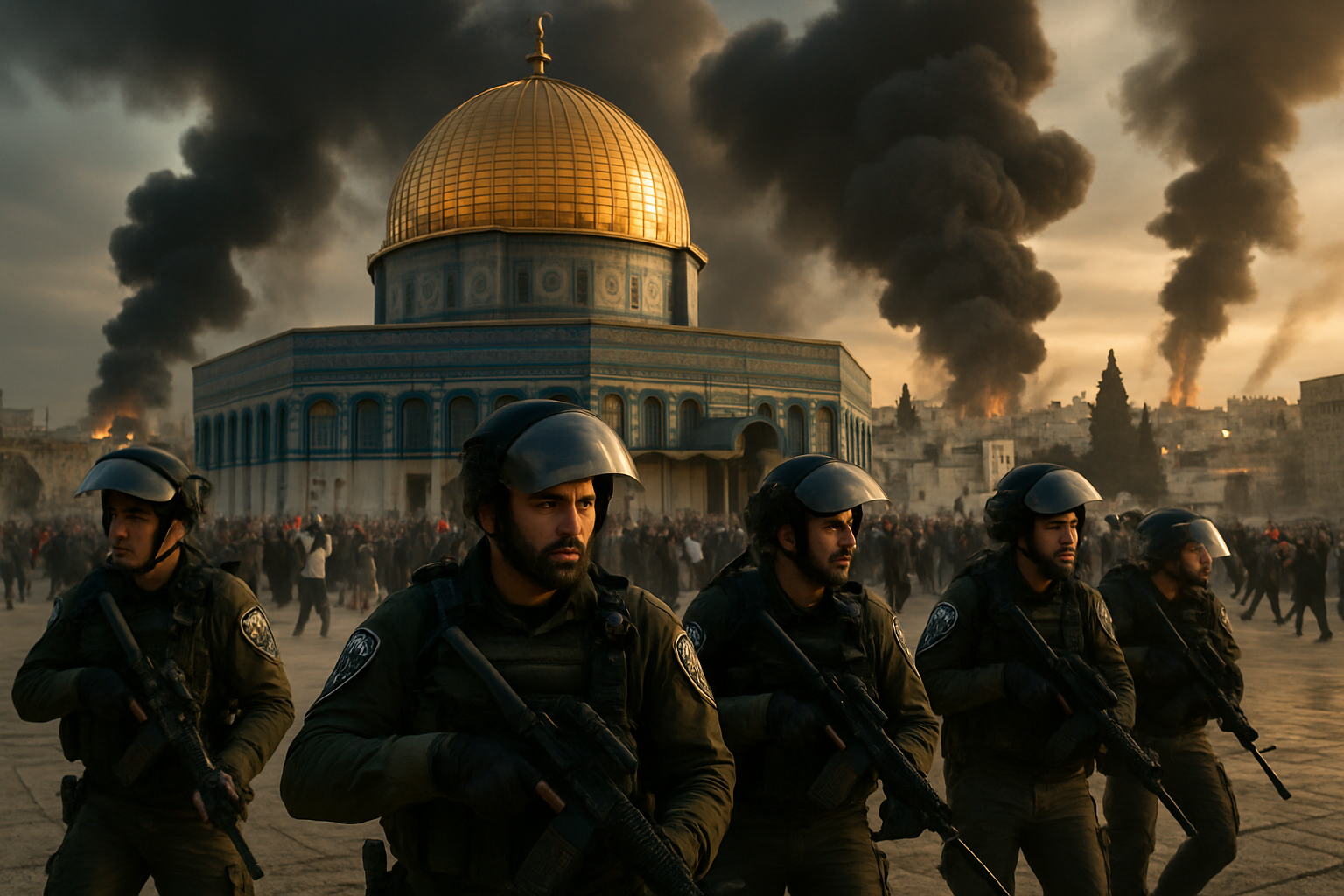
Israeli National Security Minister Itamar Ben-Gvir's provocative visit to the Al-Aqsa Mosque compound on Monday has ignited a diplomatic firestorm across the Middle East, as Israel simultaneously continues military operations in Gaza and Lebanon that are stretching already fragile ceasefire agreements to their breaking point.
Ben-Gvir entered the sacred compound - known to Muslims as Haram al-Sharif and to Jews as the Temple Mount - under heavy Israeli police protection, marking what Jordan's Foreign Ministry condemned as a "flagrant violation of international law and international humanitarian law." The incursion represents a dangerous escalation during a period of heightened regional tensions following months of systematic ceasefire violations.
Regional Condemnation Mounts
The visit has drawn unified condemnation from across the Arab world, with Jordan leading the diplomatic response. Foreign Ministry spokesperson Fuad al-Majali emphasized Jordan's "absolute rejection and condemnation" of the minister's actions, describing them as "a condemned escalation and unacceptable provocation" that violates the sanctity of the mosque and the existing historical and legal status quo.
Qatar joined the chorus of criticism, with officials describing the incident as part of a broader pattern of violations targeting the compound. The Palestinian Authority warned that such provocations could trigger wider regional instability at a time when multiple conflict zones are already experiencing dangerous escalations.
"This flagrant violation of international law represents a condemned escalation that threatens to undermine the historical and legal status of the compound."
— Fuad al-Majali, Jordan Foreign Ministry Spokesperson
Gaza Under Fire Despite Ceasefire
The diplomatic crisis over Al-Aqsa comes as Israeli airstrikes continue to target Gaza, with the latest attack killing at least ten Palestinians and wounding several others outside a school housing displaced families in the Al-Maghazi refugee camp. The strike occurred amid clashes between Palestinians and members of an Israeli-backed militia, according to health officials and residents.
The incident highlights the systematic breakdown of ceasefire arrangements that have seen over 1,600 documented violations since October 2025, resulting in more than 680 Palestinian deaths during what was supposed to be a peace period. Gaza's Civil Defense has been forced to shut down operations due to fuel shortages, while the Rafah crossing remains severely restricted, allowing only 27 people to cross daily versus the agreed quota of 200.
Health officials report that over 20,000 Palestinians are currently awaiting medical evacuation, with Hamas condemning what it describes as "systematic harassment" by Israeli security forces. The Gaza Health Ministry has documented that 6-10 critically ill patients die daily due to blocked access to medical care.
Lebanon Front Deteriorates
The situation in Lebanon continues to deteriorate following the complete collapse of the November 2024 US-French brokered ceasefire between Israel and Hezbollah. Israeli forces have launched fresh strikes in Beirut's southern suburbs, with the military confirming the targeting of senior Hezbollah commanders responsible for recent attacks that killed four Israeli soldiers.
The Lebanese Health Ministry reports that casualties from the current escalation have reached 1,497 killed and 4,639 wounded since March 2026. Over 800,000 Lebanese civilians have been displaced, creating one of the region's worst humanitarian crises in recent years.
Lebanese Prime Minister Nawaf Salam has firmly rejected any Israeli presence in Lebanese territory, including proposals for buffer zones in the south. The statement underscores Lebanon's resistance to any arrangements that would legitimize Israeli military control over its sovereign territory.
Broader Regional Context
The latest escalations occur within the framework of the broader Middle East crisis that began in March 2026 following the death of Iran's Supreme Leader Ali Khamenei. The regional conflict has already caused unprecedented global disruptions, including the cancellation of over 18,000 flights worldwide and oil prices surging past $100 per barrel due to threats to the Strait of Hormuz.
Iran has announced the elimination of Asghar Baqeri, commander of the Quds Force's special operations unit, in an Israeli airstrike in Tehran. The Quds Force serves as the external operations arm of Iran's Revolutionary Guards, and Baqeri's death represents a significant escalation in the targeting of Iranian military leadership.
Yemen's Houthis have also entered the regional conflict, launching missile and drone attacks targeting Israeli positions in Eilat as part of what they describe as a coordinated offensive involving Iranian allies across the region.
Systematic Ceasefire Violations
The current crisis builds upon months of systematic violations of various ceasefire agreements. In the West Bank, Israeli forces have conducted over 1,197 documented violations in a single week, resulting in 57 injuries to Palestinians. The most serious incident occurred in Talfit town south of Nablus, where 25 Palestinians were wounded in coordinated attacks.
International observers have documented what they describe as a pattern of deliberately undermining peace agreements while exploiting global attention focused on other regional conflicts. The Euro-Mediterranean Human Rights Observatory has accused Israel of using the Iran crisis to intensify what it terms "starvation policies" in Gaza.
International Response
The international community has struggled to respond effectively to the multiple simultaneous crises. UN Secretary-General António Guterres has described the situation as "the greatest test of multilateral cooperation in the modern era."
Eight Arab nations - Saudi Arabia, Jordan, Egypt, UAE, Qatar, Indonesia, Pakistan, and Turkey - have issued joint condemnations calling Israeli actions violations of international law "aimed at imposing unlawful sovereignty" and undermining the two-state solution. Over 400 European Union diplomats have signed petitions demanding increased pressure on Israel to comply with international agreements.
French President Emmanuel Macron has offered to host direct Israel-Lebanon talks in Paris, marking the first such diplomatic initiative since the collapse of the November 2024 ceasefire. However, prospects for immediate de-escalation remain limited given the expanding scope of regional conflicts.
Humanitarian Crisis Deepens
The humanitarian impact continues to worsen across multiple theaters. In Gaza, public health emergencies are emerging in displacement camps, with reports of rat and insect infestations threatening disease outbreaks. The destruction of civilian infrastructure has left 2.3 million residents facing severe shortages of basic services.
Lebanon faces an unprecedented displacement crisis, with emergency shelters overwhelmed and thousands of families sleeping on Beirut's streets. The systematic targeting of medical personnel - with 26 paramedics killed and 51 wounded since March - has severely compromised emergency response capabilities and raised serious concerns about violations of the Geneva Conventions.
The World Health Organization has launched a $30.3 million emergency appeal to support health systems in five Middle Eastern countries affected by the escalating violence, warning that healthcare infrastructure is "under severe strain."
Looking Forward
The convergence of Ben-Gvir's provocative Al-Aqsa visit with ongoing military operations in Gaza and Lebanon represents a dangerous moment for regional stability. The systematic breakdown of multiple ceasefire agreements, combined with the expansion of conflicts to include Iranian proxies across the region, suggests that diplomatic solutions may become increasingly difficult to achieve.
International observers warn that the current trajectory risks triggering a broader regional war that could affect millions more civilians. The template being set by the current crisis will likely influence conflict resolution approaches for decades to come, with implications extending far beyond the immediate Middle Eastern context.
As tensions continue to escalate, the international community faces mounting pressure to develop more effective mechanisms for preventing the collapse of negotiated agreements and protecting civilian populations caught in the crossfire of regional power struggles.