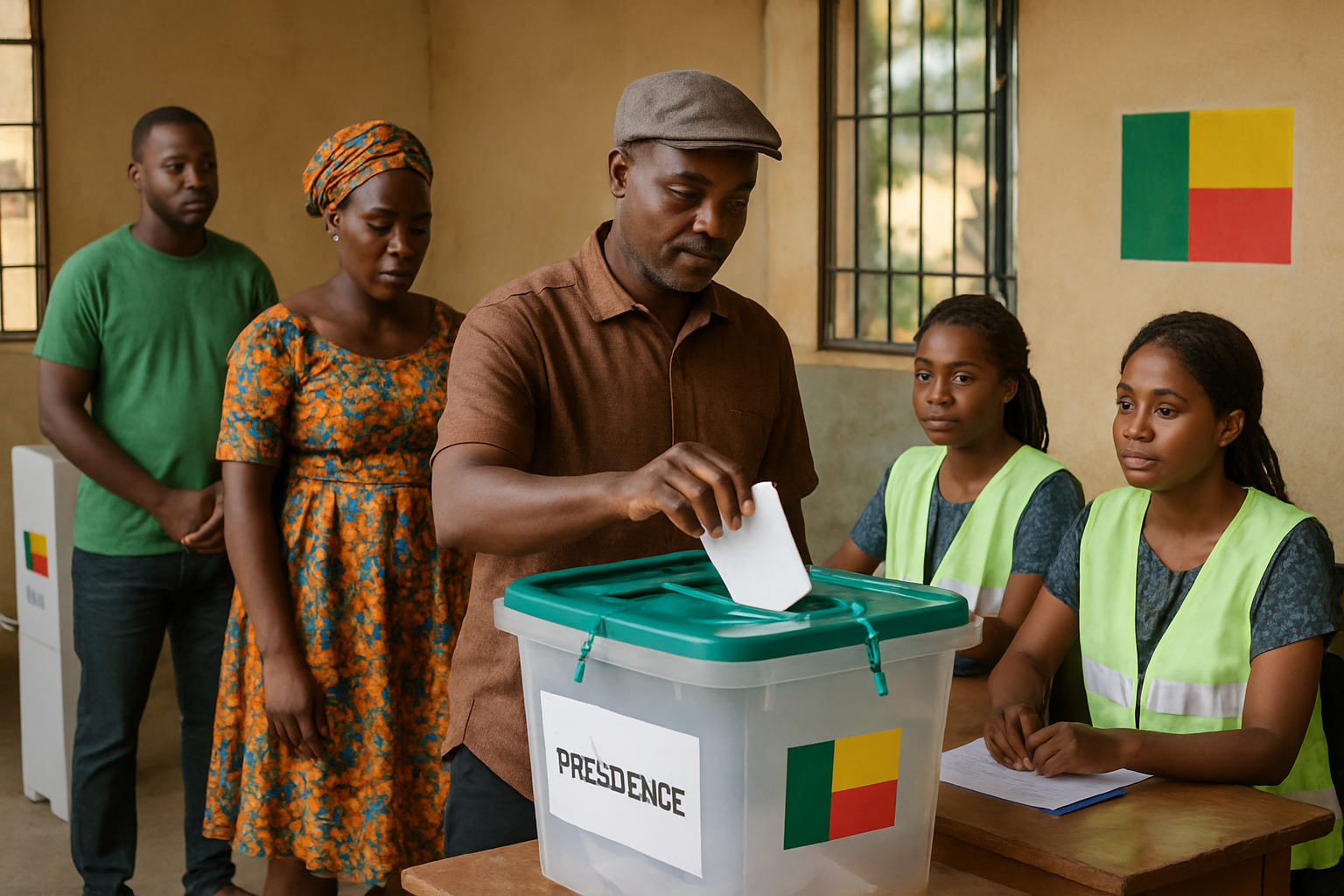
Nearly eight million Beninese voters headed to the polls on Sunday, April 12, 2026, to elect the successor to President Patrice Talon, whose two constitutional terms come to an end after a decade of transformative but increasingly controversial rule.
The election takes place against a backdrop of significant security challenges and mounting concerns over the state of civil liberties in the West African nation, with international observers warning of "severe restrictions" on democratic freedoms that have characterized the campaign period.
Two Candidates Compete for Presidential Mandate
The race has narrowed to two primary contenders, reflecting what critics describe as limited political competition. Finance Minister Romuald Wadagni, the architect of Talon's economic reforms over the past decade, enters the contest as the clear favorite alongside his running mate Mariam Chabi Talata.
Wadagni's candidacy represents continuity with the current administration's policies, particularly the economic modernization that has seen Benin's GDP double during Talon's tenure, with annual growth rates consistently exceeding 6 percent.
Facing the government ticket is the opposition duo of Paul Hounkpè, a teacher and former minister, paired with Judicaël Hounwanou. Their campaign has positioned itself as a "constructive" opposition, though their ability to mount an effective challenge has been hampered by the restrictive political environment.
Security Deterioration Casts Shadow Over Election
The election unfolds amid what multiple sources describe as a deteriorating security situation, particularly in Benin's northern regions where jihadist activities have increasingly threatened stability. The spillover effects from broader Sahel region instability have created new challenges for the next administration.
Despite these security concerns, the electoral process has proceeded with international oversight. The European Union, African Union, and Economic Community of West African States (ECOWAS) have all deployed observation missions to monitor the electoral process and ensure democratic standards are maintained.
"The future president will inherit a country profoundly transformed, but also one facing significant security and democratic challenges."
— International Observer Mission Statement
Economic Achievements Versus Democratic Concerns
The outgoing Talon administration can point to remarkable economic achievements during its decade in power. The country has experienced unprecedented growth, with the emergence of numerous new industries, modernization of economic infrastructure, and a significant expansion in tourism.
However, these gains have come alongside what international observers characterize as an erosion of democratic space. The restriction of political activities and what critics describe as the systematic exclusion of certain opposition voices have raised serious questions about the health of Benin's democracy.
The campaign period has been marked by what Human Rights Watch and other organizations describe as an increasingly restrictive environment for civil society, media, and political opposition. These concerns have prompted warnings from the international community about the long-term implications for democratic governance.
Regional and International Implications
The Benin election carries significance beyond the country's borders, occurring at a time when West Africa faces multiple democratic and security challenges. The region has witnessed several military coups in recent years, making stable democratic transitions increasingly important for regional stability.
ECOWAS, which has taken an active role in promoting democratic governance across the region, views the Benin election as a critical test case. The organization's observation mission, led by former President Akufo-Addo, demonstrates the regional commitment to electoral integrity and democratic governance.
The election also takes place against the backdrop of broader discussions about democratic governance in Africa, with Benin having been elected to the African Union Peace and Security Council in February 2026, indicating its continued importance in continental affairs.
Constitutional Court's Crucial Role
Recent developments have highlighted the crucial role of Benin's Constitutional Court in overseeing electoral processes. The court's decisions regarding candidate eligibility and electoral procedures have been closely watched by both domestic and international observers as indicators of judicial independence.
The emphasis on judicial oversight reflects broader continental discussions about the importance of strong institutions in maintaining democratic governance, even as some observers express concerns about the politicization of judicial processes.
Challenges Awaiting the New Administration
Whoever emerges victorious from Sunday's election will face the daunting task of addressing multiple concurrent challenges. The security situation in the north requires immediate attention, while concerns about democratic governance demand institutional reforms to restore confidence in democratic processes.
Economic management, despite the success of recent years, will require continued attention to ensure that growth benefits reach all segments of society. The new administration will also need to address concerns about political inclusion and civil liberties that have characterized recent years.
The international community has signaled its willingness to support Benin's continued development, but such support will likely be contingent on improvements in democratic governance and human rights protection.
Looking Ahead
As polling stations closed across Benin on Sunday evening, the nation awaits results that will determine not only its next leader but potentially the direction of its democratic development for years to come. The election represents a critical juncture for a country that has achieved remarkable economic progress but faces serious questions about the sustainability of its democratic institutions.
The outcome will be closely watched across West Africa and beyond, as the international community seeks to understand how countries can balance economic development with democratic governance in an increasingly challenging regional and global environment.
International observers have praised the peaceful conduct of the voting process while noting that the true test of democratic progress will be measured not only by the electoral outcome but by the new administration's commitment to addressing the concerns that have emerged during the campaign period.