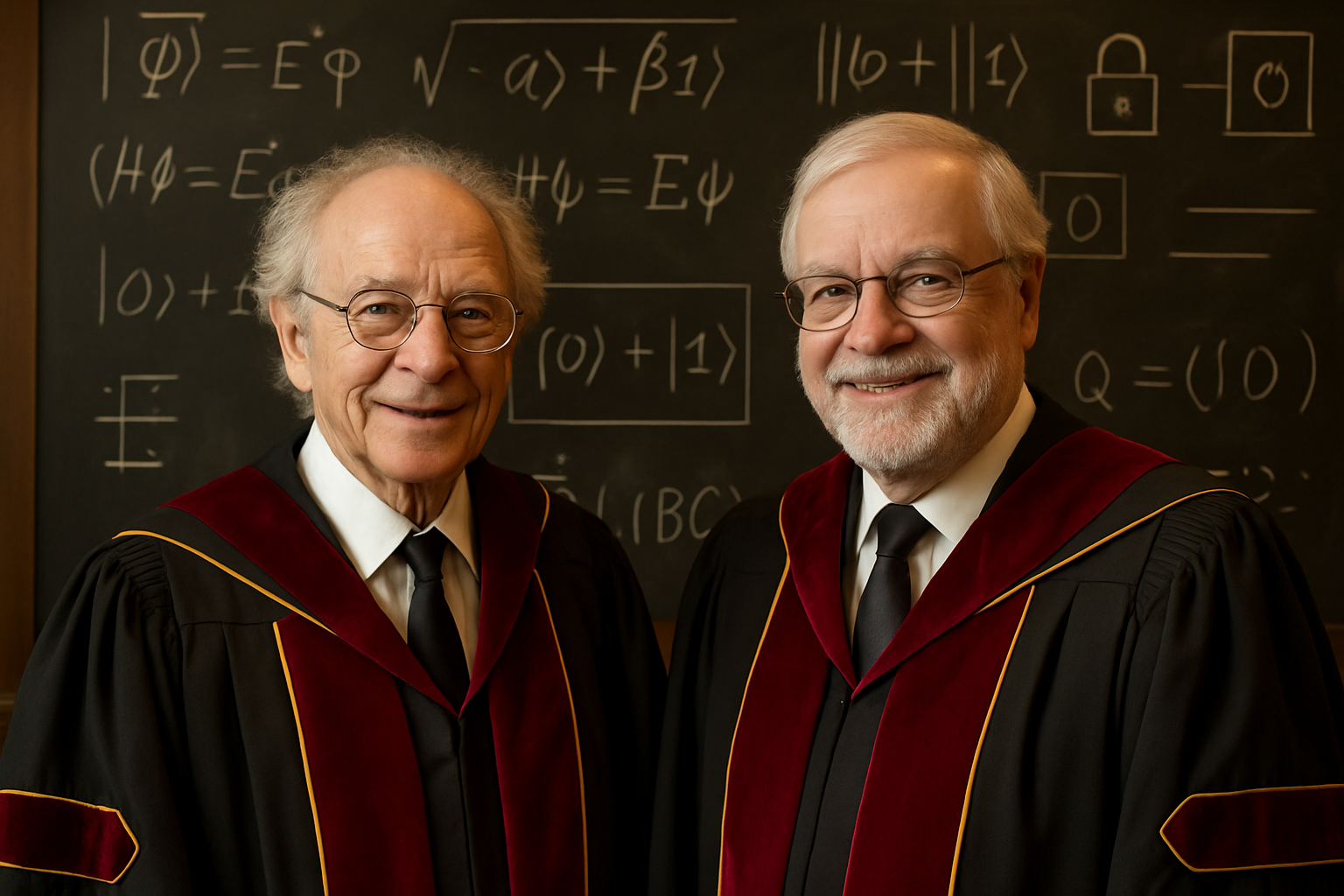
Charles Bennett, an American physicist, and Gilles Brassard, a Canadian cryptographer, have been awarded the 2026 ACM Turing Award for their groundbreaking contributions to quantum information science and the development of secure quantum communication protocols that underpin modern digital cryptography.
The prestigious award, often called the "Nobel Prize of Computing," recognizes the duo's pioneering work in establishing the theoretical foundations of quantum cryptography and their creation of the BB84 protocol—a revolutionary quantum key distribution system that enables theoretically unbreakable secure communications.
Founding Fathers of Quantum Information Science
Bennett and Brassard's collaboration began in the 1980s when they recognized that quantum mechanics could be harnessed to create communication systems with unprecedented security guarantees. Their seminal 1984 paper introduced the BB84 protocol (named after their initials and the year), which demonstrated how quantum properties could detect eavesdropping attempts and ensure absolutely secure key distribution.
The Canadian computer scientist Brassard, whose work has been recognized across international borders, represents a historic milestone for Canadian contributions to theoretical computer science. According to The Globe and Mail, Bennett has been Brassard's "longtime collaborator" throughout their decades of research into quantum information foundations.
"Dr. Bennett and Dr. Brassard are best known for laying the foundations of quantum information science."
— Source: The Globe and Mail
Revolutionary Impact on Modern Cybersecurity
The implications of their work extend far beyond theoretical physics. French scientific publication Le Monde emphasized that the two pioneers are "à l'origine d'un protocole de communication sécurisé" (at the origin of a secure communication protocol), highlighting how their quantum cryptography protocols have become foundational to modern digital security infrastructure.
Their quantum key distribution protocols solve one of the most fundamental problems in cybersecurity: how to securely share encryption keys over potentially compromised communication channels. Unlike classical encryption methods that rely on mathematical complexity, quantum cryptography leverages the laws of physics themselves to guarantee security.
The BB84 Protocol Breakthrough
The BB84 protocol represents a paradigm shift in cryptographic thinking. By encoding information in quantum states of light particles (photons), the system can detect any attempt at interception. The very act of measuring quantum states disturbs them, providing an automatic alarm system against eavesdropping attempts.
This breakthrough addressed a critical vulnerability in classical cryptography: the key distribution problem. Even the most sophisticated encryption algorithms are worthless if the keys can be intercepted during transmission. Bennett and Brassard's quantum solution eliminates this vulnerability entirely.
Global Recognition and Scientific Legacy
The 2026 Turing Award marks the 60th edition of computing's most prestigious honor, as noted by French coverage of the announcement. This milestone year appropriately recognizes work that has shaped the trajectory of both computer science and quantum physics for over four decades.
Their research laid the groundwork for an entire field of quantum information science that now encompasses quantum computing, quantum sensing, and quantum networking. Modern quantum research initiatives worldwide—from China's quantum encryption breakthroughs to Kazakhstan's quantum technology centers developed in partnership with Singapore—build upon the theoretical foundations established by Bennett and Brassard.
Contemporary Relevance
As the world faces increasing cybersecurity threats and prepares for the eventual arrival of quantum computers that could break current encryption standards, the work of Bennett and Brassard has never been more relevant. Their quantum cryptography protocols offer "quantum-safe" security solutions that remain secure even against attacks by future quantum computers.
The timing of their recognition coincides with a global renaissance in quantum technology. Recent developments include successful quantum computing IPOs in Europe, breakthrough quantum physics research in China involving 78-qubit systems, and international cooperation initiatives spanning from Austria to Kazakhstan in quantum research.
International Collaboration and Scientific Diplomacy
The Bennett-Brassard partnership exemplifies the power of international scientific collaboration. Their decades-long transatlantic research relationship between American and Canadian institutions demonstrates how fundamental scientific breakthroughs often emerge from sustained cross-border intellectual cooperation.
This collaboration model has become increasingly important as quantum research requires massive resources and diverse expertise. Current global initiatives, from European quantum sovereignty efforts to Asia-Pacific quantum development programs, follow the collaborative template established by Bennett and Brassard.
Educational and Economic Impact
Beyond their direct scientific contributions, Bennett and Brassard have influenced generations of researchers through their teaching, mentoring, and conference presentations. Their work has spawned entire academic departments, research institutes, and commercial quantum technology companies worldwide.
The economic implications of their discoveries continue to expand. Quantum cryptography technologies derived from their protocols now protect financial transactions worth trillions of dollars, secure government communications, and safeguard intellectual property across industries.
Looking Forward: The Quantum Future
As quantum technologies transition from laboratory experiments to practical applications, the foundational work of Bennett and Brassard becomes increasingly crucial. Their protocols serve as building blocks for quantum internet initiatives, secure quantum communication networks, and next-generation cybersecurity systems.
The 2026 Turing Award recognition comes at a pivotal moment when quantum technologies are achieving commercial viability. From quantum-secured financial networks to government quantum communication systems, the practical applications of their theoretical breakthroughs are finally reaching mainstream adoption.
Industry analysts predict that quantum cryptography markets will experience exponential growth over the next decade, driven by increasing cybersecurity concerns and the approaching threat of quantum computers to classical encryption systems. All of these developments trace back to the foundational insights of Bennett and Brassard.
A Legacy of Scientific Excellence
The 2026 Turing Award to Charles Bennett and Gilles Brassard represents more than recognition for past achievements—it celebrates a scientific legacy that continues to shape our digital future. Their work demonstrates how fundamental research in quantum mechanics can yield practical applications that transform entire industries.
As we enter an era where quantum technologies will increasingly define technological leadership and national security capabilities, the pioneering contributions of Bennett and Brassard provide the scientific foundation upon which this quantum future is being built. Their recognition with computing's highest honor ensures that their foundational role in quantum information science will inspire future generations of researchers to push the boundaries of what's possible at the intersection of physics and computation.