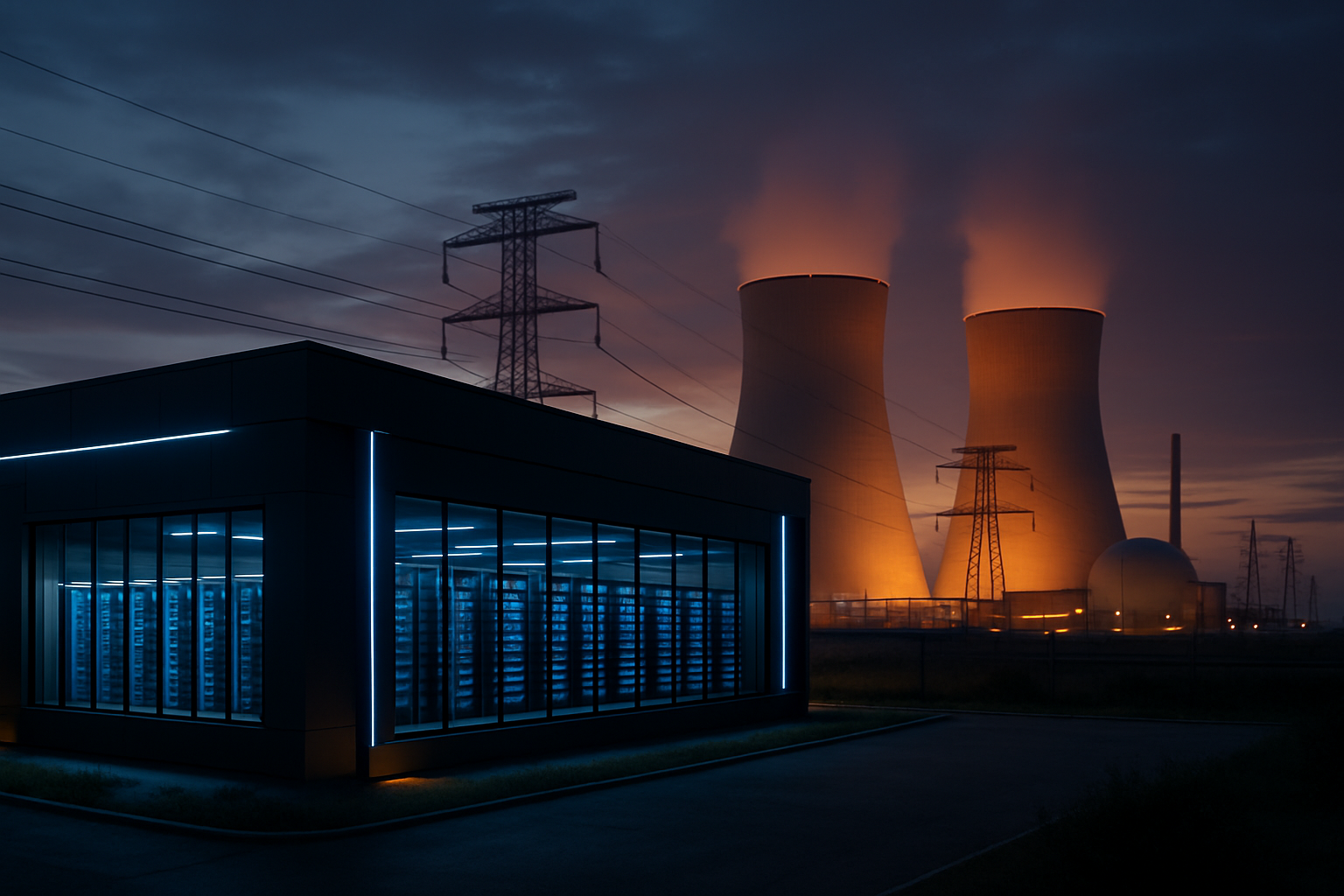
Major technology companies are making unprecedented investments in next-generation nuclear power to meet the surging energy demands of artificial intelligence data centers, marking a fundamental shift in how the tech industry approaches power infrastructure as AI transitions from experimental to essential business technology.
The move comes as global technology leaders grapple with massive power requirements for AI systems that have created what experts describe as the most significant energy challenge in the technology sector's history. With AI water demand projected by the World Bank to reach 4.2-6.6 billion cubic meters annually by 2027 for data center cooling alone—equivalent to 4-6 times Denmark's entire annual water consumption—companies are turning to nuclear power as the only viable solution for meeting both energy density and sustainability requirements.
Massive Corporate Nuclear Investments Drive Industry Transformation
Alphabet has committed $185 billion to AI infrastructure in 2026, representing the largest single-year corporate technology investment in history, with a significant portion dedicated to nuclear-powered data centers. Amazon has announced development plans exceeding $1 trillion over the coming decade, much of it focused on creating AI infrastructure that can only be sustainably powered through advanced nuclear systems.
The nuclear power renaissance is being driven by the fundamental reality that traditional renewable energy sources cannot provide the consistent, high-density power required for AI operations. Modern AI training requires continuous electricity supply without the intermittency challenges of solar and wind power, making nuclear energy the preferred option for companies seeking both sustainability and reliability.
"Nuclear power represents the only scalable solution for meeting AI's enormous energy requirements while maintaining our climate commitments."
— Technology Industry Energy Analyst
Global Semiconductor Crisis Accelerates Nuclear Power Adoption
The current investment surge occurs against the backdrop of a global semiconductor crisis that has driven memory chip prices sixfold higher, affecting major manufacturers including Samsung, SK Hynix, and Micron. Shortages are expected to persist until 2027 when new fabrication facilities come online, creating additional pressure for energy-efficient computing solutions.
This crisis has paradoxically accelerated innovation in memory-efficient algorithms and sustainable deployment strategies, with companies recognizing that nuclear-powered infrastructure provides the energy density necessary for next-generation AI systems while addressing environmental concerns that have sparked community protests in countries like Malaysia, where residents have demonstrated against data center development due to environmental and health concerns.
Next-Generation Nuclear Technology Tailored for AI Infrastructure
The nuclear systems being developed specifically for AI applications represent significant technological advances over traditional nuclear power plants. These next-generation reactors are designed with enhanced safety features, reduced waste production, and the ability to provide the consistent, high-output power that AI data centers require for optimal performance.
Companies are investing in small modular reactors (SMRs) and other advanced nuclear technologies that can be deployed closer to data center facilities, reducing transmission losses and providing more reliable power delivery. These systems are designed to operate autonomously with minimal human intervention, making them ideal for supporting the 24/7 operations required by AI infrastructure.
International Regulatory Response and Governance Frameworks
The nuclear power investments are occurring within an increasingly complex regulatory environment. Spain has implemented the world's first criminal executive liability framework for technology platforms, while France has conducted cybercrime raids on AI companies. The European Union is investigating Digital Services Act violations with potential penalties reaching billions of dollars.
At the international level, the United Nations has established an Independent Scientific Panel with 40 global experts led by Secretary-General António Guterres, representing the first fully independent global AI impact assessment body. This represents the most sophisticated global technology governance framework since the commercialization of the internet.
Strategic Implications for Global Energy Markets
The technology sector's embrace of nuclear power is reshaping global energy markets and creating new partnerships between tech companies and nuclear energy providers. Traditional energy companies are forming strategic alliances with technology giants to develop specialized nuclear facilities designed specifically for data center operations.
This convergence of nuclear energy and artificial intelligence represents a fundamental shift in how critical infrastructure is planned and developed. Countries with strong nuclear capabilities are positioning themselves as preferred locations for AI data centers, creating new forms of technological and energy diplomacy.
Environmental Justice and Community Concerns
While nuclear power offers a low-carbon solution to AI's energy demands, the development of these facilities raises important environmental justice questions. Communities hosting nuclear-powered data centers are demanding comprehensive impact assessments and meaningful participation in planning processes.
The integration of nuclear power and AI infrastructure must address concerns about environmental impacts on local communities while ensuring that the benefits of technological advancement are shared equitably. This represents a critical test of how the technology industry can pursue innovation while maintaining social responsibility.
Market Disruption and the "SaaSpocalypse"
The massive investments in nuclear-powered AI infrastructure are occurring during what industry analysts call the "SaaSpocalypse"—the elimination of hundreds of billions of dollars in traditional software market capitalization as AI systems demonstrate direct replacement capabilities for conventional software solutions.
This market disruption is driving companies to seek competitive advantages through superior infrastructure, with nuclear-powered data centers providing the reliability and performance characteristics necessary to maintain leadership in the AI marketplace. Companies unable to access adequate power infrastructure risk being left behind as AI becomes essential to business operations across all sectors.
Human-Centered AI Development Models
Despite the massive technological investments, successful AI implementations continue to prioritize human-centered approaches that enhance rather than replace human capabilities. Examples include Canadian universities using AI teaching assistants while maintaining critical thinking standards, Malaysia operating the world's first AI-integrated Islamic school that combines technology with traditional learning, and Singapore's WonderBot 2.0 heritage education system.
These success models demonstrate that the nuclear-powered AI infrastructure being developed must serve human flourishing rather than simply maximizing computational capability. The challenge for technology companies is ensuring that their massive infrastructure investments ultimately benefit society rather than exacerbating existing inequalities.
Future Implications and Civilizational Choices
Industry experts characterize 2026 as a "civilizational choice point" where decisions about AI infrastructure will establish patterns that persist for decades. The choice to invest in nuclear-powered AI data centers represents a commitment to a specific vision of how artificial intelligence will be integrated into society.
Success will require unprecedented coordination between governments, technology companies, educational institutions, and civil society to balance innovation acceleration with safety governance, commercial interests with human welfare, and national competitiveness with international cooperation.
The window for coordinated action is narrowing rapidly as AI capabilities advance and infrastructure investments lock in technological approaches. The decisions made in 2026 regarding nuclear-powered AI infrastructure will determine whether artificial intelligence serves humanity's highest aspirations or creates new forms of technological dependence and social inequality.
As the technology industry commits trillions of dollars to nuclear-powered AI infrastructure, the ultimate test will be whether these investments enable more sophisticated human-AI collaboration that amplifies human capabilities while preserving the creativity, empathy, and wisdom that define human potential in an age of artificial intelligence.