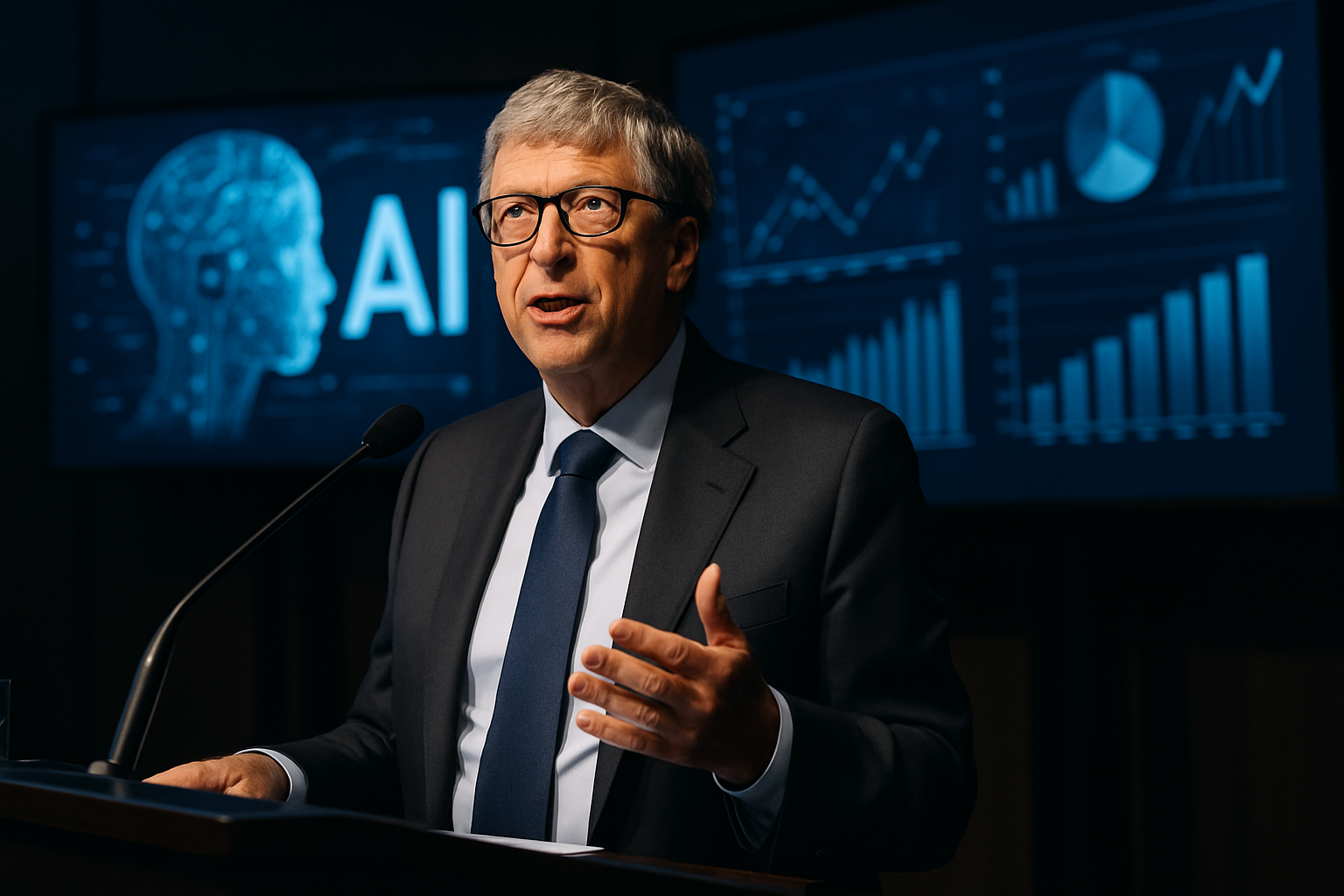
Microsoft co-founder Bill Gates has identified three critical professions likely to survive the artificial intelligence revolution, as global workforce transformation accelerates with unprecedented speed and governments struggle to implement effective AI governance frameworks.
Speaking amid what experts term "March 2026's Critical AI Inflection Point," Gates highlighted job categories requiring emotional intelligence, interpersonal relationships, and creative problem-solving with human empathy as the most resilient against AI displacement. The predictions come as artificial intelligence transitions from experimental technology to essential business infrastructure worldwide.
The AI-Resistant Job Categories
According to Bulgarian media reports analyzing Gates' latest workforce predictions, the Microsoft co-founder emphasized that roles demanding genuine human connection and cultural understanding will prove most durable. While specific profession details remain subject of ongoing technology community analysis, the categories center on positions requiring complex emotional intelligence, creative problem-solving, and authentic interpersonal relationships that current AI systems cannot replicate.
This assessment aligns with broader industry analysis showing that successful AI integration focuses on human-AI collaboration rather than wholesale replacement. The most promising implementations treat artificial intelligence as sophisticated amplification tools serving specific human goals rather than substituting human judgment entirely.
Corporate AI Revolution Accelerates
Gates' predictions coincide with dramatic corporate restructuring waves explicitly attributed to AI advancement. Block Inc., parent company of Square, Cash App, and Afterpay, eliminated 4,000 positions representing 40% of its global workforce in February 2026 - marking the first major tech layoff explicitly attributed to artificial intelligence rather than financial pressures.
"AI tools we create and use, combined with smaller, more agile teams, enable a new way of working."
— Jack Dorsey, Block Inc. CEO
The precedent has triggered industry-wide transformation, with WiseTech Global announcing 2,000 job cuts (30% of workforce) over 24 months, and Meta Platforms preparing sweeping layoffs affecting potentially 20% of staff due to mounting AI infrastructure costs. Microsoft's Mustafa Suleyman predicts AI could replace the majority of office workers within two years, with lawyers and auditors facing displacement within 18 months.
Global Governance Responses
The acceleration in AI-driven employment changes has prompted unprecedented international regulatory responses. Spain implemented the world's first criminal executive liability framework for tech platforms, creating imprisonment risks for executives who fail to meet safety standards. France has conducted AI company cybercrime raids, while the United Nations established an Independent Scientific Panel with 40 global experts - the first fully independent international AI assessment body.
In Bulgaria, political leaders are incorporating AI governance into anti-corruption efforts, with Rumen Radev announcing "SIGMA AI" - a system using artificial intelligence to analyze public procurement data and flag irregularities. The initiative represents growing recognition that AI tools can serve democratic oversight functions while reshaping traditional employment structures.
Regional Response Variations
Analysis of global workforce adaptation strategies reveals stark regional differences. Western companies predominantly implement traditional layoffs followed by selective AI hiring, while Asian corporations invest in comprehensive worker transition programs. Indian IT giants including Infosys, Wipro, and HCL have pioneered workforce evolution strategies rather than mass elimination, demonstrating alternative approaches to AI integration.
Chinese companies like Unitree have scaled humanoid robot production from 5,500 to 20,000 units, creating new employment opportunities even as automation displaces workers elsewhere. This multipolar approach to AI development challenges assumptions about technological unemployment being inevitable.
Success Models for Human-AI Collaboration
Despite displacement concerns, successful integration models demonstrate AI's potential to enhance rather than replace human capabilities. Canadian universities have implemented AI teaching assistants that maintain critical thinking standards, while Malaysia operates the world's first AI-integrated Islamic school, combining artificial intelligence with traditional religious and academic learning.
Singapore's WonderBot 2.0 heritage education program shows how conversational AI can preserve cultural knowledge while enhancing learning experiences. These examples support Gates' emphasis on roles requiring cultural understanding and authentic human relationships as particularly resilient to automation.
Infrastructure Challenges Shape Implementation
The global semiconductor crisis, with memory chip prices surging sixfold and affecting Samsung, SK Hynix, and Micron operations, has created unexpected constraints on AI deployment. Supply shortages are expected to persist until 2027 when new fabrication facilities come online, paradoxically providing workforce adaptation time through forced selective deployment rather than comprehensive automation.
Despite these challenges, massive corporate investments continue. Alphabet committed $185 billion to AI infrastructure in 2026 - the largest single-year corporate technology investment in history - while Amazon's AI development plans exceed $1 trillion. The World Bank projects AI systems will demand 4.2-6.6 billion cubic meters of water by 2027 for data center cooling, equivalent to four to six times Denmark's annual water consumption.
The Productivity Paradox
Research by German scientist Dr. Frank Bäumer reveals a concerning "productivity paradox" where AI implementation often creates more work and declining efficiency rather than promised gains. Workers report experiencing a "double workload effect" - performing their original responsibilities while also supervising and correcting AI outputs. This finding suggests that successful AI integration requires comprehensive change management and workflow redesign, not simply adding AI tools to existing processes.
Skills for the AI Age
Career experts emphasize that future-proofing requires developing hybrid competencies spanning multiple domains. Catherine Fisher of LinkedIn identifies digital adaptability as paramount - not just technical proficiency, but continuous learning capability for evolving technological tools. Essential skill categories include:
- AI collaboration and data interpretation capabilities
- Emotional intelligence and creative problem-solving
- Cultural competency for global work environments
- Critical thinking and ethical reasoning
- Interpersonal communication and relationship building
Economic and Social Implications
The transformation carries profound economic implications beyond individual job displacement. The "SaaSpocalypse" phenomenon has eliminated hundreds of billions in traditional software market capitalization as AI demonstrates direct replacement capabilities for conventional solutions. This represents a fundamental shift from software-as-a-service models to AI-based alternatives offering more responsive, cost-effective solutions.
Countries implementing comprehensive workforce adaptation approaches report improved community resilience and enhanced international competitiveness. Prevention-focused strategies demonstrate superior outcomes through reduced crisis intervention costs, improved workforce productivity, and strategic human capital development positioning nations advantageously in the global knowledge economy.
Looking Ahead: A Civilizational Choice Point
March 2026 represents what analysts term a "civilizational choice point" - a critical juncture determining whether AI serves human flourishing or becomes primarily an exploitation tool. Success requires unprecedented coordination between governments, technology companies, educational institutions, and civil society to balance innovation acceleration with responsible development.
Gates' identification of AI-resistant professions provides a roadmap for individual career planning, but the broader challenge involves ensuring technological progress serves broad social benefit rather than primarily advantaging capital over labor. The window for proactive adaptation is narrowing rapidly, requiring immediate coordinated responses that will determine human-AI workplace relationships for decades ahead.
As artificial intelligence transitions from experimental curiosity to essential business infrastructure, the future likely belongs to sophisticated human-AI collaboration that amplifies human capabilities while preserving the creativity, cultural understanding, and emotional intelligence that define human potential. The professions Gates identifies as most resilient may serve as anchors for a transformed economy where technology enhances rather than replaces the uniquely human elements of work.