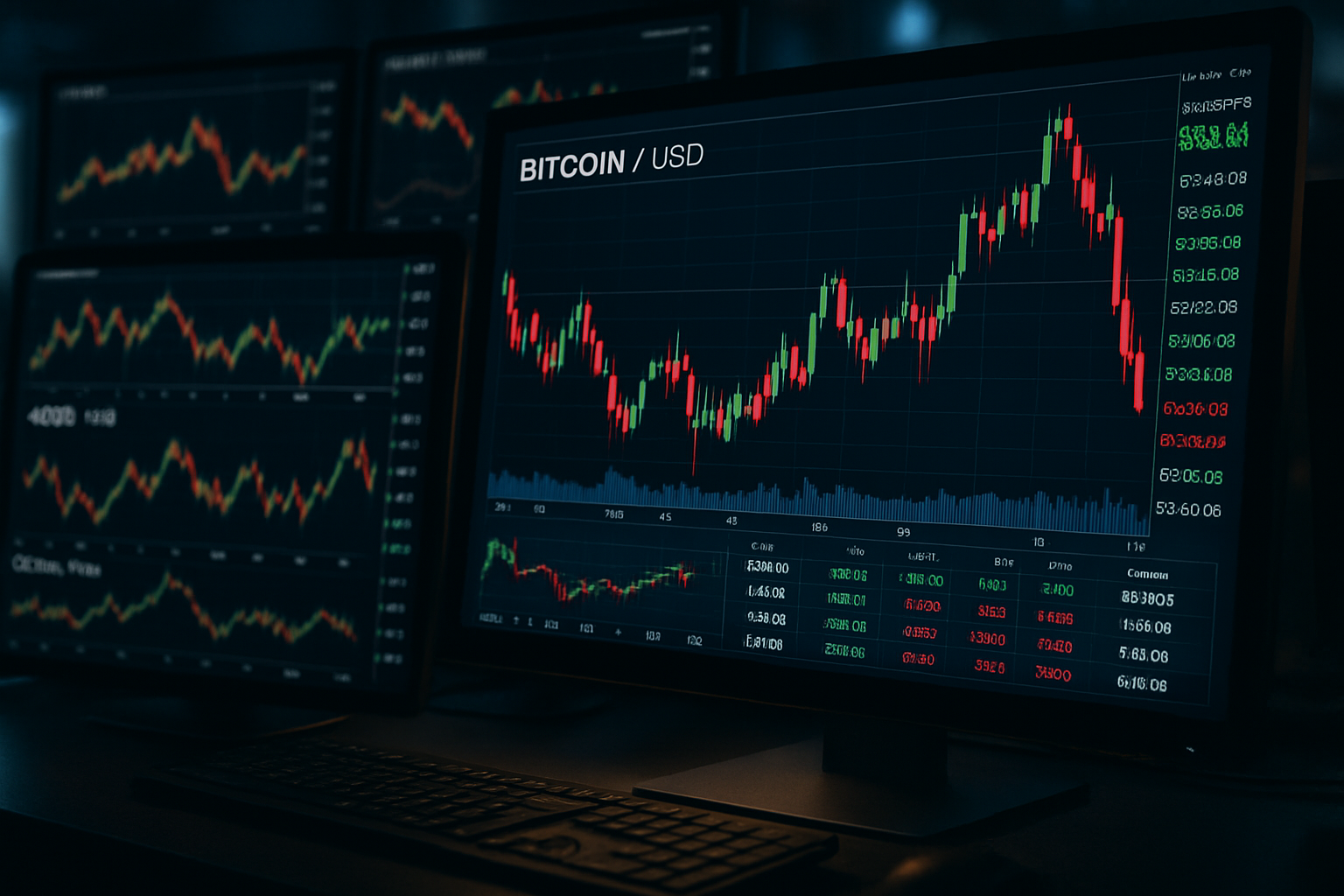
Bitcoin found its footing near $78,560 on February 3, 2026, staging a coordinated recovery alongside precious metals following a brutal overnight liquidation that saw $2.56 billion in cryptocurrency assets wiped out across global markets.
The world's largest cryptocurrency traded within a volatile range of $76,606 to $79,300 on Monday, generating $3.4 billion in trading volume as prices stabilized approximately 2.2% higher on the day. According to CoinGlass analytics, recent days witnessed one of the most severe deleveraging events in Bitcoin's history, with investors liquidating positions worth billions as market sentiment deteriorated sharply.
Technical Recovery Takes Shape
Technical analysis reveals Bitcoin's price stabilizing below prior structural support levels, though the Relative Strength Index (RSI) is attempting to turn higher from extreme oversold conditions. Weekly and daily charts suggest the cryptocurrency may be forming a base after breaking through the psychologically important $75,000 threshold last week.
The selloff returns Bitcoin to pre-election levels, erasing gains that followed Donald Trump's victory in November 2024. Trump's pro-cryptocurrency campaign promises had driven optimism in digital asset markets, but regulatory uncertainty has since dampened institutional enthusiasm as Congressional legislation remains stalled.
Coordinated Precious Metals Recovery
Paralleling Bitcoin's stabilization, precious metals markets also staged a dramatic recovery after experiencing their most severe selloff since the 1980 Hunt Brothers silver collapse. Gold rebounded from a fresh low near $4,665 to approximately $4,915, while silver recovered from a brutal drop to $79.68, climbing back to roughly $86.24.
"The tape still looks mechanical, with forced deleveraging, stop cascades, and thin liquidity driving violent swings,"
— Market Analysis, The Rio Times
The coordinated recovery across both cryptocurrency and precious metals markets suggests the deleveraging flush may be running its course, though analysts warn that market conditions remain fragile. The simultaneous selloffs in traditionally uncorrelated assets point to broader liquidity pressures affecting global financial markets.
Factors Behind Market Turbulence
Analysts identify multiple factors contributing to the extraordinary price volatility across asset classes. Political uncertainty surrounding Trump's unpredictable policy approach, combined with growing distrust in economic systems, has created an environment where traditional safe-haven assets and risk assets alike face selling pressure.
The Armenian news source 1in.am reported that Bitcoin's decline continues as part of broader cryptocurrency market weakness, with investors reassessing positions amid regulatory uncertainty. The $2.56 billion liquidation figure represents one of the largest forced selling events in cryptocurrency market history, comparable to previous major market corrections in 2022 and 2018.
Institutional Response
Financial institutions worldwide have begun adapting their strategies to navigate the heightened volatility. Banks have implemented defensive measures, with some adjusting interest rate policies and credit facilities to manage exposure to volatile asset classes. The correlation between traditionally separate markets has forced portfolio managers to reconsider diversification strategies.
Despite the severe selloff, some analysts view the current correction as a healthy deleveraging event that could establish stronger support levels for future growth. The extreme RSI readings in both Bitcoin and precious metals suggest markets may be approaching oversold conditions where value buyers typically emerge.
Global Market Context
The cryptocurrency and precious metals volatility occurs against a backdrop of mixed global market performance. While technology stocks have shown resilience with the Philadelphia Semiconductor Index gaining 1.7%, commodity markets continue to experience significant turbulence.
Al Jazeera's analysis highlights how the price swings reflect broader concerns about economic stability and monetary policy effectiveness. The simultaneous pressure on both digital and physical stores of value suggests investors are seeking liquidity rather than alternative assets during periods of uncertainty.
Looking Forward
Market participants are closely monitoring whether the current stabilization represents a genuine floor or merely a temporary pause in the broader correction. The $78,500 level for Bitcoin and the precious metals recovery levels will serve as critical technical benchmarks for determining market direction.
Trading volumes remain elevated across all affected markets, indicating continued investor interest despite the volatility. However, the mechanical nature of recent price movements, driven by forced selling and algorithmic trading, suggests that sustainable recovery will require improved market sentiment and reduced leverage in the system.
As global financial markets navigate this period of heightened correlation and volatility, the performance of Bitcoin near $78,500 and precious metals above their overnight lows will provide crucial insights into investor risk appetite and market resilience. The coordinated recovery offers hope for stabilization, but market participants remain cautious about declaring an end to the current correction phase.