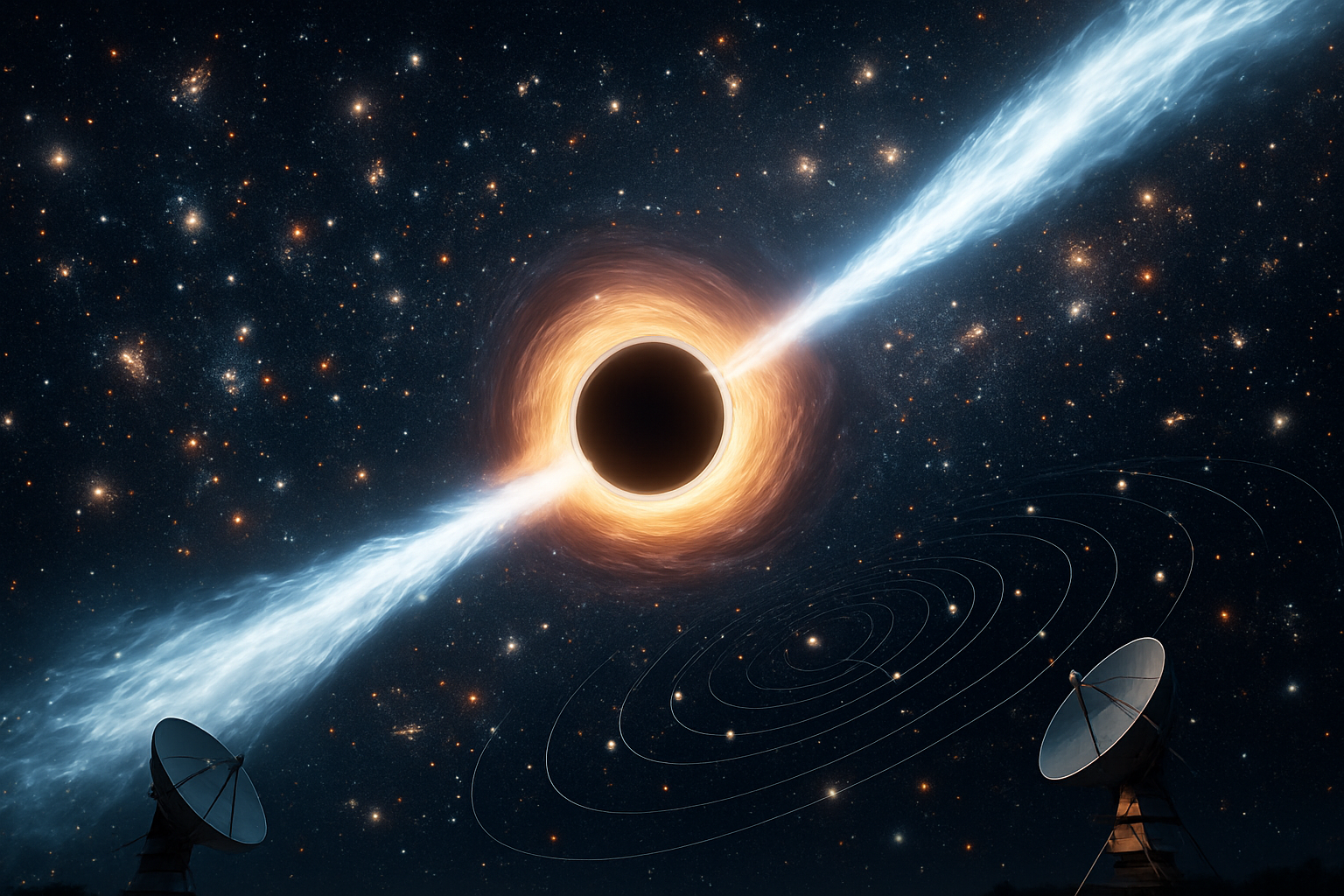
For the first time in astronomical history, scientists have successfully measured the instantaneous power and speed of jets blasting from a black hole, revealing mind-blowing velocities of 540 million kilometers per hour—half the speed of light—while astronomers simultaneously unveiled the most detailed map of the universe ever created.
The groundbreaking black hole research, published by an international team on Thursday, focused on Cygnus X-1, located 7,200 light-years from Earth. This relatively nearby black hole-star system demonstrated jet power equivalent to 10,000 suns, representing the first direct measurement of these cosmic phenomena that have puzzled scientists for decades.
"This is a historic moment for astrophysics," said Dr. Maria Castellanos, planetary defense coordinator at the European Space Agency. "We're witnessing the raw power of the universe in ways we've never been able to measure before."
Revolutionary Black Hole Measurements
The research team's achievement represents a paradigm shift in understanding black hole feeding mechanisms. Previously, scientists could only theorize about the instantaneous power of these cosmic jets. The new measurements reveal that the jets from Cygnus X-1—the first black hole ever identified more than half a century ago—produce energy output that dwarfs entire star systems.
The jets travel at approximately 540 million kilometers per hour, or roughly half the speed of light, carrying material and energy across vast distances in space. This velocity measurement required unprecedented precision and international cooperation using the most sensitive gravitational wave detectors capable of measuring cosmic ripples smaller than a fraction of a proton's width.
What makes this discovery particularly significant is that it challenges conventional understanding of tidal disruption events. Rather than brief explosive phenomena, these black holes demonstrate complex, long-term dynamics with persistent matter ejection continuing for years after consuming stellar material.
Most Detailed Universe Map Ever Created
Simultaneously, astronomers have completed the most comprehensive mapping project in cosmic history using the Dark Energy Spectroscopic Instrument (DESI). The five-year survey has catalogued more than 47 million galaxies and quasars—nearly ten times more than previous large-scale cosmic maps.
This unprecedented dataset provides scientists with the most detailed three-dimensional map of the universe's structure, revealing the cosmic web of matter distribution across billions of light-years. The survey's scope represents a fundamental leap in our understanding of cosmic architecture and dark energy's influence on universal expansion.
The DESI project required sophisticated night-sky surveys with unprecedented detail, processing vast amounts of data through AI-powered analysis systems. The resulting map will serve as a foundation for decades of astronomical research, helping scientists understand everything from galaxy formation to the fate of the universe itself.
Planetary Alignment and Future Cosmic Events
These discoveries occur amid a remarkable period of celestial activity. Astronomers have announced that the next major planetary alignment will occur on September 8, 2040, when five planets of the Solar System will appear within a narrow sector of the sky. This rare "parade of planets" phenomenon continues the extraordinary astronomical events characterizing this era.
The alignment will feature Mercury, Venus, Mars, Jupiter, and Saturn in a configuration visible to naked-eye observers worldwide, providing educational opportunities and public engagement with astronomy on a global scale.
"We are living through a golden age of astronomical observation, where advanced technology and international cooperation are revealing cosmic secrets at an unprecedented pace."
— Dr. Elena Papadopoulos, National Observatory of Athens
International Cooperation Drives Discovery
These breakthroughs exemplify the power of international scientific collaboration. The black hole measurements required coordination between multiple space agencies and research institutions, while the universe mapping project involved scientists from dozens of countries working with shared telescope facilities.
The research demonstrates how modern astronomy transcends national boundaries, with data sharing, coordinated observations, and joint analysis producing insights impossible for any single nation to achieve independently. This collaborative model has become the standard for major astronomical discoveries in the 21st century.
Advanced analytical techniques including AI-powered data processing, sophisticated spectroscopic analysis, and gravitational wave detection have revolutionized the field. These tools enable real-time analysis of cosmic phenomena across vast distances, providing unprecedented precision in measurements that would have been impossible just a decade ago.
Implications for Planetary Defense
The timing of these discoveries carries additional significance given ongoing concerns about cosmic threats to Earth. NASA has previously warned that approximately 15,000 medium-sized asteroids capable of destroying entire cities remain undetected by current monitoring systems.
The advanced detection capabilities demonstrated in these projects—particularly the universe mapping technology—could contribute to enhanced asteroid monitoring programs. The same instruments and analytical techniques used to catalogue distant galaxies can be adapted for tracking potentially hazardous near-Earth objects.
The international cooperation frameworks developed for these astronomical projects provide templates for addressing planetary defense challenges that transcend national boundaries and require coordinated global responses.
Space Economy Golden Age
These scientific achievements occur during what experts describe as the transition from the "AI revolution" to the "space economy golden age." The convergence of artificial intelligence, advanced sensors, and international cooperation is creating unprecedented opportunities for cosmic discovery and commercial space applications.
The techniques developed for measuring black hole jets and mapping the universe have direct applications in satellite technology, space navigation, and deep space exploration missions. As the global space economy approaches an estimated $1 trillion valuation by 2030, these fundamental discoveries provide the scientific foundation for humanity's expanding presence in space.
Commercial space companies are already incorporating lessons from these research projects into their mission planning, from improved navigation systems to enhanced space weather monitoring capabilities essential for protecting satellite infrastructure.
Future Research Directions
The successful measurement of black hole jet speeds opens entirely new avenues for astrophysical research. Scientists plan to apply similar techniques to other black hole systems throughout the galaxy, creating a comprehensive database of cosmic jet phenomena.
Future research will investigate whether different types of black holes produce jets with varying characteristics, how stellar environments influence jet formation, and whether these measurements can help identify potentially habitable worlds around other stars by understanding their cosmic radiation environments.
The universe mapping project will continue expanding, with plans to catalogue additional regions of space and track cosmic evolution over time. This longitudinal data will provide insights into how the universe's structure has changed and will continue to evolve over cosmic timescales.
Educational and Cultural Impact
Beyond their scientific significance, these discoveries capture public imagination and inspire new generations of scientists and engineers. Educational institutions worldwide are incorporating the findings into curricula, while astronomy clubs report unprecedented enrollment as people seek to understand these cosmic revelations.
The combination of spectacular visual imagery from space telescopes and comprehensible measurements—like comparing jet power to 10,000 suns—helps translate complex astrophysics into accessible concepts that connect with broader audiences.
Museums and planetariums are developing exhibits showcasing these discoveries, while citizen science projects enable amateur astronomers to contribute to ongoing research through coordinated observations and data collection.
As humanity continues to push the boundaries of cosmic understanding, these achievements in measuring black hole jets and mapping the universe represent landmark moments in our species' quest to comprehend the cosmos. They demonstrate that through international cooperation, advanced technology, and sustained scientific inquiry, even the most extreme phenomena in the universe can yield their secrets to human curiosity and ingenuity.