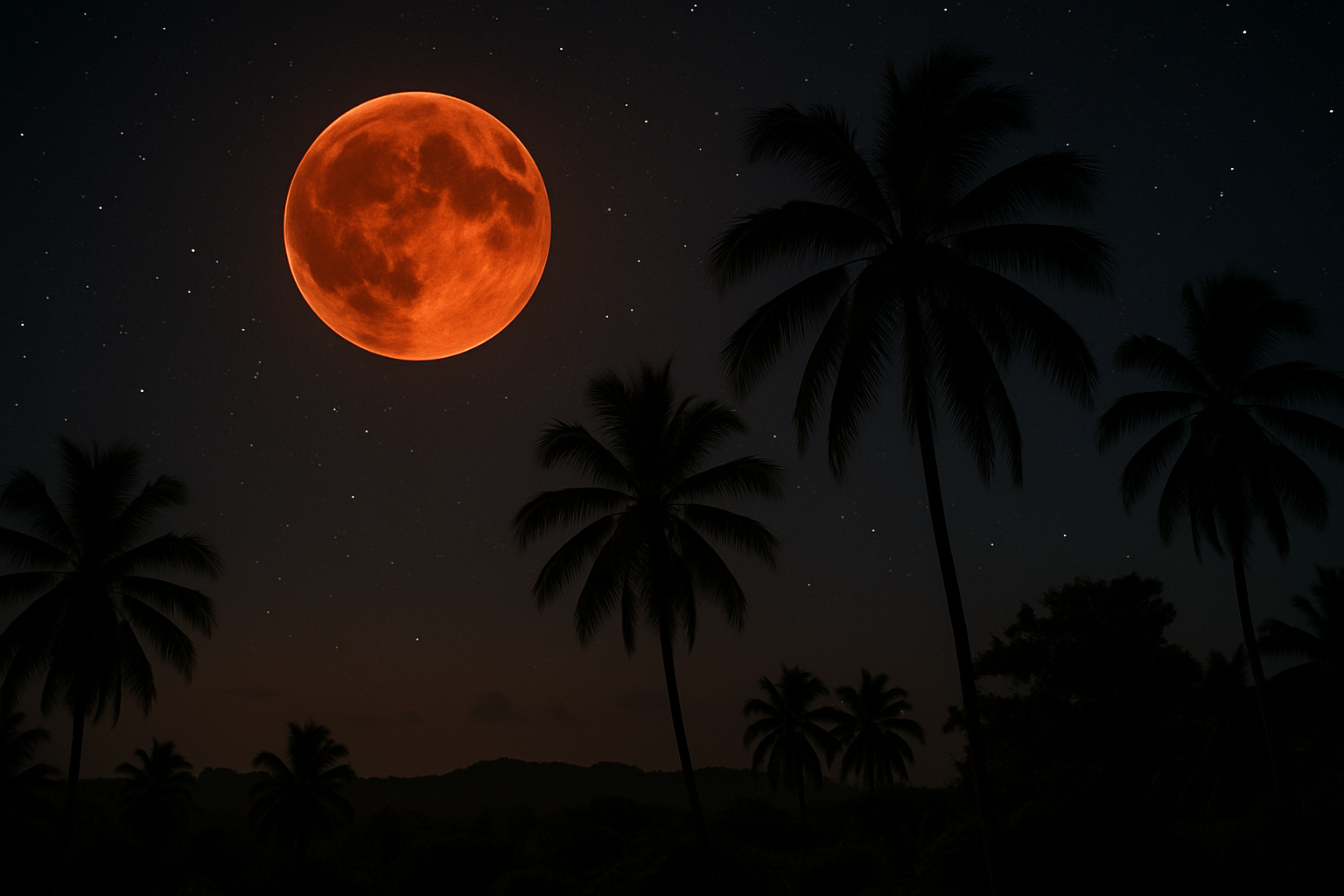
The Dominican Republic and much of the Caribbean will witness a spectacular total lunar eclipse in the early morning hours of Tuesday, March 3, 2026, as Earth moves between the Sun and the full Moon, creating the dramatic reddish "blood moon" effect that has captivated observers for millennia.
According to meteorological analyst Jean Suriel, the phenomenon will begin with its penumbral phase at 4:44 a.m. local time, when the Moon will start to subtly darken as it enters Earth's outer shadow. The eclipse will progress through partial phases before reaching totality, when the Moon will take on its characteristic deep reddish-copper coloration.
Global Astronomical Event of 2026
This lunar eclipse represents 2026's only total lunar eclipse visible from the Americas, making it a significant astronomical event for the region. The eclipse will also be visible across other parts of North and South America, East Asia, Australia, and New Zealand, creating a shared celestial experience spanning multiple continents.
New Zealand observers are particularly fortunate, with the country positioned to have the "best seat in the world" for viewing the eclipse, with peak totality occurring around 12:30 a.m. local time. The event provides a rare opportunity for coordinated global observations, contributing valuable data to ongoing lunar research.
In Ecuador, the total lunar eclipse will also be visible during the early morning hours, with varying observation conditions depending on the city. Local astronomers are preparing observation events to help the public understand and appreciate this rare celestial phenomenon.
The Science Behind the Blood Moon
The dramatic red coloration during totality occurs due to Earth's atmosphere refracting sunlight around our planet's edge. Blue light is scattered more readily by atmospheric particles, while red and orange wavelengths pass through more easily, casting an eerie reddish glow on the lunar surface.
This same phenomenon creates red sunsets and sunrises here on Earth. During a total lunar eclipse, observers essentially see all of Earth's sunrises and sunsets projected onto the Moon's surface simultaneously, creating the haunting "blood moon" effect.
"The eclipse will begin with its penumbral phase at 4:44 a.m. local time, when the darkening will be subtle and gradual."
— Jean Suriel, Meteorological Analyst
Optimal Viewing Conditions in the Caribbean
The Dominican Republic's geographic position provides excellent viewing conditions for the eclipse, with the event occurring during the pre-dawn hours when the sky will be at its darkest. Unlike solar eclipses, lunar eclipses are completely safe to observe with the naked eye, requiring no special protective equipment.
Observers across the Caribbean region will share this celestial experience, with the eclipse visible throughout most island nations. The event occurs during a period of relatively stable weather patterns in the region, though observers are advised to check local forecasts for cloud cover conditions.
Amateur astronomers and photography enthusiasts are preparing for the event, as lunar eclipses provide excellent opportunities for both visual observation and photography using standard cameras and telephoto lenses.
Historical and Cultural Significance
Lunar eclipses have held special significance across cultures throughout human history. Ancient civilizations often viewed blood moons as omens or supernatural events, developing rich mythologies around these celestial phenomena. Today, they serve as powerful reminders of our planet's place in the solar system and the elegant mechanics of celestial motion.
The March 3, 2026 eclipse occurs during what space scientists describe as the "golden age of astronomical observation," with unprecedented technological capabilities enabling both professional and amateur astronomers to document and study these events in extraordinary detail.
Scientific Research Opportunities
Modern lunar eclipses provide valuable research opportunities for scientists studying Earth's atmospheric properties and lunar surface characteristics. The way Earth's atmosphere filters sunlight during an eclipse reveals information about atmospheric composition, pollution levels, and climate conditions.
International space agencies and research institutions are coordinating observations of the March 3 eclipse to gather data that will inform ongoing lunar exploration programs, including NASA's Artemis missions and other lunar research initiatives planned for the latter half of the 2026.
The event also provides educational opportunities for students and the public to engage with astronomy and space science, fostering scientific literacy during a period of renewed interest in lunar exploration and space research.
Photography and Documentation
The eclipse presents exceptional opportunities for astronomical photography, with observers able to document the complete progression from the initial penumbral phase through totality using standard digital cameras. Time-lapse photography can capture the entire event, showing the gradual transformation of the Moon's appearance over several hours.
Recent advances in smartphone camera technology, including those recently approved by NASA for space applications, mean that even casual observers can capture impressive images of the blood moon effect. Professional photographers are planning comprehensive documentation of the event from multiple Caribbean locations.
Preparation and Viewing Tips
Observers planning to view the March 3 eclipse should prepare for early morning viewing in March weather conditions. Comfortable seating, warm clothing, and red flashlights for preserving night vision are recommended for the multi-hour event.
While no special equipment is required, binoculars or small telescopes can enhance the viewing experience by revealing surface details and color variations during the eclipse phases. Multiple viewing location backup plans are advisable due to potential cloud cover.
Astronomy clubs and educational institutions across the Dominican Republic and Caribbean region are organizing community viewing events, providing opportunities for shared astronomical experiences and expert guidance for first-time eclipse observers.
Connection to Broader Space Developments
The March 3, 2026 lunar eclipse occurs during a remarkable period of space exploration activity. With NASA's Artemis program preparing for lunar missions, SpaceX advancing lunar colonization plans, and international cooperation expanding through programs like the International Space Station, the eclipse serves as a reminder of humanity's growing connection to lunar exploration.
This celestial event connects ancient astronomical traditions with modern space science, occurring during what researchers describe as the transition from the "AI revolution" to the "space economy golden age." The eclipse represents the intersection of natural celestial phenomena with humanity's expanding presence in space.
Regional Viewing Coordination
Caribbean nations are coordinating public information campaigns to ensure residents understand the timing and significance of the eclipse. Tourism boards across the region recognize the potential for astronomical tourism, with visitors planning trips specifically to witness this rare celestial event.
The shared experience of observing the blood moon creates opportunities for regional cooperation in science education and public outreach, demonstrating how astronomical events can foster international collaboration and scientific interest across national boundaries.
As the Dominican Republic and its Caribbean neighbors prepare for this rare celestial spectacle, the March 3, 2026 blood moon eclipse promises to be a memorable event that combines scientific wonder with cultural significance, marking 2026 as a year when the cosmos provided a spectacular reminder of our planet's place in the vast universe.