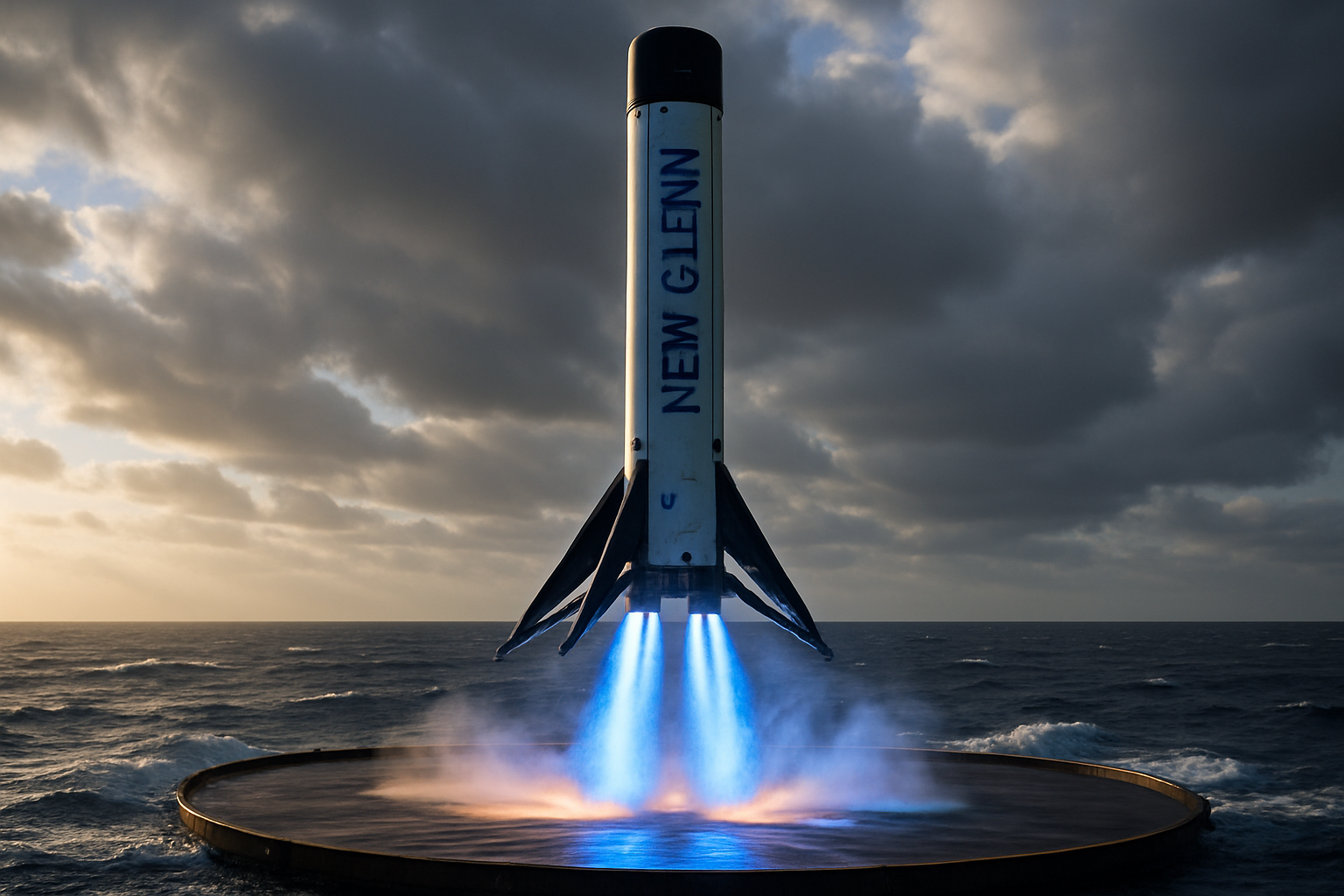
Blue Origin made aerospace history on April 19, 2026, successfully landing a reused New Glenn rocket booster for the first time, representing a major breakthrough in reusable rocket technology and intensifying competition with Elon Musk's SpaceX in the rapidly expanding commercial space sector.
The achievement marks a critical milestone for Jeff Bezos' space company, which has been working to establish itself as a major player in the commercial space industry during what analysts are calling the "space economy golden age." The successful recovery of the previously-flown New Glenn booster demonstrates Blue Origin's growing technical capabilities and positions the company as a serious challenger to SpaceX's market dominance.
Technical Achievement and Innovation
The New Glenn rocket's reusable first stage successfully executed a precision landing after completing its orbital mission, showcasing advanced propulsive landing technology similar to SpaceX's Falcon 9 boosters. This represents Blue Origin's first successful recovery of a previously-used New Glenn booster, a significant step toward the cost-effective space operations that have made SpaceX's business model so successful.
According to industry sources, the landing occurred amid fierce competition between Bezos's firm and fellow tech titan Elon Musk's SpaceX, which has already recovered numerous boosters and demonstrated the economic viability of reusable rocket technology. SpaceX has successfully landed and reused Falcon 9 boosters more than 570 times, revolutionizing the economics of space access.
Market Competition and Strategic Context
The achievement comes during a watershed moment for the global space industry, with the space economy projected to exceed $1 trillion by 2030. Blue Origin's success with the New Glenn booster represents a crucial step in competing with SpaceX's established Starlink constellation and Falcon Heavy capabilities.
Blue Origin has been developing an ambitious satellite constellation plan, filing FCC applications for up to 51,600 satellites to support space-based data centers. This massive constellation would be designed to offer continuous solar power, unlimited expansion potential, and eliminate the massive cooling water requirements that constrain terrestrial data centers.
"This achievement validates our approach to sustainable space access and demonstrates that competition in the commercial space sector is intensifying."
— Industry Analyst, Space Economy Research
Space Economy Golden Age Context
Blue Origin's milestone occurs during what space industry experts are calling the "space economy golden age," characterized by unprecedented private investment, technological innovation, and international competition. Major developments include SpaceX's potential trillion-dollar IPO scheduled for June 2026, NASA's $20 billion commitment to a permanent lunar base by 2030, and China's planned crewed lunar missions by 2030.
The timing is particularly significant as the global semiconductor crisis has driven memory chip prices up sixfold, creating renewed interest in space-based computing alternatives. Blue Origin's satellite constellation project aligns with this trend, offering orbital computing capabilities that could address Earth's infrastructure constraints.
Technical Challenges and Environmental Considerations
The space industry faces growing environmental scrutiny, with Austrian research documenting atmospheric pollution from rocket launches, including tenfold increases in lithium concentrations from rocket debris. The European Space Agency warns that over 34,000 tracked orbital objects create collision risks traveling at 17,500 mph, raising concerns about space debris management.
Blue Origin's reusable technology approach helps address some environmental concerns by reducing the number of rockets that become space debris. However, the scale of planned operations, including the massive satellite constellation, requires careful environmental management both on Earth and in space.
International Competition and Cooperation
The commercial space race extends beyond the U.S., with China advancing its Shenlong reusable spacecraft program, European nations pursuing space independence through initiatives like Germany's €10 billion SATCOMBw 4 satellite system, and emerging nations like Pakistan developing space capabilities through partnerships with China's Tiangong space station.
Blue Origin's success also comes as NASA successfully completed the historic Artemis II mission, ending a 54-year gap in human deep space exploration. The mission, featuring Canadian astronaut Jeremy Hansen as the first Canadian beyond Earth orbit, validated international cooperation frameworks and advanced space technology capabilities.
Future Implications and Strategic Positioning
The successful New Glenn booster landing positions Blue Origin to compete more effectively for lucrative government and commercial contracts. The company's focus on lunar missions and space-based infrastructure aligns with NASA's Artemis program goals and the growing commercial interest in space-based manufacturing and computing.
Blue Origin has established a European headquarters in Luxembourg, announced by Economy Minister Lex Delles, as part of the company's global expansion strategy. Luxembourg has attracted over €2 billion in space investments through its SpaceResources.lu initiative, creating a favorable regulatory environment for space resource utilization.
Economic and Strategic Impact
The achievement represents more than a technical milestone; it validates Blue Origin's business model and competitive positioning in the rapidly expanding space economy. With space-based data centers projected to become cost-effective within 36 months according to industry predictions, Blue Origin's satellite constellation could generate substantial revenue streams.
The successful booster recovery also demonstrates the maturation of commercial space technology, transitioning from experimental ventures to essential infrastructure. This shift reflects broader trends in the space industry, where private companies are increasingly taking the lead in innovation and cost reduction.
Looking Ahead: The New Space Race
Blue Origin's New Glenn booster success marks a pivotal moment in the commercial space race, challenging SpaceX's dominance while advancing the broader goal of making space access more affordable and sustainable. The achievement comes as the space industry prepares for unprecedented expansion, with multiple companies and nations investing billions in space infrastructure.
As the space economy enters its "golden age," Blue Origin's technical breakthrough positions the company to play a major role in humanity's expansion beyond Earth, from lunar settlements to space-based manufacturing. The successful landing of the reused New Glenn booster represents not just a corporate milestone, but a step toward the spacefaring civilization that both Bezos and Musk envision.
The competition between Blue Origin and SpaceX continues to drive innovation in reusable rocket technology, ultimately benefiting the entire space industry through reduced costs and improved capabilities. As more players enter the commercial space sector, this competition promises to accelerate humanity's progress toward becoming a truly spacefaring species.