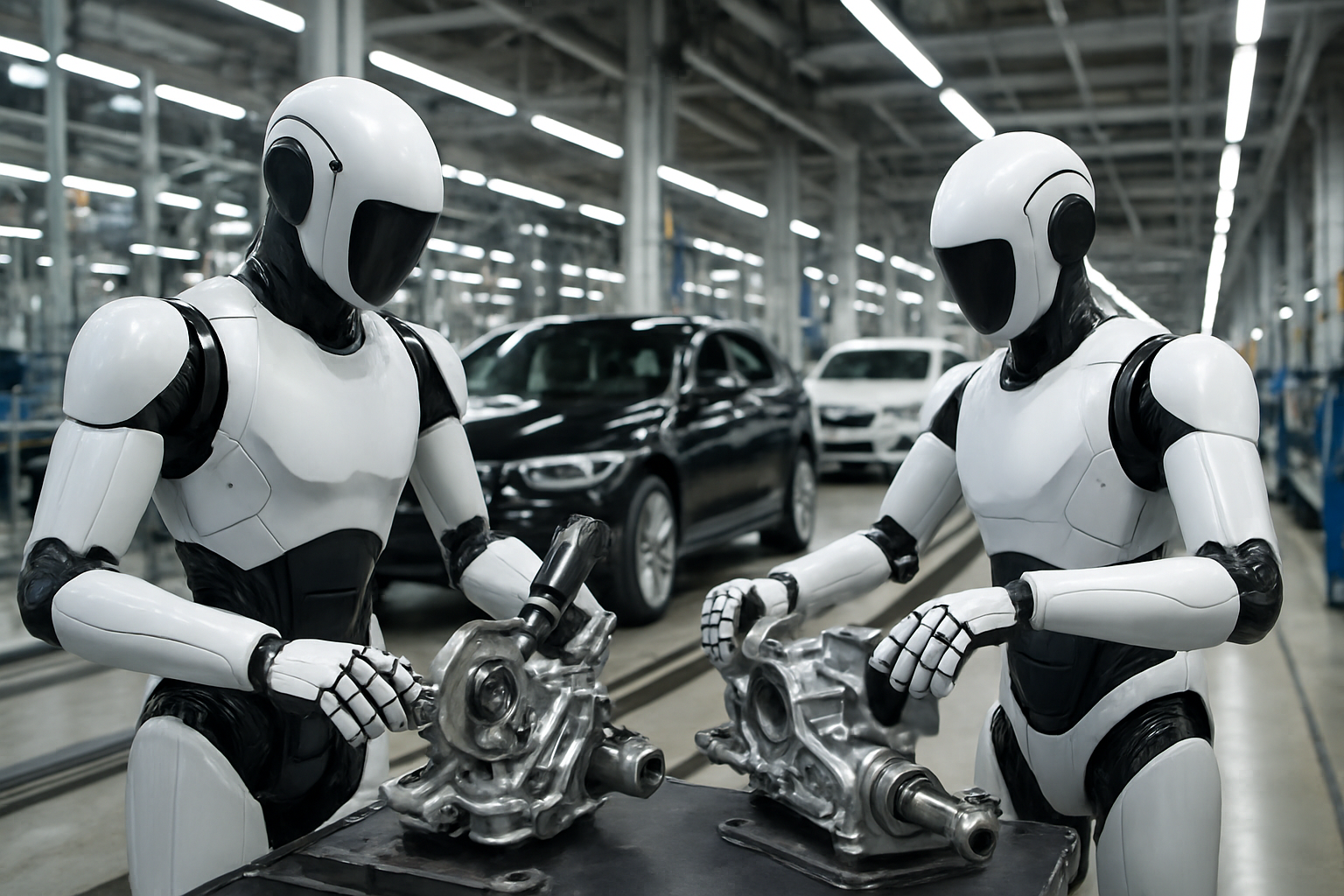
German automotive giant BMW has announced a pioneering deployment of two AI-powered humanoid robots at one of its German manufacturing facilities, representing a significant milestone in European industrial automation amid intensifying competition with Chinese robotics technology.
The robots, dubbed "Aeon" and developed by Swedish company Hexagon, stand 1.65 metres (5.4 feet) tall, weigh 60kg (132 pounds), and move on two wheels. These black-and-white humanoid machines possess the capability to autonomously manipulate and move components within factory environments that have been previously scanned and digitally mapped.
This landmark initiative comes as global competition in humanoid robotics reaches unprecedented levels, with Chinese manufacturers leading production scaling efforts and achieving remarkable technological breakthroughs throughout 2026.
Strategic Response to Chinese Robotics Dominance
BMW's humanoid robot trial represents Europe's strategic response to China's aggressive expansion in robotics technology. Recent memory analysis reveals that Chinese companies have achieved remarkable progress in mass-producing humanoid robots, with Unitree Robotics announcing production scaling to 10,000-20,000 units in 2026, up from 5,500 in 2025.
The timing of BMW's announcement is particularly significant given Chinese robotics companies' recent demonstrations during Spring Festival celebrations, where four companies (Unitree, Galbot, Noetix, MagicLab) showcased kung fu and somersault capabilities, marking the transition from laboratory concepts to mass production.
According to industry analysis, China has achieved automation breakthroughs across multiple sectors, with logistics efficiency reaching a record-low 13.9% of GDP ratio through systematic AI and robotics implementation.
Technical Specifications and Capabilities
The Aeon robots feature advanced AI-powered systems capable of operating autonomously within digitally mapped factory spaces. Their wheel-based mobility system allows for efficient movement throughout the manufacturing floor, while their humanoid form factor enables interaction with equipment and components designed for human workers.
The months-long pilot phase beginning this year will test the robots' ability to integrate seamlessly into BMW's existing production processes while maintaining the company's stringent quality standards. The trial represents a careful evaluation of humanoid robotics' potential to enhance, rather than replace, human manufacturing capabilities.
"This pilot programme represents our commitment to exploring innovative automation technologies while maintaining the precision and quality BMW customers expect."
— BMW Manufacturing Division
Global Context and Infrastructure Challenges
BMW's robotics trial occurs within a complex global technology landscape marked by significant infrastructure constraints. The ongoing semiconductor crisis has created a sixfold surge in memory chip prices, affecting manufacturers including Samsung, SK Hynix, and Micron, with shortages expected to persist until 2027.
Despite these challenges, major technology companies continue unprecedented AI and robotics investments. Alphabet has committed $185 billion to AI infrastructure in 2026, while Amazon's development plans exceed $1 trillion, demonstrating the industry's transition from experimental to essential technological infrastructure.
The World Bank projects that AI-driven automation will require 4.2-6.6 billion cubic meters of water annually by 2027 for data center cooling alone—equivalent to 4-6 times Denmark's annual water withdrawal—highlighting the environmental implications of the robotics revolution.
Competitive Landscape and Market Dynamics
BMW's humanoid robot deployment comes amid what industry analysts describe as the "SaaSpocalypse"—a market disruption that has eliminated hundreds of billions in traditional software company valuations as AI and robotics replace conventional business models.
Chinese robotics manufacturers have demonstrated remarkable capabilities beyond manufacturing applications. Recent developments include robotic performances at major cultural events and integration into various industrial sectors, suggesting a comprehensive approach to robotics commercialization.
The competitive pressure extends beyond pure technology capabilities. China controls approximately 60% of global critical mineral production and 90% of refining capacity for materials essential to robotics and AI systems, creating strategic dependencies for international manufacturers.
Regulatory Environment and Safety Considerations
The deployment occurs within an evolving regulatory landscape for AI and robotics technology. European authorities have implemented increasingly sophisticated governance frameworks, with Spain pioneering criminal executive liability for technology platforms and France conducting cybercrime enforcement operations targeting AI companies.
The United Nations has established an Independent International Scientific Panel comprising 40 experts—the first fully independent global AI assessment body—to evaluate the societal implications of widespread automation and artificial intelligence deployment.
These regulatory developments reflect growing governmental recognition that robotics and AI represent fundamental technological transformation requiring careful oversight to balance innovation benefits with societal considerations.
Implications for European Manufacturing
BMW's pilot programme represents a critical test case for European manufacturing competitiveness in an era of rapid technological transformation. Success could establish templates for broader industrial robotics adoption across the continent, while demonstrating that European companies can effectively integrate advanced automation technologies.
The initiative aligns with broader European Union strategies to maintain technological sovereignty amid competition from Chinese and American technology companies. Recent EU summits have focused on eliminating internal barriers, reducing administrative burdens, and protecting "Made in Europe" products through coordinated competitiveness strategies.
Industry experts note that successful robotics integration requires balancing technological advancement with preservation of manufacturing employment, maintaining quality standards while achieving efficiency gains, and ensuring long-term competitive positioning in global markets.
Future Implications and Industry Transformation
BMW's humanoid robot trial represents a pivotal moment in the evolution of manufacturing technology. The pilot programme's outcomes will likely influence similar initiatives across the automotive industry and broader European manufacturing sectors.
The deployment occurs during what experts characterize as February 2026's "critical inflection point" in AI and robotics development—a period determining whether these technologies fulfill their transformative promise or require significant corrections due to infrastructure constraints and societal concerns.
Success in integrating humanoid robots into manufacturing processes could accelerate European adoption of advanced automation technologies, potentially reducing dependence on traditional labor-intensive production methods while maintaining the precision engineering standards for which German manufacturing is renowned.
The global robotics competition continues to intensify, with multiple nations investing heavily in automation capabilities as strategic economic and technological priorities. BMW's pilot programme positions Germany as a serious competitor in this crucial technology sector, potentially influencing the balance of global manufacturing competitiveness for decades to come.