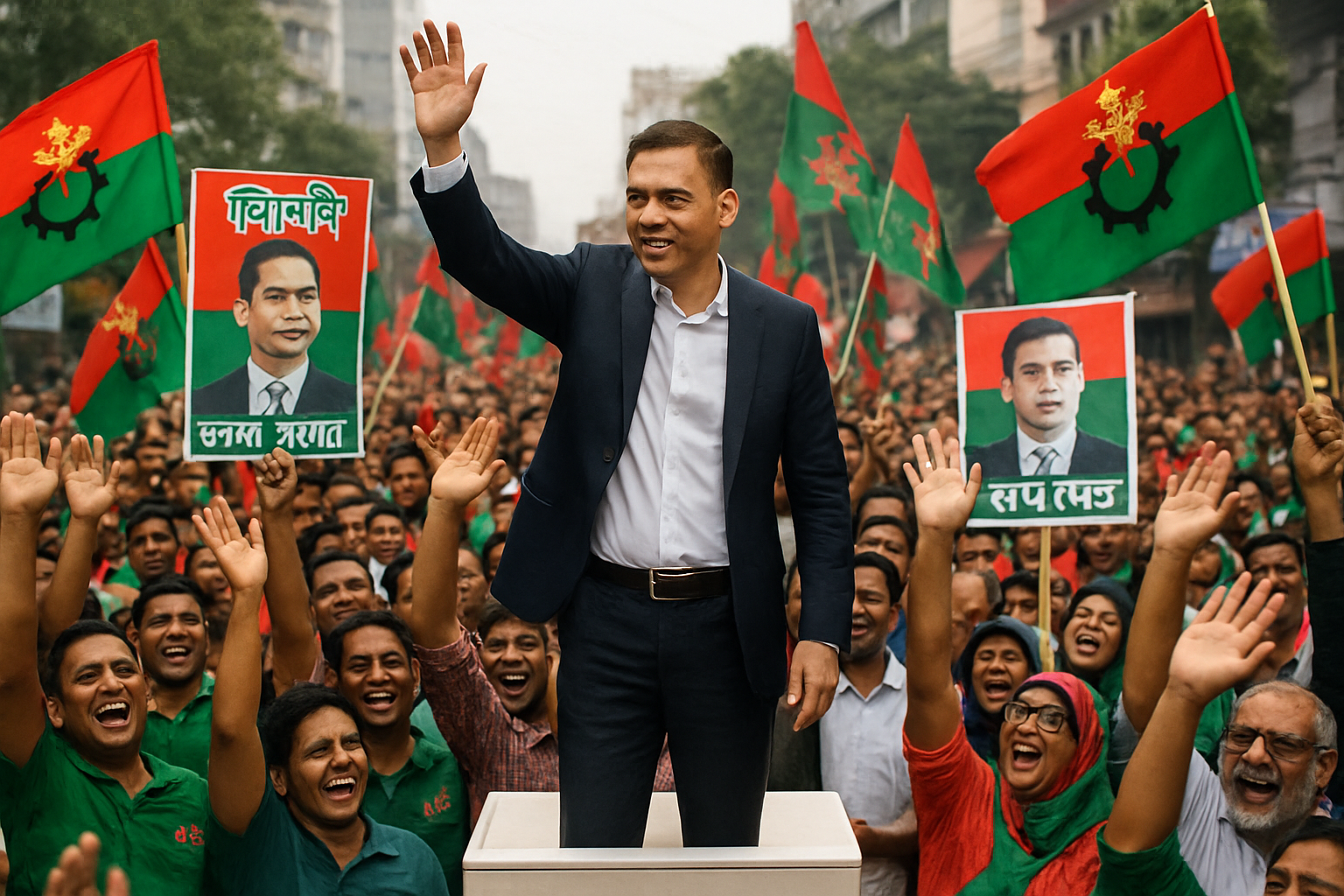
Bangladesh Nationalist Party (BNP) has achieved a historic landslide victory in the country's first democratic election since the August 2024 student uprising, with party chairman Tarique Rahman positioned to become Prime Minister after securing an overwhelming two-thirds majority in parliament.
According to multiple sources and unofficial results, the BNP has won approximately 212 of 299 parliamentary seats, marking a dramatic political transformation that ends Sheikh Hasina's 15-year authoritarian rule and completes Bangladesh's remarkable democratic transition following the youth-led revolution.
The victory represents the most significant electoral triumph in Bangladesh's democratic history, conducted under unprecedented international oversight with 394 observers from 27 countries - the largest monitoring mission in the nation's recent history. The election proceeded peacefully across 42,651 polling centers with a robust 48% voter turnout, demonstrating renewed public faith in democratic institutions.
International Recognition and Congratulations
The international community has moved swiftly to recognize the BNP's victory, with key regional powers extending congratulations to Rahman. India's Prime Minister Narendra Modi personally called Rahman, reaffirming India's commitment to maintaining close bilateral ties despite historical tensions between New Delhi and the BNP.
"Congratulations to Tarique Rahman and the Bangladesh Nationalist Party on your election victory, and to the Bangladeshi people for a peaceful and democratic election process"
— UK Government Statement, February 13, 2026
The United Kingdom expressed readiness to work with the new government on shared priorities including economic growth, migration, climate action, and security cooperation. Bhutan's Prime Minister Tshering Tobgay also congratulated Rahman, emphasizing hopes to "further strengthen the warm ties of friendship between Bhutan and Bangladesh."
Notably, Rahman's adviser Ziauddin Hyder indicated the incoming government may renegotiate what it considers "unfavorable" trade deals with the United States, suggesting potential shifts in Bangladesh's international economic relationships.
Democratic Transformation Complete
The election marks the culmination of an extraordinary 18-month journey from authoritarian rule to competitive democracy. The August 2024 student uprising, led by the "uprising generation" of 55 million voters aged 18-37 (representing 44% of the electorate), successfully toppled Sheikh Hasina's Awami League government, which has now been banned from political participation.
BNP Secretary General Mirza Fakhrul Islam Alamgir achieved a decisive victory in his constituency, winning Thakurgaon-3 with 236,308 votes - more than doubling his nearest rival. Rahman himself was declared elected from both Bogra-6 and Dhaka-17 constituencies, underlining the breadth of BNP support across urban and rural areas.
The election was conducted with massive security deployment of nearly 900,000 personnel in what officials described as the largest peacetime operation in Bangladesh's history, yet proceeded with minimal violence - a stark contrast to previous contested elections.
Youth Demographic Drives Change
The decisive role of young voters cannot be overstated in this democratic transformation. The "uprising generation" - those who participated in or supported the 2024 protests - turned out in unprecedented numbers, demanding accountability, transparency, and effective governance over traditional party loyalties.
While the student-led National Citizen Party, which emerged directly from the 2024 protests, managed symbolic victories including Nahid Islam's win in Dhaka-11, the broader youth demographic ultimately coalesced around the BNP's promise of comprehensive national renewal.
Upon his victory, Rahman expressed gratitude to supporters outside his Gulshan residence, saying: "I am grateful for the love you have shown me. Please pray for me." His message reflected the weight of expectations from a population demanding fundamental change after years of authoritarian rule.
Historic Overseas Participation
The election featured Bangladesh's first-ever overseas voting system, enabling 883,000 postal ballots including 444,436 from expatriates through the innovative ICPV (International Citizen Postal Voting) system. This breakthrough in diaspora political participation, particularly significant for the British Bangladeshi community, establishes Bangladesh as a regional leader in inclusive democratic practices.
The success of overseas voting could influence neighboring South Asian countries to adopt similar measures, expanding democratic participation for their global diaspora communities.
Opposition Results and Political Realignment
The Jamaat-e-Islami coalition, allied with the student-led National Citizen Party, secured approximately 70 seats, representing the strongest Islamist showing since Bangladesh's 1971 independence. However, this fell far short of challenging the BNP's dominant position, indicating voters' preference for the BNP's broader appeal over ideologically narrower alternatives.
The complete absence of the Awami League from the political landscape - banned following their role in the violent suppression of the 2024 uprising - has fundamentally realigned Bangladesh's political system away from the traditional two-party dominance toward BNP hegemony with a clear constitutional mandate.
Challenges Ahead
Rahman's incoming government faces significant challenges, including implementing the "July Charter" that institutionalizes the principles of the 2024 uprising, addressing transitional justice questions regarding mass killing trials, and managing complex regional relationships.
The interim government under Nobel laureate Muhammad Yunus achieved a major diplomatic breakthrough with the United States, securing a 19% tariff rate and zero tariffs for textiles using US materials. The new BNP government must sustain these economic gains while pursuing its own policy agenda.
Questions remain about the BNP's approach to accountability processes for crimes committed during the Hasina era, with youth leaders like Asif Mahmud expressing concerns about potential obstacles to justice mechanisms.
Regional and Global Implications
Bangladesh's successful democratic transition provides a compelling template for peaceful political change through mass mobilization. As the world's eighth-largest country by population, this democratic transformation influences regional stability patterns and offers hope for similar movements globally.
The success has particular significance for Nepal, which faces elections next month under similar circumstances of youth-led democratic renewal. Regional powers including India, China, and the United States will closely monitor how the new government balances domestic priorities with international cooperation.
"This represents the most significant democratic transformation since independence, with youth-led political revolution successfully institutionalized through peaceful electoral processes"
— International Elections Expert, February 13, 2026
Looking Forward
As Rahman prepares to take office, his government inherits a nation with heightened expectations for democratic governance, economic development, and social justice. The BNP's two-thirds majority provides unprecedented legislative authority to implement constitutional reforms and address the systemic issues that sparked the 2024 uprising.
The international community's extensive monitoring and support for this electoral process demonstrates global commitment to Bangladesh's democratic consolidation. Success in translating electoral victory into effective governance will determine whether this historic transition becomes a model for democratic renewal or a cautionary tale about the challenges of post-revolutionary politics.
With Rahman's return from 17 years of London exile to assume the country's highest office, Bangladesh embarks on a new chapter that could reshape South Asian political dynamics and serve as an inspiration for democratic movements worldwide. The true test of this democratic revolution now lies not in achieving power, but in wielding it responsibly for the benefit of all Bangladeshi citizens who courageously demanded change.