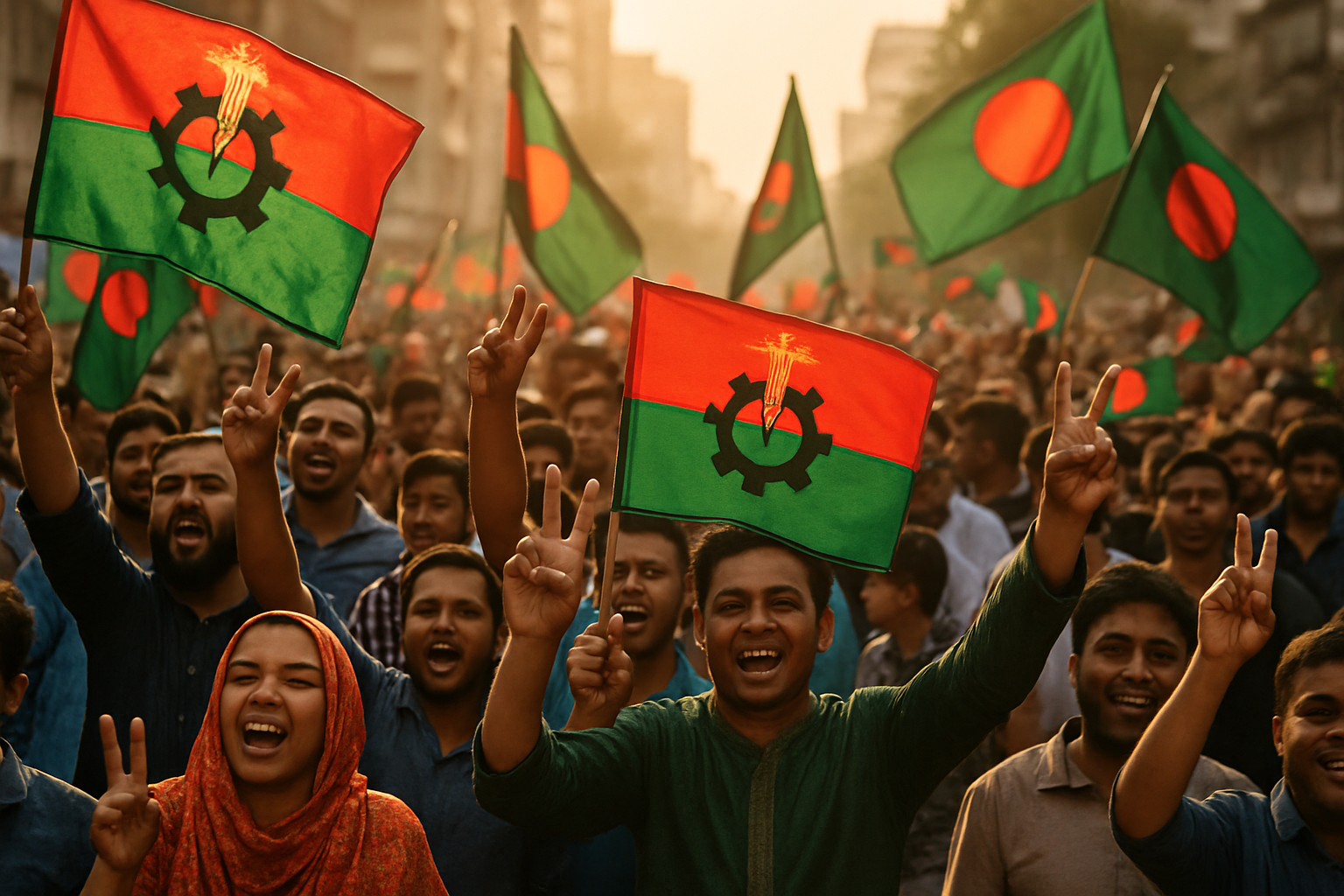
The Bangladesh Nationalist Party (BNP) achieved a decisive landslide victory in the country's first parliamentary election since the 2024 student uprising, securing at least 212 of 299 seats and positioning Tarique Rahman to become Prime Minister after a 17-year exile.
In results announced Friday morning, the BNP's commanding two-thirds majority represents the most significant political transformation in Bangladesh since independence, marking the end of Sheikh Hasina's 15-year authoritarian rule and completing a remarkable democratic transition that began with the August 2024 youth-led uprising.
Historic Democratic Milestone
Thursday's election was hailed as Bangladesh's first truly competitive democratic contest in over a decade, conducted under unprecedented international oversight with 394 observers from 27 countries providing the largest monitoring mission in the nation's recent history. The process proceeded peacefully across 42,651 polling centers, with Election Commission officials praising the "unwavering commitment to peaceful, credible and participatory election."
BNP Secretary General Mirza Fakhrul Islam Alamgir, speaking to journalists at his Thakurgaon residence, emphasized that the party would "form government with those who participated in the joint movement," acknowledging the coalition nature of the democratic transformation that brought them to power.
"Despite winning by a large margin of votes, no celebratory procession or rally shall be organised. We call for special prayers nationwide for the nation and its people."
— BNP Official Statement
Opposition Results and Political Realignment
The main opposition coalition led by Jamaat-e-Islami and its allies secured approximately 70 seats, marking the strongest Islamist showing since Bangladesh's 1971 independence. The student-led National Citizen Party, which emerged directly from the 2024 protests, won several symbolic victories including Nahid Islam's triumph in Dhaka-11.
The Awami League, banned from participation following the August uprising, was notably absent from the political landscape, creating a fundamental realignment that saw traditional two-party dominance replaced by a multi-party competitive system.
International Legitimacy and Oversight
The election's credibility was bolstered by massive international engagement, including Japan's Election Observer Mission led by former ambassador Watanabe Masato, and a 200-plus strong EU monitoring delegation. Historic overseas voting enabled 883,000 postal ballots, including 444,436 expatriate votes through the ICPV system—a breakthrough particularly significant for the British Bangladeshi community.
Malaysian Prime Minister Datuk Seri Anwar Ibrahim was among the first international leaders to congratulate the BNP victory, describing the outcome as "a triumph of democracy" and praising Dr. Muhammad Yunus's stewardship during the transition period.
Tarique Rahman's Remarkable Return
The victory marks an extraordinary political comeback for Tarique Rahman, son of former Prime Minister Khaleda Zia and late President Ziaur Rahman, who returned to Bangladesh in December 2025 after 17 years of exile in London. His transformation from political outcast to Prime Minister-designate represents one of the most dramatic reversals of fortune in South Asian political history.
Rahman's return coincided with a period of massive political upheaval that saw the student-led movement successfully challenge and ultimately topple Sheikh Hasina's government through sustained peaceful protests that captured global attention.
Youth Demographics Drive Change
The election results reflect the decisive impact of Bangladesh's young electorate, with 55 million voters aged 18-37 representing 44% of the total electorate. This "uprising generation" brought fundamentally different expectations for governance, demanding accountability, transparency, and effective service delivery rather than traditional party loyalty.
The National Citizen Party's emergence from the student protests and its successful transition into electoral politics demonstrates the sustainable impact of the youth movement on Bangladesh's political landscape, even as the BNP captured the broader democratic mandate.
Security and Peaceful Conduct
Despite massive security deployments involving nearly 900,000 personnel in the largest peacetime operation in Bangladesh's history, the election proceeded with minimal violence—a stark contrast to previous contested elections. The peaceful conduct was particularly noteworthy given the political tensions and fundamental nature of the transition.
Home Affairs Adviser to the interim government emphasized the largely peaceful nature of the process while urging objective reporting to counter rumors and misinformation that could undermine the democratic achievement.
Economic and International Implications
The incoming BNP government inherits significant economic opportunities, including a major US trade breakthrough achieved by the interim government under Muhammad Yunus—a 19% tariff rate with zero tariffs for textiles and apparel using US materials. This signals potential strategic realignment in Bangladesh's international relationships.
Pakistan Prime Minister Shehbaz Sharif was quick to congratulate Rahman, expressing hope for strengthened bilateral relations, while observers noted potential implications for regional cooperation frameworks including SAARC and broader South Asian integration efforts.
Challenges Ahead
The new government faces immediate challenges including implementing the July Charter that institutionalizes principles from the 2024 uprising, managing transitional justice processes related to mass killings during the previous regime, and addressing economic development needs while maintaining the democratic momentum.
Questions remain about how the BNP government will handle ongoing trials related to violence during the uprising period, with Youth Adviser Asif Mahmud having previously raised concerns about potential obstacles to accountability processes under BNP leadership.
Global Democratic Template
Bangladesh's successful transition from authoritarian rule through youth-led uprising to competitive elections provides a compelling template for democratic consolidation that is being closely watched internationally. The peaceful transfer of power represents a vindication of non-violent resistance and institutional democratic processes.
The success occurs amid broader global democratic challenges, positioning Bangladesh as a potential model for other nations facing similar pressures between authoritarian governance and popular demands for democratic accountability.
Regional and International Response
Regional powers are closely monitoring the transition's implications, with India facing potential challenges given historical BNP skepticism toward Indian influence, while China's Belt and Road Initiative projects may face review under the new administration.
The European Union and United States, which provided substantial support for the democratic transition, are expected to deepen engagement with the new government, particularly given the successful implementation of overseas voting and democratic institutions during the transition period.
As vote counting concluded and results were finalized, Bangladesh stood poised to begin a new chapter in its political history—one that started with young protesters demanding change and culminated in a democratic mandate for transformation that promises to reshape South Asian political dynamics for years to come.