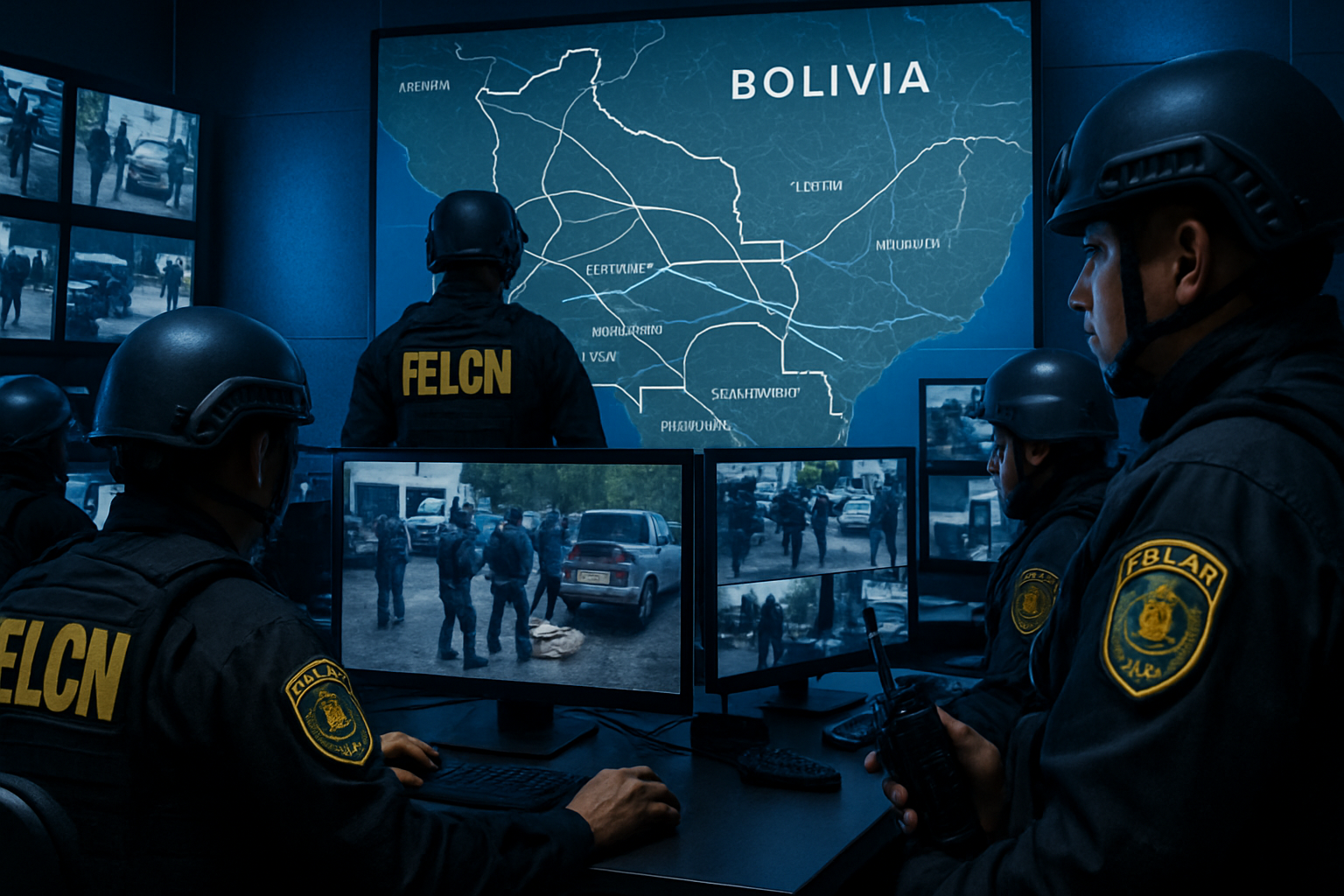
Bolivia's anti-narcotics forces have launched a series of high-profile enforcement operations this week, including the seizure of an illegal aircraft and the recovery of stolen police weapons, as government officials announce a fundamental shift toward more aggressive counter-drug policies amid concerns over expanding cocaine production capacity.
The Fuerza Especial de Lucha Contra el Narcotráfico (FELCN) conducted a major raid at a hangar in the El Trompillo airport area in Santa Cruz de la Sierra following the detection of an unauthorized aircraft departure. The operation, led by FELCN Departmental Director Nelson Campos, resulted in the seizure of both the aircraft and the hangar facility where investigators discovered two aircraft fuselages, one of which lacks proper registration with Bolivia's civil aviation authority.
According to preliminary reports, the aircraft departed around midday Thursday without authorization and successfully evaded established security controls. "We have proceeded with the seizure of the aircraft and the hangar, which will result in opening a case and conducting the corresponding investigations," Campos confirmed, as cited by the Bolivian Information Agency (ABI).
Government Announces Strategic Policy Shift
The enforcement actions occur as Bolivian officials acknowledge the country faces an unprecedented narcotics challenge. Speaking at the 28th anniversary ceremony of the Joint Task Force (FTC), Vice Minister of Social Defense and Controlled Substances Ernesto Justiniano warned that Bolivia confronts a critical scenario marked by expanding coca cultivation and growing cocaine production potential.
Justiniano revealed alarming statistics showing approximately 40,000 hectares of coca cultivation with the capacity to generate up to 300 tons of cocaine annually. This production capacity, he emphasized, demands a more robust and planned state response to prevent further deterioration of the security situation.
The Vice Minister positioned the country as transitioning toward a more operational anti-drug policy focused on concrete results and territorial control. "The country is moving toward a more operational anti-drug policy, focused on concrete results and territorial control," Justiniano stated, framing the FTC anniversary not merely as a commemoration but as the beginning of a new phase in counter-narcotics efforts under the administration of President Rodrigo Paz.
Enforcement Challenges and Criminal Sophistication
The complexity of modern drug trafficking operations became apparent in a separate incident where criminals attempted to recover a seized truck through violent means. Bolivia's National Customs office reported that officials successfully neutralized an attack involving the use of explosives and firearms as criminals attempted to recover confiscated cargo.
The attack occurred between the fifth and sixth ring roads of Santa Cruz de la Sierra during a routine control operation. "Thanks to the coordinated and firm action of National Customs officials, these attempts were neutralized and the confiscated truck reached its destination safely," the institution stated, though they did not specify whether arrests were made or provide the exact location of the incident.
Meanwhile, in a concerning development highlighting the boldness of criminal organizations, authorities reported the discovery of stolen weapons and police equipment near a property connected to captured drug trafficker Sebastian Marset. According to the Vice Ministry of Social Defense and Controlled Substances, neighbors alerted authorities after observing individuals on a motorcycle throwing a black backpack containing the stolen items.
International Context and Regional Cooperation
These operations occur within the broader context of enhanced international cooperation against drug trafficking organizations. Bolivia's enforcement successes build upon the dramatic March 2026 capture of Sebastian Marset, the Uruguayan drug kingpin who ranked third on the DEA's most wanted list with a $2 million bounty on his head.
The Marset operation demonstrated Bolivia's emergence as a reliable security partner under President Paz's administration, utilizing what officials termed "surgical" enforcement methods rather than widespread military campaigns. The success enabled unprecedented cooperation within the Shield of the Americas coalition, a 17-nation anti-cartel alliance established by the Trump administration in March 2026.
Intelligence gathered from the Marset case revealed criminal organizations operating with state-like capabilities, including encrypted communications, compartmentalized international structures, and advanced surveillance systems. These networks have connections spanning from South American production centers to European and Asian markets, moving tons of cocaine through sophisticated logistics operations.
Technological Arms Race
The recent enforcement actions highlight the ongoing technological competition between criminal organizations and law enforcement agencies. The unauthorized aircraft operation demonstrates how traffickers exploit legitimate aviation infrastructure, while the coordinated attack on customs officials shows criminal groups possess military-style weapons and tactical coordination.
Government officials acknowledge that criminal adaptation consistently outpaces law enforcement countermeasure development, requiring sustained investment in technology and international cooperation mechanisms. The discovery of unregistered aircraft fuselages suggests criminal organizations maintain sophisticated logistics capabilities for modifying and operating clandestine transportation networks.
Enhanced screening technologies, digital forensics, and AI-assisted pattern recognition have become essential tools in the government's response, though officials stress that technological solutions must be combined with comprehensive strategies addressing the underlying conditions that enable criminal recruitment.
Strategic Implications
Vice Minister Justiniano positioned the Joint Task Force as the primary operational arm of the new anti-drug strategy, emphasizing that the anniversary celebration marks the beginning of an intensified phase in combating narcotics trafficking. The approach represents a shift from reactive enforcement to proactive territorial control aimed at disrupting criminal organizations before they can establish operational bases.
The policy overhaul occurs as Bolivia seeks to balance effective law enforcement with maintaining constitutional protections and democratic oversight. Officials emphasize that success requires sustained political commitment, adequate resources, and continued international cooperation while addressing root causes such as poverty, limited economic opportunities, and weak governance in rural areas.
The recent operations also demonstrate the importance of community engagement, as civilian reports enabled the recovery of stolen police equipment and the investigation of suspicious aircraft activities. This community-based approach represents a key component of the government's strategy to create comprehensive security networks extending beyond traditional law enforcement capabilities.
Looking Forward
As Bolivia implements its strategic policy shift, officials acknowledge that success will depend on maintaining the operational momentum demonstrated in recent high-profile cases while building sustainable institutional capabilities. The 300-ton cocaine production potential highlighted by Vice Minister Justiniano represents not only a national security challenge but a regional threat requiring continued international cooperation.
The government's emphasis on territorial control and operational results suggests a long-term commitment to disrupting criminal networks through sustained pressure rather than sporadic enforcement actions. However, the sophisticated nature of modern drug trafficking organizations, demonstrated by their ability to conduct complex aviation operations and coordinate violent attacks against government facilities, indicates that Bolivia's anti-drug forces face an adaptive and well-resourced adversary.
The coming months will test whether Bolivia's strategic overhaul can effectively counter criminal organizations that have evolved to operate with capabilities rivaling legitimate state institutions, while preserving the democratic governance principles that distinguish effective law enforcement from authoritarian approaches to security challenges.